 It seems like a long time since I first stepped into a classroom. A year has come and gone, and in its course yielded unanticipated lessons. I’ve chronicled the day-to-day mischief and chaos I’ve witnessed, but after the final bell, what has this teacher learned?
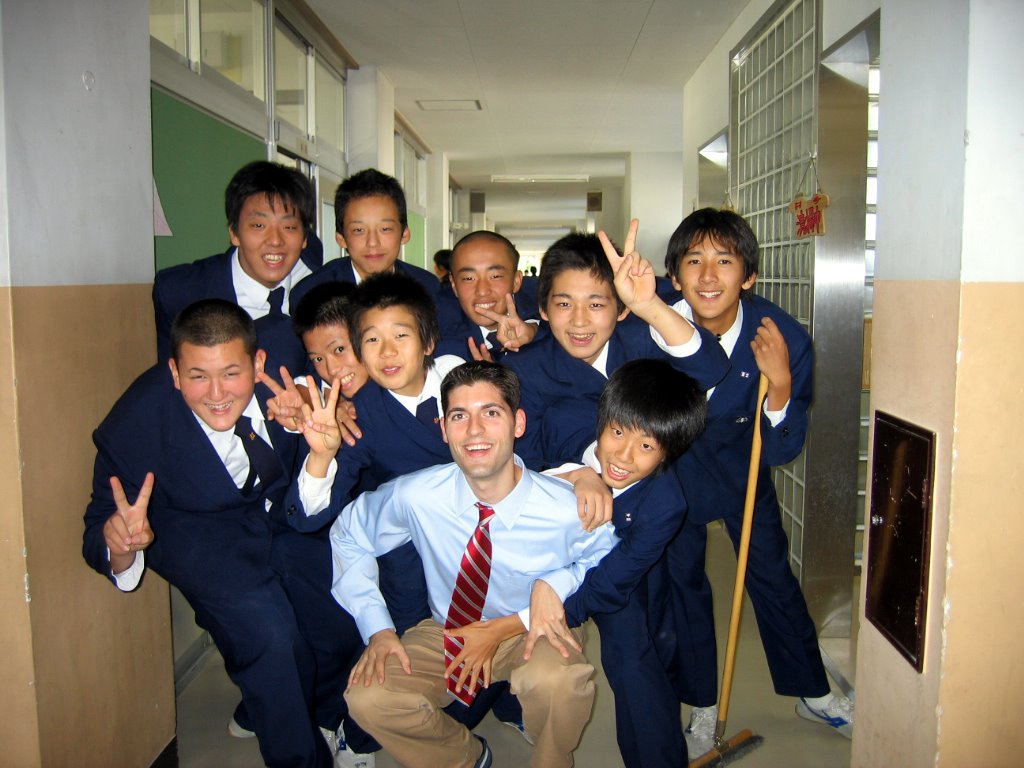
In a world of poverty and politics, natural disasters and nuclear weapons, I’ve come to value innocent students as an outlet for juvenile jokes and mutual companionship. School immersed me in the simplicity of malleable minds free of adult worries and real-world problems. 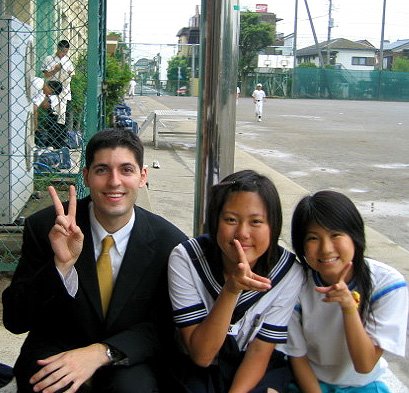 Junior high in Japan was a triumphant return to a time in America that I’ve tried to black out; I never even bought a yearbook then. This job gave me an opportunity to make up for one of those three years of misery. More than 10 years later and on another continent, I finally became one of the cool kids, just disguised as a teacher in Pumas.
Friendship was superficial, but I wasn’t expecting to forge life-long connections with kids half my age. We bonded for the moment, and it was the moment that counted. Our lives intersected fleetingly, but these students touched me (spiritually, but certainly also physically) in ways their American peers could not.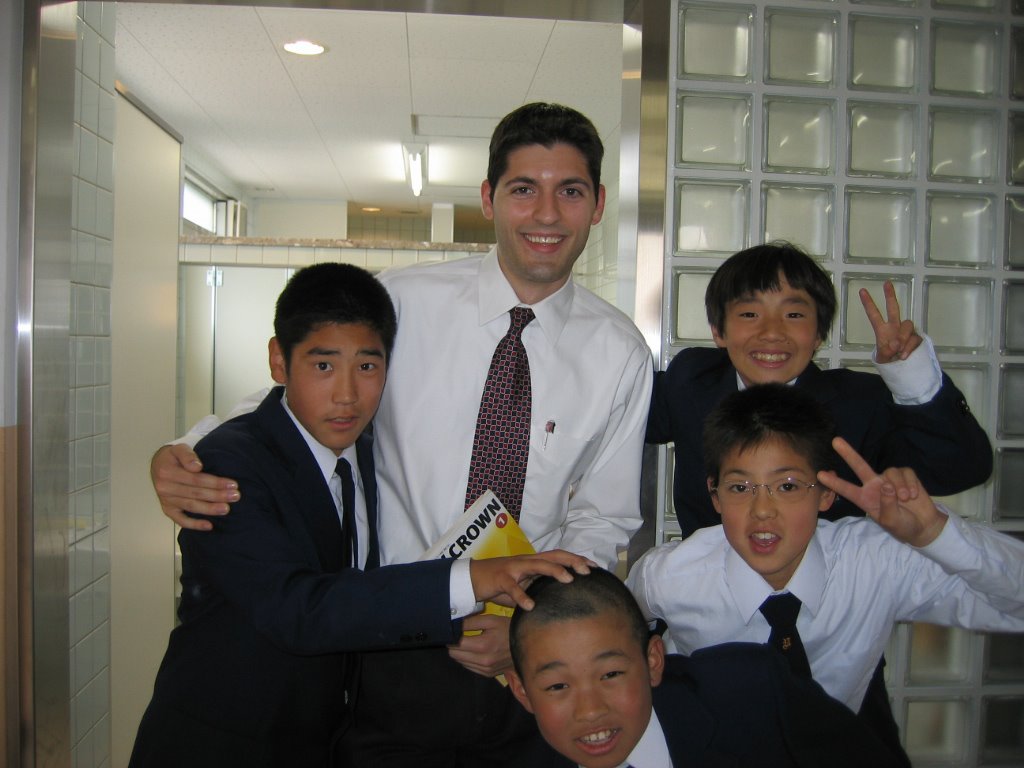 They patched a void of camaraderie in a confusing culture where I maintain shallow roots. Japan – with its traditions, etiquette, food, and language – is arguably the most complex country on earth. To even begin to grasp the intricacy of this society is a challenge that takes months of close observation. Businessmen and tourists don’t stay long enough to gain a sense of true Japan.
I came face-to-face with raw culture in a working class ward not in any guidebook: I participated in daily life at public school. In return, students got up close (and often too personal) with a foreigner otherwise inaccessible at their sheltered age. We symbiotically brightened the boredom of the curriculum through high-fives, immature jokes, and recess sports. The universality of shared company overcame the awkward exchange of languages. When crossing cultures, baby steps in communication feel like a big connection. With wide eyes and curling corners of mouths, they signaled that our company was more than just shared – it was appreciated. Even cherished. I felt like big brother, and wanted to hang out with students after school and pass around bags of dried squid and melon flavored chips while fighting over PlayStation2 controllers.
After growing up, I never thought much about kids, especially not working with them. I became a teacher in Japan because it’s the easiest path to a work permit. I never expected to become attached to those half my age and of a startlingly different ethnicity. They taught me more about life and about myself than I taught them grammar. We grew together, but on different wavelengths.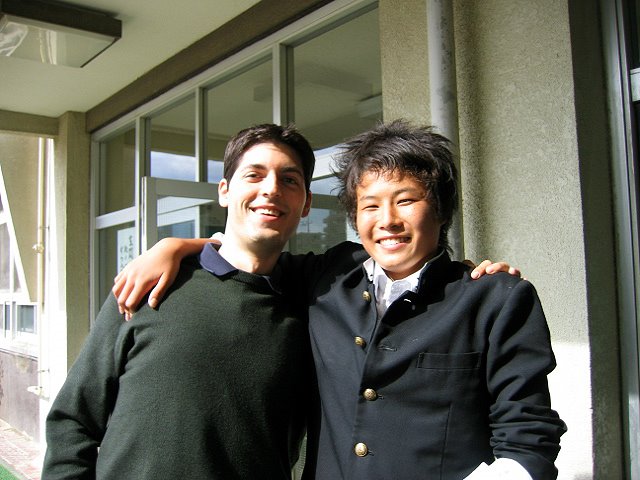 Through teaching I came to understand the power of a personal touch. Few jobs can influence the direction of someone else’s life. Part educator and part entertainer, I planted seeds of English and Americana in spongy minds. I know that more than a few will mature into interpreters, translators, even English teachers. I never realized this power from my days on the receiving side of the lectern.
A Douyoto School girl chose this to say in a composition about “one important thing:”
Though I’m doing bad and good things…varied things, I’m having a good time at school. I think I can enjoy school life by grace of friends. There are disgusting things in my school life. But my friend gives me spirits a lift when I feel down.
The school which has many friends is pleasant place!! I have a dream. One day, all students will go to school.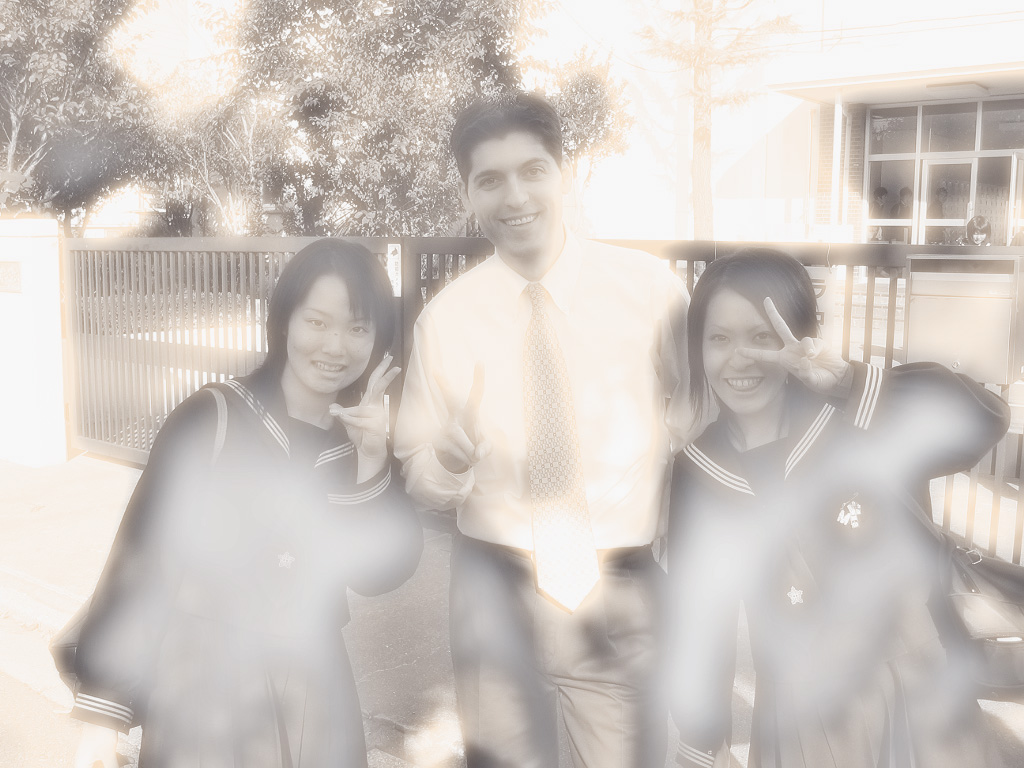 To be a part of these young lives for however brief, the memory – on both sides – will persist. None of them (thank god) are reading this, but if they could, I’d want to look them in the eye and with a slight bow of my head say “thank you.” You were my reason for staying in Japan – hundreds of reasons, in fact. Each one similar but slightly individual.
The end is just the beginning. Stay tuned for a whole new season of students.
The New Batch drama premiers this September.
Monday, July 10, 2006
Reflections

Thursday, January 26, 2006
The Long Goodbye
It started with Douyoto’s 7th grade section 1-1, and it’s going to last until mid-March. Not long after I finally finished introducing hobbies, height and number of family members to the 50 classes in four junior high schools, it’s time to start saying good-bye. Forever. I beefed up my student photo alum with requests for class pictures. “I’ll never forget you, class 1-1,” I waxed in Japanese as students shuffled up to the board — some more willingly than others —while careful not to intermingle genders. Some paused for a moment, processing my profound words spoken in their native tongue. One boy felt moved enough to respond: “But I’ll forget you!” Thanks, kid.
While hundreds of faces inevitably blur together, a few stand out. I’ll miss the two sumo. Only eight schools citywide have sumo teams, and Nebiko – a barrel of flesh – placed second in the Tokyo junior high tournament.
In the same class is his shorter sidekick, also with a shaved head and no neck, sort of like a soccer ball, but with ears shaped like satellite dishes. Neither can speak much English, and from what I saw of their compositions, their Japanese ain’t good either (mostly written in hiragana while other students used more complex kanji characters). Gambatte, guys.
I’ll also miss the 7th grader who, shaped more like a linebacker than a sumo, left red marks on my hand every time we high-fived. I won’t forget the patient pronunciation of another 7th grader with whom I spent hours after school reciting John Lennon’s “Imagine” for her eventual speech content triumph.  For the 9th graders soon to enlist in high school, I exploited the occasion of our last class to indoctrinate young minds with Jefu’s four tips for a good life:
#4 Follow your heart, desires, dreams, passions, whatever. I think I used the phrase, “Be all that you can be,” but left out the toll free U.S. Army recruitment number. Just don’t become joyless dark-suited sacks of salarymen. Japan already has more than its fair share.
#3 Come visit me in New York. Not now, but once you master enunciating “r”s and “l”s as different sounds.
#2 Keep practicing your English. It might land you a better job. You are very young, and can eventually become fluent like me (laughs of disagreement).
#1 Do. Not. Smoke. (Pounding heart and lungs) Ever. I know your grandmother and father’s mistress do, but I don’t care if you never practice your English again so long as you aren’t plunking change into a cigarette vending machine glowing from every street corner.
“Yayaaa,” one boy with spiky hair moaned while squirming in his seat. “I inherited a strong body from my mother, so I will be okay.” The Japanese English teacher laughed and translated, whereupon I shook my head. Still, I remain hopeful that when such decision-making times come in the future, that they’ll remember the cool, tobacco-free New Yorker who made English class slightly less boring than usual.
This influential power of teachers became apparent near the end of a 7th grade class. A nondescript boy approached me with a pad of Post-Its. He wanted me to sign the first two. My eyes followed him back to his seat. How would he tarnish sensei’s name?
Suspicion dissolved into disbelief as I watched him open a glue stick and carefully adhere my signature to the cover of his notebook. A lump formed in my throat. It was that moment that validated my entire Japanese experience.
Monday, January 23, 2006
Long Time, No See
“Miyukiiii, you’re late!” shouted a teacher from his sidewalk post.
The staff of Douyoto School acts like protective parents stationed on street corners around the school looking out for stragglers. This is a small school – only 280 students, and thus has a family atmosphere. They almost lost one member before my eyes. Had the same teacher not blocked Miyuki’s intended sprint through the crosswalk, he would have had an unfortunate encounter with a minivan.
It was a bittersweet week. I hadn’t taught at my favorite school since Halloween, but January’s reunion would be short-lived. It was my final scheduled appearance. The 7th graders seemed to have forgotten my name because some insisted on calling me Johnny or Bobby. I think they’ve been watching too much TV again. Nevertheless, they welcomed me back with open arms and a few questions, like “how do you say ‘anus’ in English?” and “was that you on TV?” I hope the two weren’t related.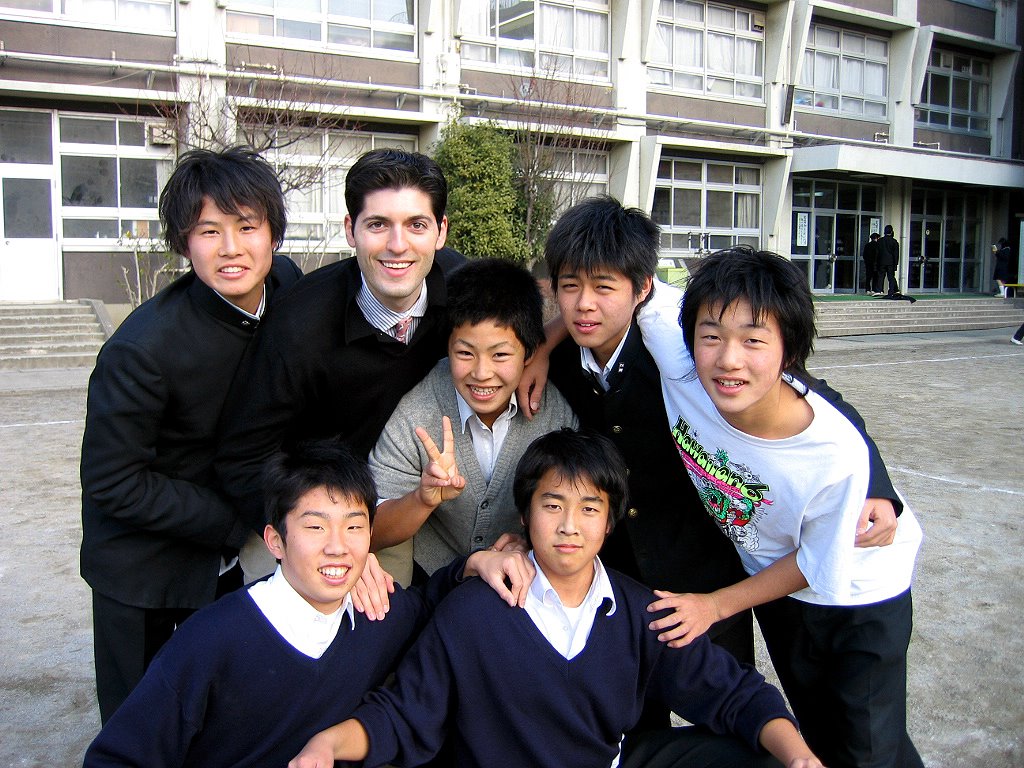 I quizzed them with listening comprehension passages about Thanksgiving and Hanukkkah. Unlike at Kanokita School, where only the walls pay attention, Douyoto students volunteer to recite model textbook readings. English, while not as popular as gym, is at least favored over math and art. In a school survey, 61% rated English as either their favorite subject or one they like.
This, after all, is the school where I coached two students to victory in a sweep of the two first prizes at the ward’s English speech contest. Douyoto divided my loyalty by unseating last year’s champion Nubata School, the second favorite of the four I teach at.
As a parting gift, Douyoto 8th and 9th graders gave me a new batch of compositions to correct. The 9th graders, currently mired in jiken jigoku (high school entrance “examination hell”), wrote about their dreams. It was heartening to read their aspirations pieced together in mangled English. Among the future bakers, barbers, clinical psychologists, weather forecasters and nursery school teachers, some didn’t yet have a “future dream.”
Others expressed exactly what they wanted. One boy confessed an urge to “become a temporarily straight adult.” Talk about lost in translation! Two verbalized definitive goals. One, to follow in dad’s footsteps at Japan Rail. The other, to become a conductor on the Seibu line in a 3800 series train, a mechanical diagram of which accompanied his text.
A humble girl had this to say:
I want to be common housewife in the future. Why? First, it is an ideal every morning that send a husband and child out. I am similar afterwards and do terrible housework in various ways and want to finish first. Now I do not like a help of a house very much. Therefore I want to do my best little by little.
I’m setting her up with this boy:
My dream I would like to be happy old man. What’s happy? Happiness might be different for the person. The dream for me is to do to want do it is necessary to do, and doing. It’s my dream!!
Meanwhile, the 8th graders described “their important one thing.” Family, pet cat, soccer ball, baseball glove and Nintendo were common. One girl wrote about having “a considerate heart.”
This capitalistic boy coveted more tangible values:
My important thing is money. A mony can change everything.
Japanese money is yen that has many kinds. The smallest yen is own yen next five, ten, fifty, hundred, 500….A money made all of us happy, and it is life.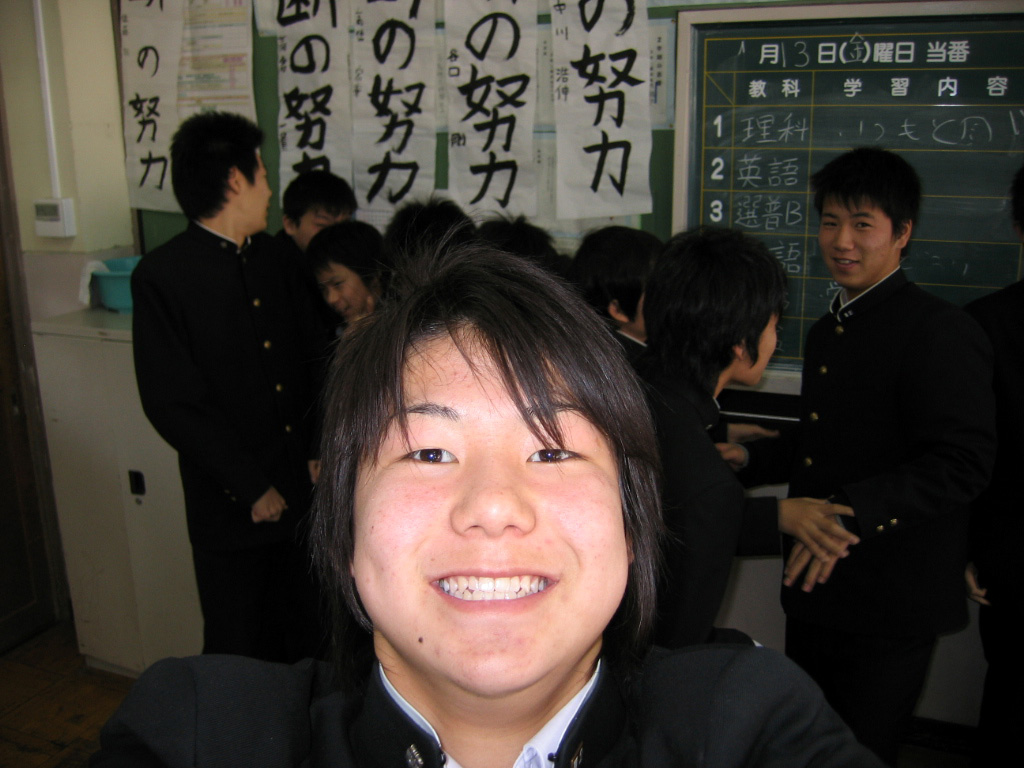 Comic books enthrall Japanese young and old, apparently even in the afterlife:
My important thing. It is many comics. It gave me many some thing. For example, knowledge, smiling face, etc…It isn’t miss my life. I like comics. So my coffin in these comics. Because I want to read comics in the other world.
As this blogger well knows, never underestimate the power of the pen:
I have a important thing. It’s a pen. Because it is needed to write. But I often break it. Now I have six pens in my pencase. I often by pen. But it is expensive, isn’t it?
If you say “Yes” you are right.
If you say “No” you are stupit.
Yet even teacher make mistakes. I misspelled cockaroach, cavier and badmitton on the board. I drew an uncomfortable silence after mispronouncing the Japanese word for Thanksgiving (kansha-sai) as kancho-sai. Day of Thanks came out as “enema festival.”
A blooper at recess was just as embarrassing, but more painful. I should have known better than to play a sport I know nothing about while in loafers. I’m not sure how it happened. Maybe I tripped on the soccer ball, or maybe over my own feet, but the next thing I knew I was tumbling. Not just falling down, but a sputtering, flailing dive. Had my palms and right knee not broken the fall, I would have tasted playground dirt.
My stumble drew a chorus of laughs. I casually dusted off my stained trousers, which hid a skinned knee glistening with blood that hadn’t broken the surface. “You’re weak,” one boy shouted in Japanese, adding “and slow, too” while I hobbled after him ready to ring his neck.
I atoned by teaching two 8th grade classes on my own. Technically this is illegal because I am not a certified teacher in Japan. 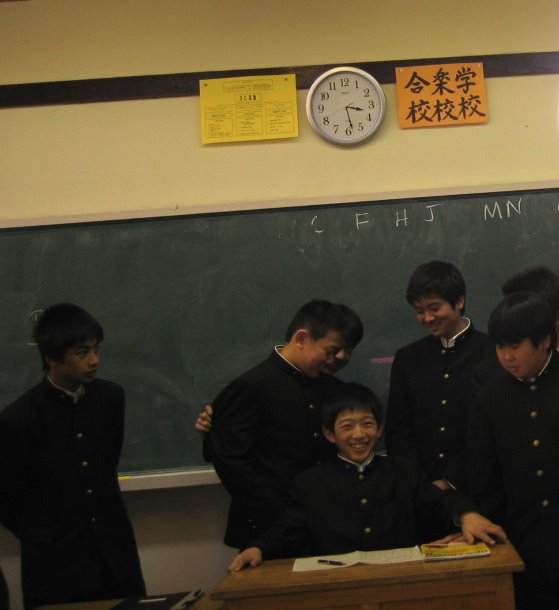 However, Ms. Kimura had to take her feverish son out of elementary school and to the doctor, leaving me in charge of the lesson plan. I drilled cooperative students on reading passages and vocab before running out the clock with hangman. I told them it was our last class together. They stood up, bowed and gave me a mild round of applause. I high-fived my way out the door for the final time.
Sunday, June 26, 2005
The English You Didn't Learn in School
My usual four hours of sleep interrupted by a 5.6 earthquake, I wobbled into work pooped, and plopped down at my assigned desk in the teacher’s office. Constipation. Feces. Two words scrawled on a piece of paper had the same effect as a can of iced coffee from the vending machine.
Ms. Kimura approached me. “Today’s lesson we are going to learn about sickness. I wanted to know some other words for these.” Synonyms for shit. 8:35 a.m. Wasn’t it a little early to have our minds in the toilet?
Well, if you must know, stool and bowel movement are also polite ways of saying feces. I noted the primary furniture meaning of stool, and how bowels have significance beyond the intestines. Kids say poopy. Animals excrete turds. Humans take a crap; they take a number two. I decoded the difference between numbers one and two. Ms. Kimura was eating this up. Grinning gave way to snickering. I couldn’t contain myself any longer. ESL had hit a new low. What about the “s” word, I wondered? The final fecal frontier. I shouldn’t, should I? “Shit.” I did.
Later in class we repeated G-rated afflictions like stomachache, broken leg, and insect bite. Role-playing involved asking and answering, “What’s the matter?” But student curiosity transcended textbook ailments. I acted out scatterbrained to peels of laughter.
“A student wants to know how you say…when you are sick…and you blahhh.” “Vomit?” “Yes, can you write some words for this on the board?” Synonyms for throw up. Upchuck, hurl, spill my guts. Lose my lunch got giggles after translation. “Wow, you have so many words. In Japan, we have only two.” “Oh, I can keep going, shall I?” I delved into euphemisms like pray to the porcelain god and regional Dartmouth slang like boot. I taught Japanese middle school students how to boot. What’s next, substitute beer pong for gym class table tennis? I’ll go rack the Asahi. “Class, do you know what is ‘rack’…?”
Thursday, June 23, 2005
Popular in Pumas
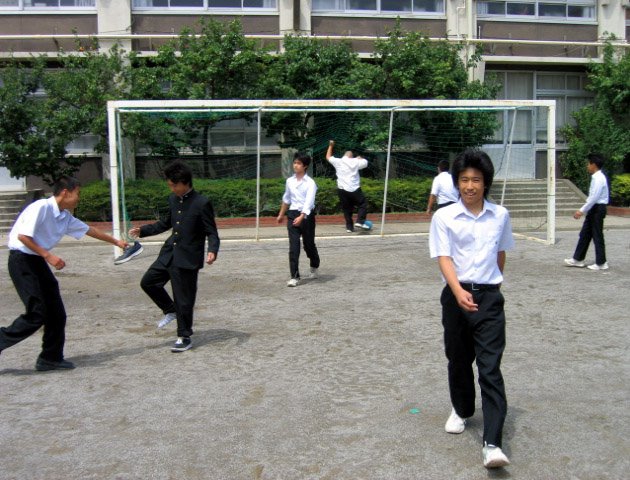 My return visit to Douyoto School this week was much improved from my initially disappointing reception in May. Perhaps students felt my three-week absence. Perhaps they felt more comfortable around me the second time around. Or perhaps they felt the power of the Pumas.
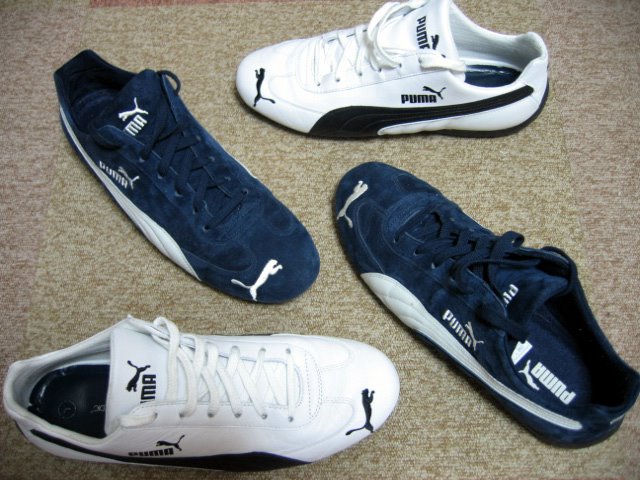 This has to be the single hottest brand here. Youth wear Puma shirts, tote Puma umbrellas, and store writing implements in Puma pencil bags. In Japan, each student has a cloth pencil case holder, and Puma has about a fifth of the market. But few locals sport Puma footwear. So, while in New York, I snagged myself two pairs to serve as trendy “indoor” shoes.
The entire school took notice. As I paced around class pronouncing numbers one through 21 or the vocab du jour, heads turned down to my feet with magnetic attraction as the mountain lion logo over my toes navigated aisles cluttered with uniform backpacks. Kakoii they call me. Cool guy.
My rising popularity became official when the lunch bell rang and three eighth grade boys asked me if I’d eat lunch with their section. Honored, I instantly accepted. This touched off squabbling as to who would sit next to me. With precious lunchtime minutes ticking away, as a compromise, I ate at the front of class facing everyone.
Lunch ended, and clean up (read: chaos) began. A bully hoisted the teacher’s swivel desk chair and turned it sideways. Legs spinning, it resembled a giant drill press pulverizing a student into the blackboard.
With the trays cleared, the lunch cart doubled as an arm wrestling arena. I’m quickly chosen. The first opponent put up a fight, but the sensei 12 years his senior triumphed. I felt pretty good about upholding my tough guy image.  Then, from the back of the room, Nebiko emerged. A sumo-in-training, he already surpasses my size 12 foot not to mention my 32” waist. Reluctant to take on this predator for fear of losing face (or a finger), I’m strong-armed by peer pressure. The bout began. Size was on his side. Half my age, Nebiko is one-and-a-half times my weight. Our strength equalized into a stalemate. But slowly I gained the upper hand, and defeated the favorite to a chorus of “ooohs.”
After using my weaker left arm to topple a rightie, I’ve averted humiliation at the hands of eight graders. I wiped my brow. Challengers exhausted, 15 minutes remained before class. “Do you want to play some soccer?” someone asked. “Of course, ikimashoo!” I slipped into my “outdoor” dressy Rockports and trotted onto the clay field also used for track and baseball. Whether he liked it or not, Nebiko played goalie, but for the other team.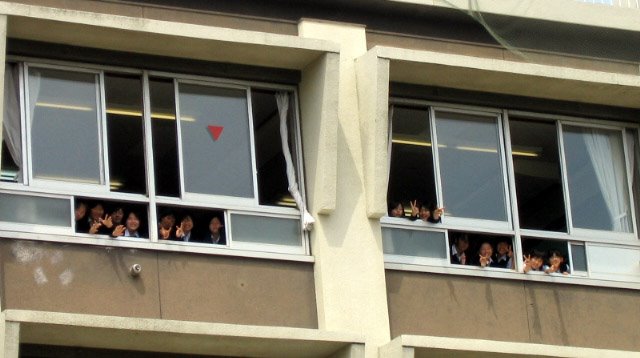 The crowd roared as I took the field. Girls in the upper deck raced to fourth floor windows and shouted “Jefu!” The window girls waved down to their teacher who last played soccer during his own junior high days. Nevertheless, I registered two impressive, but wholly accidental blocks. A shot on our team’s goal glanced off my hip, and later my groin suffered the brunt of a Nebiko kick; a sumo always gets revenge. The game ended in a 1-1 draw, but I sensed victory in becoming one with the students.
Saturday, May 21, 2005
Week One at Douyoto School
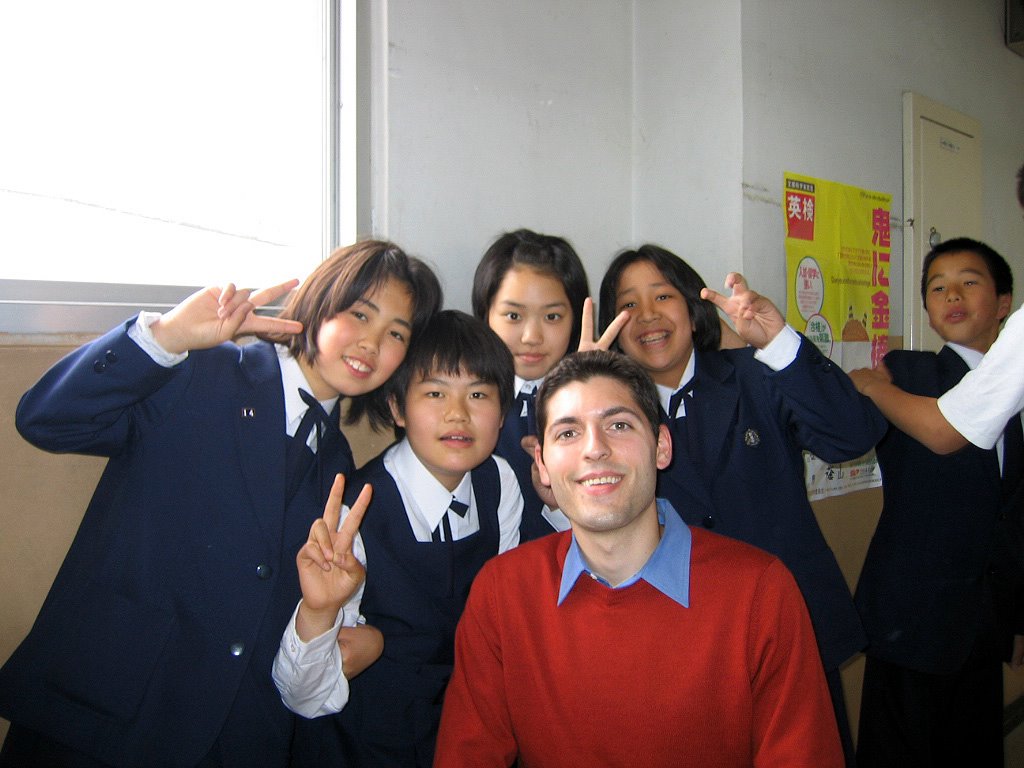 Consisted of only three working days, each of which I wished I were teaching back at Nubata. My first self-introduction went awry when drawing stick figures of my family on the blackboard. I thought it would be clever to redraw my stick really tall, so I erased my head and torso and emphasized my height, which is a constant source of amazement. Facing the class to mention my favorite foods, I detected scattered giggling. Tempura couldn't be this amusing.
My newly acquired teacher instincts sensed something amiss. I spun around to check the board. To my horror, I had sloppily reconnected my stick torso to my stick legs, endowing myself with a stick boner. I casually rubbed away my genitalia, but these being middle school minds, I’m sure they’ll be snickering until March. More skillfully rendered was my map of the continental United States, used to pinpoint where I lived, worked, and attended school.
The D in Douyoto stood for disappointment after my electric week at Nubata. School lunches were less tasty and didn’t include dessert. Also, I received less adulation from my fan club. Exceptions included a boy who offered me his house, and one who spent class creating an origami hornet so lifelike that I feared it might sting me upon accepting the gift.
Douyoto wasn’t totally to blame. One morning I arrived a full five minutes late, and when asking one English teacher about my performance that week, she admitted, “I think the students would like it if you could smile more.” Separation syndrome from Nubata was painfully apparent.

