“Money and Card” was the title of the final lesson with Mr. Mochizuki. Preparation was simple: wow the kids with faces of dead presidents on American currency. I brought a dollar’s worth of new pennies to Japan to inspire interest in American culture, and as backup should pencil prizes become exhausted.
The first student to guess the value of the coin I held up received a cash prize. Like ravens, shiny coins distracted 7th graders. I wasn’t so generous with the bills. I weighted down $1, $5, color $10, and $20 notes on the front desk with piles of pennies, and called up rows of students for a viewing. Their eyes turned green, and begging began.
Upon realizing that I was lax about their taking centy souvenirs, they got greedy. They clamored for something I walk away from when dropped. There were a lot of outstretched palms to grease. One kid reacted after smelling a fistful of change. Yup, smells like America all right. Japanese currency is somehow odorless.
I brandished a credit card to regain the educational focus of the lesson. This only stirred the pot. Visa is not everywhere you want to be in this cash-based society, and I transformed from assistant teacher to Daddy Warbucks. The bell rang before I could count my change, but by then it was too late. About 25% of the kids made off with 75% of the coins.
I stuffed the bills, card, and a few remaining dimes into pockets while shaking off demands for more. I continued to laugh until they started poking in places I didn’t wanted to be touched. One pilfered the bag of coins from my rear pocket. I beat him on the head with the textbook until I got a refund.
I consolidated valuables into the front pocket and made for the door. Three kids blocked my path. I sliced through them, but two more held the door shut. I needed backup, preferably an armored car, but even the bumbling Mr. Mochizuki would do. He had already left, and I had to fend off the mob alone.
Driven by hormones and greed, they groped and grabbed – my pockets, buttocks, anything they could get their dirty little fingers into. Outnumbered and outmaneuvered, my bum ankle only hampered my agility.
They were swarming now. Desperation swelled in my gut. I went into survival mode, and backed into a corner. One tried to sneak behind me, so I used my hips to check him into a metal cabinet. He yelped, holding his hand in pain. Others reached in for the “arm”ed robbery.
I knocked two boys out of the way, and broke for the back door again. The kids exited from the front, and confronted me in the hallway. Once there they suddenly became like fish out of water. Although their momentum died, it wouldn’t be the last time they tried to make off with my jewels.
Stay tuned for “Nuts for Nuts”….
Friday, June 02, 2006
Money Hungry

Friday, April 07, 2006
Loosing That Loving Feeling
It was January, my first week back after New Year’s break. I had missed the childish camaraderie, and was even looking forward to defending the privacy of my parts on a daily basis. The last update on the mischievous nuts at Kanokita Junior High was in October. I’ve been taking careful notes of their behavior since then. By now I’ve finished up at my three other schools, so the focus of the blog will shift to these bundles of trouble doing what they do best – causing it.
“Mr. Mochizuki, how are things here at Kanokita this New Year?” I asked, fishing for gossip.
“Oh, same as usual. Not in particular,” he said showing off his front teeth from behind oversized glasses. That smile always gave me the willies.
Two more days back in session would be enough to erode Mr. Mochizuki’s veneer of winter recess relaxation to the point of disillusionment: “Mr. Jef, I no like this class. Why am I appointed this school?” he suddenly complained before class. “To tell you the truth, I don’t want to come to this place. There are very bad students, maybe the worst in Tokyo.” Although shocked by his candid confessions to a younger and contracted employee, he had a point.
The honeymoon period’s over. I dragged my feet up the stairs to class with Mr. Hirogashi, a young teacher who spent December break in Hawaii on his honeymoon. Regarding the three other schools I rotate among, he asked, “Do you notice a difference between this school and the others?”
I nearly laughed out loud, but realized he was in fact quite serious. He’s fixed at one school, and sounded like he was hoping to gain insight into the outside world populated with better disciplined students.
Perhaps he’s longing for the past. After all, he met his bride while teaching in another ward of Tokyo; however, Japanese school rules stipulate that a husband and wife cannot teach in the same ward, much less the same school. So he designated himself for reassignment, which after half a year at this school must mean he’s filed divorce papers just to get his old job back.
Blood-curling screams echoed into the stairwell from an undisclosed location. It could have been from upstairs or downstairs – maybe from both. Something then crashed to the floor. Usually it’s loud and metallic, but the dull thuds worry me most. Mr. Hirogashi filtered out these background noises.
Students at two of my other three schools were angels compared to Kanokita kids. I didn’t want honesty to burst his already bruised bubble. Morale in the teacher’s room was low enough.
“Well, the 7th graders aren’t so bad,” I said with a positive spin. Actually, Omiyada’s, led by the inept Mr. Nishono, acted worse. Kanokita’s 8th and 9th graders, however, were the bottom of the behavioral barrel.
“I think this school is like a jail,” he said as we climbed passed 8th grade classrooms on the third floor – ground zero for disobedience. His analogy was faulty. Although inmates are also bad apples, and as a matter of law must remain on the premises, a jail enforces order through authoritative guards. Kanokita is more like a game preserve where wild beasts roam free in a loosely patrolled area. There are some rangers, but not enough to be effective guardians.
At the top of the stairwell on the fourth floor, we turned right instead of left. “Oh no, no, no…not this class,” I grumbled to myself. There’s only one room at this end of the hall. It’s the class with the boy with the huge birthmark on his chin whose standard greeting is, “Oh Jefu! Son of a bitch!”
There were eleven students today, but they still outnumbered two teachers. Four girls in the front row were throwing pen cases (one labeled “Bump of Chicken,” a popular band) at one another or using textbooks to inflict head trauma. The boys behind them sketched their own variations of manga characters from an illustrated masterlist.
Efforts to overlay the worksheet on top of their drawings were brushed away. When Mr. Hirogashi then tried removing the drawings, a student yelled and ripped the worksheet in half. Mr. Hirogashi acquiesced.
The girls in the back of the room were hopeless. I knew from past experience that I’d be wasting my energy. One sat on the windowsill staring into space. One foot was planted on her seat while the other leg rested across her desk. At least she looked comfortable. Beside her, a friend craned her neck out the window to report on the boys P.E. soccer game.
Two girls glanced up from writing letters in multi-colored ink. They welcomed talking to me (in Japanese), but one preferred listening. At first I thought she had a new earring, but then spotted an earphone concealed beneath her long black hair. My face lit up, and she begged me to keep quiet. I just smiled and returned to the front of the room to survey the scene from a macro level. Finely fashioned paper airplanes crisscross flight paths in the back of the room.
Except for pretending to arrange to go to a Beyonce concert with a boy who practiced English five hours a day over winter vacation, classes were an exercise in futility. The students don’t care. There’s nothing stopping them from showing it. And there’s nothing I can do except witness the chaos unfold.
Saturday, November 05, 2005
Halloween: Octopus, Medusa and Manslaughter
 Holidays offer the chance to substitute the usual textbook drivel with creative lessons. In Japan, Halloween passes with little fanfare, except for at establishments catering to boozing foreigners. With some students only vaguely aware of the traditions, I kicked off classes by bringing the ghoulish cast of characters to life through colored chalk.
This created immediate cross-cultural confusion. After I sketched a ghost, a boy shouted out “octopus,”  so I added feet, only to draw more laughs – ghosts in Japan don't have them. I guess that’s also true of their American counterparts. Students guessed “bones” for my rendition of a skeleton. I then explained the superstition of black cats, which happens to be the name and logo of a parcel delivery service here.
A witch flying on a broomstick by moonlight was easily identified, so I went a step further to rile up the crowd. Straddling a broom borrowed from the class cleaning closet, I hopped across the room letting lose a high-pitched cackle. Even the sleeping kids (there’s always one or two) awoke to see the commotion. One boy in the front row started crying because he couldn’t stop laughing.
Trick-or-treating posed a challenge to explain. I acted it out by weaving a garbage pail through the aisles of desks, knocking on a few to ask for chocolate and candy. I got only blank stares in return, so the Japanese English teacher stepped in to translate.
At Kanokita School, Mr. Mochizuki shared a grisly Halloween story from 1992 when a 16-year-old Japanese exchange student in a white disco costume rang the wrong doorbell in search of a Halloween party in Baton Rouge. The startled proprietor yelled, “freeze,” but the boy mistook the command for “please,” and approached the man wielding a .44 Magnum, which he unloaded into the trespasser’s chest.
This tragedy reinforces the Japanese stereotype of trigger-happy Americans. Mr. Mochizuki was always dredging up the issue of guns in America, and capitalized on an incident that hit close to home to prove American barbarism. Arms folded, I held back disgruntlement and leaned against the door, watching young grins turn upside-down. We all gasped at the story’s exclamation point: 31-year-old Rodney Peairs was acquitted of manslaughter. I regained the floor and quickly shifted gears to build up anticipation for the unveiling of my Halloween costume, a Rastafarian wig friends purchased while vacationing in Jamaica. Scattered cheers answered my call for, “Do you want to see my costume?” so I excused myself and ducked into the hallway to throw on dreadlocks. I looked both ways to avoid embarrassment in front of Halloween-unaware teachers, or worse, district education officials on the lookout for signs of progress in the chaos at Kanokita.

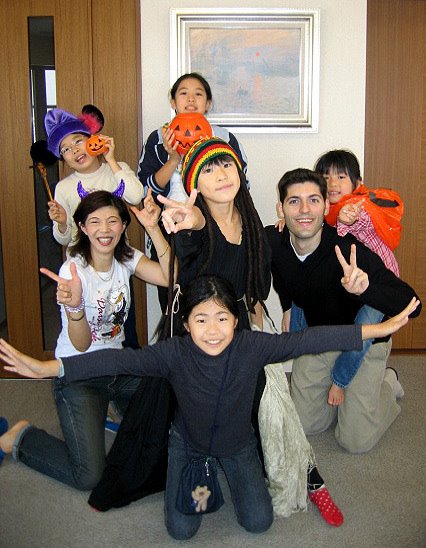
 What the heck was sensei wearing on his head? The puzzling costume produced amusing guesses, most commonly that I was a girl. Other mistaken identities included, Mexico, Medusa, and tree roots. One girl was in favor of the new look: “it suits you,” she said. The girls wanted to touch my locks while the boys wanted to try on the wig, which played perfectly into my plan of getting photo-ops.
The dreads shed and scratched, but I kept the wig on for the duration of the class for amusement’s sake. I tied the hair into a bun to get it off my shoulders. Sometimes I pretended to eat it. Sticking a dreadlock inside each nostril was a crowd pleaser.
In religious holiday news, on October 13 I informed Mr. Mochizuki that I would not be eating lunch with the children that day. I would not be eating lunch at all because of Yom Kippur, the Jewish Day of Atonement.
No, I was not on a diet, did not have a stomachache, and was not about to undergo a medical procedure. Explanation of why I was fasting was more difficult to translate than what the students surmised.
Although not religious, I make an effort on the holiest day of the Jewish calendar. But neither Jews nor Judaism rang a bell with Mr. Mochizuki. Not even after looking up the translation in the dictionary. After I convinced him that Judaism was not a sect of Christianity, he asked, “Are you Islam?”
I groaned silently, and tried a different tactic. “Do you know the country of Israel?” No. “How about the Holocaust?” Curious stare. “You know, how Hitler killed 6 million people in Europe, and well, most of them were Jews?” “Ahh, okay,” the teacher said, as if recalling some trivial factoid from the recesses of his brain. “Please tell the children some information.” “About the Holocaust!?” Thankfully, classes last only 50 minutes.
Around the corner is Thanksgiving, which while my favorite holiday on the calendar of either country, is rather boring to explain to Japanese students. We consume truckloads of turkey and harvest vegetables in the company of our dysfunctional extended families. Scrawling a turkey on the blackboard invited creative interpretations of Thanksgiving’s iconic bird, but fortunately peacock, ostrich, and pigeon do not make the menu at my family’s dinner. Pigeon pie, anyone?
Friday, July 01, 2005
The Losing Team
 What’s it like to be on a losing team? Just ask the
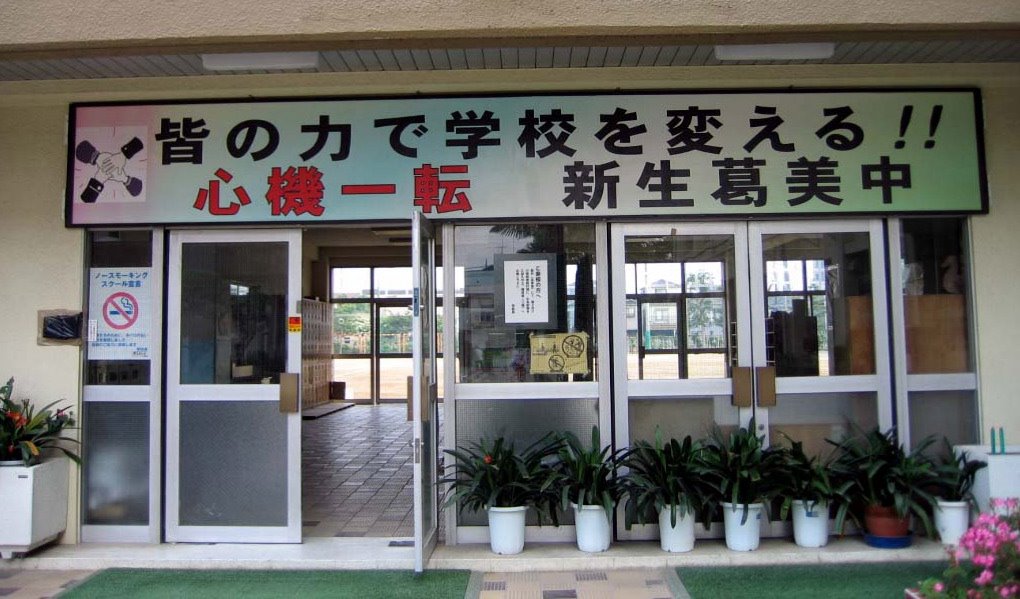
 Boston Red Sox Chicago Cubs. Or the staff at Kanokita Junior High. There are two dozen junior high schools in one of Tokyo’s quiet southeastern wards. I rotate among four. Teachers at two schools weighed in about my upcoming debut at the third. “Maybe, they are the worst,” Mr. Nakamura at Nubata School advised, wrinkling his nose. “I sink they are the worst school in all of the ward,” another teacher concurred.
“I have heard some bad things about that school,” Ms. Kimura at Douyoto commented. “Last year they got some press from students fighting. Nobody wanted to send their kids there.” Okay, clearly Kanokita wasn’t the jewel in this ward's educational crown. So, what do losers want? A sure winner. Send in the American assistant English teacher. He could turn this sinking ship around. That’s exactly what Mr. Mochizuki did. I was surprised to hear from the head English teacher in advance of my first day; no other school had called me up requesting to schedule a lesson-planning meeting.
I begrudgingly obliged. I don’t get paid enough to make goodwill visits. I paced outside of the principal’s office. The frosted glass door opened, and half a dozen ninth graders filed out. Their narrow eyes, spiky hair, and rolled up sleeves announced middle school menace. Were these the kids from the newspaper? I couldn’t imagine engaging them with funny faces and American flag pencils I hand out to reward student effort.
“The principal will now make time available to see you,” Mr. Mochizuki said, ushering me into the office. Two youthful, smartly dressed teachers joined me on the couch. They, too, were part of Kanokita's ESL team. Although Mr. Mochizuki was about 50, it was his first year at Kanokita. In fact, it was everyone’s first year here. I pondered the fate of last year’s batch of English teachers. Did they walk off the job, escaping with all limbs intact? Or might I happen upon blood-soaked clothes in a janitorial closet, or find charred femurs on the soccer field? I had been warned.
In the safety of the principal’s office, everyone wanted to know how I taught lessons at the other schools of better repute. “Well, actually I am the assistant teacher. I follow the Japanese English teacher’s lesson plan.” “Ahh, I see. So you don’t have some lesson plan of your own?” “Well, sometimes I have ideas for games.” “Ahh, do you play games at the other schools?” “Yes,” although mostly I’m a human tape recorder, I wanted to add. The teachers panned for nuggets of wisdom while the Japanese-speaking principal made himself useful at the coffee machine. Quick! How do you say, "I don’t drink coffee" in Japanese?
When I mentioned eating school lunch in the classroom, Mr. Mochizuki blanched. Ms. Hattori and Mr. Hirogashi looked at each other as if I had suggested eating one of the children – an idea equally preposterous as volunteering to eat with these troublemakers. “School permitting,” Mr. Mochizuki cleared his throat. “You will eat lunch with teachers.”
Throughout the meeting I sensed that the new staff genuinely hoped to patch the school’s battered reputation. My presence would play a key role in sparking student interest in English. Nevertheless, this was a pitched battle. Unlike Jaime Escalante in “Stand and Deliver,” try as Mr. Mochizuki might, mischievous bad apples would spoil efforts at fruitful instruction.
Will Southeastern Tokyo mimic East Los Angeles? Find out next week, only at Tokyo Tanenhaus.

