Friday evening is a special time, marking the transition from the freshly finished workweek. Monday morning’s obligations are a small, dark cloud on the horizon. First come two nights of smooth sailing, each followed by a morning of slumber and the rest of Sunday to recharge.
In college, after classes on Friday I hosted a weekly news radio show that bridged the divide between lecture halls and fraternity row later that night. Even though nobody tuned in, broadcasting through a microphone was therapeutic and marked the beginning of the weekend’s liberation.
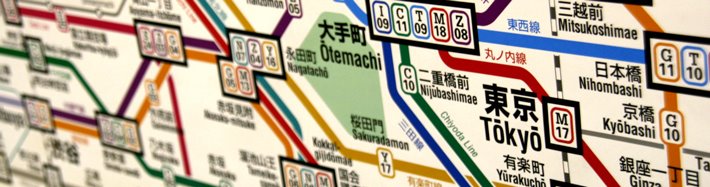
In Tokyo, I turn to basketball to air out pent-up frustrations, often courtesy of absent-minded middle schoolers and ineffective team teachers. I continue to stick with the gym in my old neighborhood now 40 minutes away by subway. After the game I head to Monzen-Nakacho’s name-knowing local restaurants that feel like the closest thing to home when 7,000 miles away from it.
Satisfaction from a surprisingly successful game (12 pts, 10 rebs, 3 blks, 2 stls) collapsed into shock when I rounded the corner to Java. My first Monzen-Nakacho hangout had been my favorite outlet for a glass of dark beer, home-cooked beef stew and casual conversation in English with Narumi the proprietress.
This pub with an eclectic interior had now been gutted. Naked wires hung like strangled snakes from the ceiling. A notice with a big phone number was taped to bare glass once covered with a patchwork of tapestries from Southeast Asia. I assumed the number wasn’t for takeout, and shuffled down Eitai Street to find another place for dinner. Knees ached from running the court, and now my heart had a small tear from Java’s sudden closure.
The chill in the air steered me to a familiar ramen shop that I valued for is hearty portions and, more importantly, picture menu. I always pointed to the same noodles mixed with pork and caramelized onions, garnished with a runny raw egg. The long counter was also a blessing when dining alone and trying not to feel like it.
Reaching for a menu, my hand recoiled as if the paper had sprouted thorns. By my standards, it had indeed mutated beyond recognition. The new menu did not include a single picture, much less a word of English. I panicked. The staff would expect me to order soon. From behind the counter sounds of bowls banging and water hissing as it boiled made me sweat with indecision. Asking for an English menu would be a futile embarrassment. Asking for a standard miso or soy sauce-based ramen was akin to ordering sandwich with white bread in a deli. It was too late to leave, so I stalled by pretending to peruse columns of bewildering kanji characters while I racked my brain for a dignified solution.
Now two years into this adventure, I was suddenly knocked back to its early days when I didn’t understand anyone or have a clue about anything. Days when I relied on pointing to plastic models in shop windows, and still wasn’t sure what I was about to eat. The resurgence of helplessness and solitude was a stomach-turning reminder as to how little I’ve progressed even at simple tasks.
Pulling the “Oh I’m ringing and it’s really important!” ruse and hurrying back out to the sidewalk worked once upon realizing that the only thing rotating around the sushi conveyor belt was empty dishes; later in the evenings you have to order your fish instead of plucking whatever looks good coming down the line. That night I opted for convenience store take away rather than trying to pronounce Japanese fish names in front of the local panel of judges behind their piles of soy sauce-stained plates.
Extricating myself eventually came from an overlooked source – the menu itself. Amid the hieroglyphics I picked out a phrase I could digest: 味山ラーメン [literally, miso mountain ramen]. It sounded like the standard miso-flavored ramen, perhaps with some mountain vegetables. Or so I thought.
I stopped sweating and ordered. Relief was short-lived. The mountain ramen was twice the size of any ramen I had ever seen. It had the stability of a cone balancing three scoops. Just looking at the steaming mound sated my mild appetite. Chopsticks felt like leaden rods. For fear of stirring the pot (and triggering a noodleslide onto the counter), I nibbled on cabbage cherry picked off the summit.
Just then a group of 10 co-workers entered with designs on sitting at the counter, capacity 12. My seating shield – a group of four near me – retreated to pay, leaving me naked in the middle. As they strategized on how to squeeze themselves around the foreign obstacle, I moved my mountain to the corner of the counter.
Mr. Kurihara, in a gray suit and puffy red cheeks, plopped down beside me with gratitude. He wiped his round glasses. He seemed impressed that I was from New York and could speak a smattering of his native tongue, but was blown away by the size of my ramen. Three of his juniors also wiped their glasses to get a better look at the spectacle still smoldering before me. In a rare role reversal, they ordered “whatever he’s having – ”
“It’s the mountain ramen,” I interjected with authority in Japanese. I flipped through the menu and pointed out the listing. They cooed in understanding. I resumed digging in, but hardly made a dent even after five minutes. Waiting for his own noodle and vegetable mountain, Mr. Kurihara leaned over with one last question:
“Do you give English lessons?”
Wednesday, May 23, 2007
Mountain Ramen

Monday, April 09, 2007
Dinner with a hook
Here's an article I wrote about my favorite restaurant in Tokyo:
For more pictures of what it's like to catch your own dinner, click here.
Monday, March 19, 2007
Teacher, Can You Spare A Coin?
Spit hit the curb with a smack outside of 7-11. It was 8:06. My eyes moved up from the ground to the source of the guttural noise. I knew that kid. A 16-year-old with a freshly shaved head, his white shirttail peeked out the back of his black uniform jacket. Matching trousers hung low on his slim thighs. He wasn’t my student, but I’m sure we had talked on occasion, probably about coarse rather than course subjects.
His arm amorously wrapped a classmate as he initiated a private moment in a public place during morning rush. One of the great things about Japan is the taboo on P.D.A., which he was flouting while spitting on the road (much more acceptable).
We both reached the door at the same time.
“Oh, sensei [teacher], ohayo!” he greeted with a devilish grin.
“Hey, how are you?” I asked what’s-his-face.
“Oh, sensei,” he cocked his head and repeated, unable to muster the simplest answer in English.
We headed for the same aisle, he for breakfast bread and I for fruit juice. Selection was good. Bread shelves were stocked with all of your favorites like chocobread and peanut butter cream Danish.
“Whaddaget?” I asked.
Corn bread. And by corn bread I mean yellow kernels embedded in white stuff on a Danish.
“That’s disgusting,” I said in Japanese.
“Nah, it’s delicious,” he countered.
I turned back to scan the juices and make a final selection.
“Sensei” he called. “I forgot my lunch.”
“OK, well, here you are,” I said, waving to microwavable pasta with hot dog slices and egg salad sandwiches stuffed with the yolks of those hard boiled.
This morning I felt like apple juice.
“Sensei” he called again. “I forgot my money.”
It was the quiver in his voice that turned me around. I stared into his drooping eyes for clues on how to react. His girlfriend stood in his shadow. Wasn’t she less forgetful? Whether the kids like it or not (and most do not), I get paid to be their teacher. Yet here was a chance to do something more than that. Here was a chance to play dad. I moved closer. I didn’t have to think for long.  My hand intuitively dipped into the outer pocket of my bag. I felt the raised edges of a ¥500 ($4.25) coin and fished it out. His eyes were trained on my bag, waiting to see how much I’d pull out. I felt like everyone in 7-11 had also paused to witness charity in slow motion.
Compared to the rest of Asia, there aren’t a lot of needy kids in the world’s second largest economy. Yet here I was giving the gift of lunch money – enough to make Sally Struthers proud.
“Sensei, arrigato. Arrigato, sensei!” he thanked while cupping his hands to receive the oversized golden gift.
He said it would cover him for both today and tomorrow. Then he grew silent. It was my turn. To foster some sense of responsibility, I told him in which teachers’ room I sat.
“Tomorrow,” he cried in Japanese.
“OK,” I smiled.
“Or the next day!” he added, heading to the register.
N.B. Hey kid, “tomorrow’s” been three months and counting. Sensei wants his gold coin back.
Sunday, February 25, 2007
Dinner with the Fam (Part III)
It’s been a while since I’ve chronicled life with my Japanese family (Part I here, Part II here). Their drinking house (izakaya) Daruma is the one place in this megalopolis where I truly feel at home.
It’s 9 p.m. Friday night in Monzen-Nakacho. Izakaya are bustling along the narrow streets of this Edo-era neighborhood as salarymen celebrate the end of the work week (well, at least those who get Saturdays off). Chatter and the sound of clinking glasses resonate from small shops with glowing red lanterns. Despite an empty stomach, I see red as a warning, not a welcome. I dare not intrude into unfamiliar territory, and remain on the cold side of wooden doors and frosted glass.
Daruma is different. A large front window makes patrons (and seat availability) easily visible, and friendly owners keep an eye out for regulars passing by. That’s how I met my parents almost two years ago during my second week in Japan.
I slowed as I passed by Daruma, hoping to catch the eye of the older gentlemen who bowed to me the evening before while I was walking the streets on a nightly food-finding mission. From the safety of the sidewalk on the opposite side, my eyes instead connected with a woman shaped like a turtle.
I made a spoon-fed mouth gesture to gauge if I, a foreigner, was welcome to eat there. Poking her head outside and spouting off Japanese, the turtle of a woman waved me in with enough fanfare to attract the attention of her husband and nearby diners. I walked into the wood-paneled room filled with men dressed in dark suits. On my way to the expat nightlife enclave of Roppongi, I radiated color from inside a DKNY shirt.
Tonight I blended better in a black hoodie and sweats, fresh from a Friday evening basketball game that I still attend despite moving across town. Then, like now, I take the stool closest to the door. A committee greets me the same way they do for regulars who have been dining there nightly for decades.  Aya, the married older daughter (above right), hands me a yellow washcloth to wipe my hands. Her mother, turtle-shaped Ma-san, welcomes me in Japanese. Kitchen hand Nao brings over a tab and nods. This is code for my ordering the usual – deep-fried river shrimp and a big bottle of beer. The cook couldn’t hear Nao’s placing my order above the din, so Nao acted out his best river shrimp impersonation that looked like a swimming dog. We both laughed. The scene inside here is how it was, is, and always will be.
The most effusive of greeters is Dad (Otosan), who was noticeably absent. One of the dozen 50-year-old salarymen took it upon him to slip in a Dean Martin CD from the rack of disorganized albums of Jazz greats like John Coltrane and Miles Davis.
Simply saying “hai” (yes) in response to Nao’s nodding was enough to get a rise out of the salaryman next to me. His oversized glasses rested on a forehead wrinkled from crunching 40 years worth of data – probably by hand. Super-sized moles had sprouted in the valleys of his wrinkles. His head bobbed in and out of consciousness. He closed his eyes while swiveling a toothpick around his gums before tossing it in his plate of soy sauce. He then raised his glass halfway before gravity pulled it back to the warped counter.
Nao delivered an omelet filled with natto (stringy, stinky fermented soybeans), and placed it next to the man’s half-eaten plate of whale sashimi.
“I don’t want it,” he said with a wave of the hand.
“Really?” Nao asked.
“I don’t want it!” he repeated with the defiance of a kid being force-fed broccoli.
The exchange brought Ma-san over from the other end of the counter where she was toasting a red-faced patron and nibbling fried chicken off his plate.
“Half, how about half?” she pleaded.
He would have none of it, so the once model-sexy Aya was brought in for feminine coercion. She slid onto the stool next to him and consoled him. After cutting the omelet with a spoon, she fed it to him “here-comes-the-airplane” style. My nose twitched at the fumes. Natto’s pungent odor is one almost all foreigners in Japan detest, and I’m no exception.
He took one spoonful but refused more, and instead swallowed Aya whole with a bear hug. Unfazed, Aya fed herself, and then passed the plate to Nao, who took a bite and let Ma-san finish the dish.
Just then Otosan arrived. He didn’t see me at first, so I patted him on the back as he was hanging up his jacket next to the CD rack, and got the welcome I missed.
“Ah, Jeff-er-e, my son,” he called out in English, and then leaned on my shoulder.
“Yakeddo,” he cried, wincing.
I knew that word! Or I once did. My brain quickly scanned the archive of Japanese words that have gone in one ear and out the other...Archery! No, that couldn’t be right. He rolled up his trousers, and a bandage appeared around his leg.
“Burn. Burn! You burned yourself!” I said.
“With oil,” Aya chimed in Japanese while picking at a block of ice and sending crystals flying like fireworks.
“With water,” Ma-san added with a gesture of pouring a pot onto herself.  The doctor told him not to work, but a leg burn wasn’t gonna sideline this super grandpa battling liver cancer. Ma spooned the last of the omelet into her mouth before rising up to greet new guests with her high-pitched “Irasshaimase!” Miles trumpeted in the background. Otosan rubbed my back. No matter how mediocre of a basketball game (this one ended with my blowing three put-backs – all on one play), Daruma lifts my spirits.
Otosan moved from behind me to introduce my new neighbor, who had replaced the drunken mole man. I was told that he was “a comedian,” which I soon figured out was a joke meaning fool. The computer programmer ordered raw tuna for the two of us.
I asked Nao for atsuage, fried tofu garnished with horseradish and scallions. Nao tried pushing natto, but like the mole man before me, I’d have none of it. “It smells like my shoes,” I cried, taking one off to demonstrate.
The fool and I talked in a mix of languages, mostly about names and traditions of Japanese food. I was able to understand some of what he was saying, and could even weigh in on Tokyo’s current events, like the stoppage of several north-south train lines during morning rush.
“…Saikyo line…this morning…” I overhead two men discussing.
“Me too, me too,” I butted in Japanese. I had been on that line. “Unbelievable, wasn’t it?” For Japan it was. Operations had halted for almost 10 minutes while I was changing to the Kehin-Tohoku line, reducing a roaring Akabane station to an eerie silence one might find in a cemetery without any birds.
Transit woes are rare here, but when they happen, they are cause for a blog. Stayed tuned for “Tohoku, We Have a Problem.”
Tuesday, January 16, 2007
Drinking in the New Year
For an all work and no play culture, the Japanese make exceptions to let loose in December and January. That’s when bonenkai (忘年会) and shinnenkai (新年会) parties give co-workers and friends reason to forget the old and celebrate the new.
January 14th’s shinnenkai was with Kensuke (last seen on the blog saving my life) and some of his buddies (last seen barbecuing in the park – click on the “Kensuke” label link at right for a refresher). I anticipated an evening of struggling to speak in Japanese and relying heavily on hand gestures oiled by sake, shouchu, and draft beer.
Kensuke and friends seemed subdued, maybe because everyone was off to a shaky start. Kensuke was set to lose February’s income because Master was closing the izakaya and taking a month’s rest – in Hawaii. Working Mondays at a pachinko parlor wouldn’t make ends meet.
Tak, fighting a cold, looked depressed underneath his wool hat. He didn’t even have part-time prospects after his long hair got him bounced from an interview at another pachinko parlor.
After talking about jobs, or the lack thereof, conversation switched to girlfriends, or the lack thereof. Kensuke and Tomo recounted their foray into Kabukicho, Tokyo’s red light district. After 10 minutes of perusing photos, about $125 got them 15 minutes with the Japanese girl of their choice. Except that when the door opened, in walked a Korean, they said with a trace of buyer’s remorse.
The affable grill master from the summer BBQ was noticeably absent, but checked in a few times via cell phone from home where he was studying for a college exam. Such obligations, however, didn’t stop Tomo from extending Sunday’s shinnenkai until 2:30 a.m. Monday. The slim tae kwon do fighter (below) tied a ponytail on top of his head and cursed off a Chinese test looming later that day.
“Not pass,” he said, gritting his teeth. I didn’t disagree, as his Chinese vocabulary was about the same size as mine – four words.  Around the table, lighters sat perched on cigarette packs like poker chips. Kazu blew rings from his mouth. Ailing Tak dragged on a cigarette and blew mucus into a wet wipe. The table began to clutter with empty glasses, discarded edamame pods, and bare plates as fried chicken, raw octopus, and other shareable snacks were attacked upon arrival. I dipped slender shishamo (ししゃも, smelt fish) into mayo and savored its scaly texture. The Japanese have caught on: mayo makes everything taste better.
Quiet Kazu was wearing a long sleeve shirt imprinted with a map of New York City’s subway. I pointed to the dot on his chest where I was born. A barrage of “New York life” questions followed, which were mostly contorted fantasies picked up from watching too many B-movies.
The guys were most interested in black people and junkies; needle in forearm gestures accompanied their questions about the latter. How many black friends did I have? How did I greet them on the street? Were cops not strict about marijuana? Did I use in high school? Did all junkies use wheelchairs? Did the one junkie per block ratio hold true in the City? So as not to completely disappoint them, I pointed to Kazu’s shoulders and said that in those outlying areas you could find what you were looking for.
I might have misinterpreted, but Kensuke then shared a factoid that for every 100 meters between a NYC police station and his hotel, there was a 150% chance that a Japanese person would get mugged twice.
We later moved into a private booth equipped with a karaoke machine. Earlier, sniffling Tak had been eager to know if I could rap. Something about wanting me to do so at his band’s show. In denial that I couldn’t, he queued “Lose Yourself.” I reluctantly picked up the mic, and by the time I put it back down I had new respect for Eminem’s speed. Hopefully I convinced Tak to keep searching for a performer.
We took turns thumbing through a song book the size of a state telephone directory. I knew just where to flip. With sporadic practice over the months, I’ve assembled a repertoire:
Bon Jovi – Livin’ on a Prayer
Zager and Evans – In the Year 2525
America – Horse With No Name
Javine – Surrender
Linkin Park – Numb
Celine Dion – My Heart Will Go On
It’s a nice mix of oldies, rock, and pop that won’t push my limited vocal range. Celine is a shattering exception, but by that point nobody will remember anything anyway.
Despite my spirited first-time rendition of Mr. Mister’s “Kyrie,” quiet Kazu turned out to be the most talented. While the others stuck with Japanese hits, he handled the Red Hot Chili Peppers on key and in clear English.
Aside from memorized lyrics, however, their collective English ability was quite limited. The five of us nevertheless connected. Cell phone dictionaries bridged gaps, such as for gesture-defying words like entrance examination, conscription, and sperm bank.
Although they kept complimenting my Japanese, it hadn’t improved since the BBQ six months ago. I still only know about 10 verbs, half of which I can use correctly. Instead, I spit out a steady diet of nouns and hope people get the picture. Kensuke made an interesting point. Despite not studying, my living in Japan for less than two years has made me more proficient than their six years of compulsory English education. Kensuke (center) and Tomo
By 10:30 p.m. Kazu and Tak called it a night, but Kensuke, Tomo, and I moved on to a yakitori place that could become my next neighborhood hang out. Staff welcomed me like a regular, and I pulled up a padded beer barrel stool among the lively locals growing louder after every glass. Kensuke kept the sake flowing and ordered skewers of torikawa (とりかわ, grilled chicken skin), tiny bird eggs, liver, and pork slices.
Around 1:30 a.m. a female friend from their junior high days joined us for a final round of sake and skewered entrails. We then parted ways into the chilly January night, 2007 having been initiated Japanese style.
Thursday, September 28, 2006
Sayonara to Summer
In half an hour? The Japanese aren’t known for their spontaneity, but here Kensuke was inviting me to a BBQ two days after he saved my life. It was the last day of summer before I returned to work. Soon I would only be able to feel the sunshine from the wrong side of classroom windows.
The night we met at DJ’s place, Kensuke mentioned his favorite park near where we live. I counted the homeless people sleeping on benches in Yotsuya Sannencho Park. No sign of grills. No sign of him either.
Once he arrived at our designated meeting point, he led me away through twisting alleys with quiet homes bathed in soft afternoon light. A park like none I have seen in the capital came into view. A bamboo fence enclosed a gravel lot. In one corner, trees shaded a small shrine. Businessmen and elementary school children stopped by to summon the spirits.
Dark splotches dotted the back of Kensuke’s Bob Marley t-shirt. A towel wrapped around his neck soaked up the last of summer’s sweat. Our feet crunched on pebbles as we approached his four friends sitting around a hibachi. Two sat leaning against the fence sharing earphones like Siamese twins.
The cook rose up from sitting on the cooler to welcome me with a cold Yebisu beer. I recognized the tanned and mustached boy from DJ’s place. The grill sizzled with an assortment of meat, which he piled generously onto my paper plate before I took a “padded” seat on a flattened cardboard box.
This being a city that has repeatedly burned down over its long, fire-prone history, cooking devices were banned in the park. Helicopters chattering above added to the cook’s paranoia, which he voiced in Japanese.
“If the police come, you run,” translated a slim 19-year-old who has the Friday night shift at Kensuke’s restaurant. He pulled back his long auburn hair with a tortoiseshell headband and continued, “You are teacher.”
We all laughed. Water sources close at hand quelled any risk of fire. Near the shrine was a manual water pump, and much of this small sanctuary was filled with a dirty pond home to some resilient goldfish and one fearsome Kappa water monster, or so the boys told me.
This mythical creature lurks in rivers and ponds, and preys upon humans by gently sucking out their entrails through the anus (distended rectums of drowning victims is evidence). Only cucumbers can combat a Kappa’s hunger for humans, so pocket a good supply the next time you take a dip.
The hot plate sizzled with pork, sausages, smelt fish, and veggies. A record player studded with Sapporo bottle caps turned out reggae beats. I held my own as we talked in Japanese about various subjects like music, cars, and girls. They said Japanese Olympic gold medal skater Arakawa had a “horror face.” I charged that American Britney Spears was dumb and ugly. However, we came to agreement that Sharapova was one fine piece of Russian meat.
Aside from the imported Jamaican music, the park, food, company, and conversation felt like the real Japan. Although always an outsider here, for a few hours on the last day of summer I felt incorporated into Japanese life.
It didn’t last long. I suddenly urged to cry out in my native language. Surrounded by the Japanese atmosphere, I wanted to reassert my identity. I grabbed my Yebisu beer can, and thumbed away the beaded sweat. I read the English label aloud like I was at a poetry reading. Even the earphone twins tuned in to listen. Unable to digest my words, they captively swallowed them whole.
“You are so cool,” the cook smiled following my impassioned delivery.
I took a refreshing sip before returning the compliment with an empty plate.
Monday, September 11, 2006
The Night Kensuke Saved My Life
 DJ’s party is always a good place to meet Japanese people. Last month’s theme was “virgin honeymoon,” and featured a mural of a pumpkin-headed woman in a mini-skirt swinging an ax. Illuminated under black lights, it came closer to Halloween than honeymoon.
Unlike past events when I helped pass out flyers on the corner to suspected English-speakers, this party was a closed event. The bar was trying to keep a low profile – from the cops. Apparently they had visited on another night, which was enough to spook DJ & Co. of a follow-up at their monthly event.
Usually I don’t have a connection to the people I meet, but I shared something in common with Kensuke. He lives down the road from me, and works at an izakaya in between our apartments. He invited me for dinner two nights later.
Wisps of a goatee decorated his young face. Soft, wide almond eyes invited friendship. He seemed like the sort of person you could become friends with instantly. He dressed like an apprentice in the restaurant’s t-shirt and a tightly rolled headband that crowned his head like a halo. He accompanied the chef on frequent smoking breaks in the kitchen. In 35 years I could see him in the chef’s grease-stained apron with the frying pan in one hand and a cigarette in the other.
The chef, 59 and grandfatherly, spoke just a few words of English, so we stuck to basic Japanese. Not knowing what to order, I expressed basic preferences, namely that “I like fish and meat.” He took it from there. The boiled and bony mystery fish was disappointing, but five assorted yakitori skewers made up for it.
Kensuke brought me a raw egg to use as a dipping sauce for the meat. Raw eggs are a common and flavorful garnish in Japan. I draw the line at eating raw chicken. Away I dipped, only to have Kensuke correct me that only one of the five skewered meats was meant to be egged.
Three hours of limited Japanese conversation ensued. Kensuke asked if I wanted to finish off my meal with some sake. It went down smoother than water. The chef scolded him upon learning that he had poured from the most expensive bottle. Master wrote it off on the house.
The owner of the restaurant had one more present before I called it a night. Master reminded me of someone who would have attended Woodstock. Concert posters, t-shirts, and autographed photos lined the walls. A long, bony face sat atop a lollipop frame. A rolled-up headband also circled his head, and his lips squeezed a lit cigarette.
From a box of individually wrapped sweets, he presented me with a pastry from Sendai. He had trouble opening the plastic wrapping. At a BBQ the next day, Kensuke would tell me that Master was roaring drunk as per usual, although he hid it well. He sliced through the wrapping with scissors, and put the pastry on a plate in front of me. He turned his attention to a small packet that came wrapped with the pastry.
Master’s fingers obstructed my view, but I was pretty sure it was a dessicant, boldly labeled “DO NOT EAT” in both languages. Master cut it open.
“Excuse me, what is that?” I quivered in Japanese.
“Sauce,” he said, dumping black powder onto my white pastry. I cringed. The powder looked like mold, and had some seasame seeds mixed in. Was he trying to kill me? I hadn’t even paid the bill yet.
Although still very much a foreigner, I now see through Japanese eyes. Master’s pastry put me in a pickle. I thanked him for his generosity, and prepared to save face by stuffing mine. My gut churned at what a sense of cultural dignity moved me to eat. I could stomach the aches. Besides, I was still on summer vacation, and had a free day to burn at the doctor’s or hospital if necessary.
I stalled by nusing the last of my sake. I trusted its guidance. I reasoned turning the pastry over and picking at the untainted side, and conceding fullness before I fully poisoned myself.
My hand hovered above the plate. Just then Kensuke came out of the kitchen. He was holding the crumpled packed Master had thrown away. He politely suggested to his boss that maybe the special sauce wasn’t designed for digestion.
“Hai, hai, hai,” Master chuckled off the minor mistake, slapping me on the back. He staggered to the back of the room to fix me up with a pristine pastry.
I turned to Kensuke and mouthed thanks. The incident shook me up, not because of Master’s mistake, but at how I had nearly convinced myself to nibble around poisoned food to maintain the important Japanese concept of harmony.
Master and chef bid me farewell, encouraging me to return again. Thanks to a life-saver named Kensuke, I intend to do just that.
Tuesday, August 01, 2006
Animal, Vegetable or Mineral?
Making Sense of Japanese Supermarkets
I arrived in Tokyo from New York tired, alone, without a job and, worst of all, hungry. Eerily realistic plastic food displayed in restaurant windows wasn’t much help. I was clueless as to what the replica was imitating. Even picture menus puzzled. I needed someplace to inspect goods up close, and preferably under bright lights. I needed a supermarket.
Here, senses of smell, taste or touch come in handy when sight alone proves insufficient. Unable to crack Japanese labels, I play the grocery guessing game, which entails crossing fingers and tossing an item into my basket. I’ve made two memorable mistakes.
 I have an acute weakness for dried baby sardines inserted into Japanese snack mixes. True to my American roots, I buy in bulk. Elated upon discovering an extra large bag of little fish, I unwittingly purchased – and partially consumed – cat food, which got a rise out of a Japanese friend who declined a nibble.
I am also guilty of gulping what I thought was a can of refreshing “Italian lemon and California lime” soda. A few minutes later it hit me – in the head, as I stumbled around my apartment in a Suntory stupor.
A chore anywhere else in the world, grocery shopping in Japan transforms routine into cultural phenomenon. My local branch of the Akafudado chain is no exception. The experience begins right outside the supermarket’s automatic doors. A lady with a generous smile peddles a cart of ¥100 (85 cents) skewers of grilled animal parts unknown. Some are tasty, others crunchy. One triggered a gag reflex.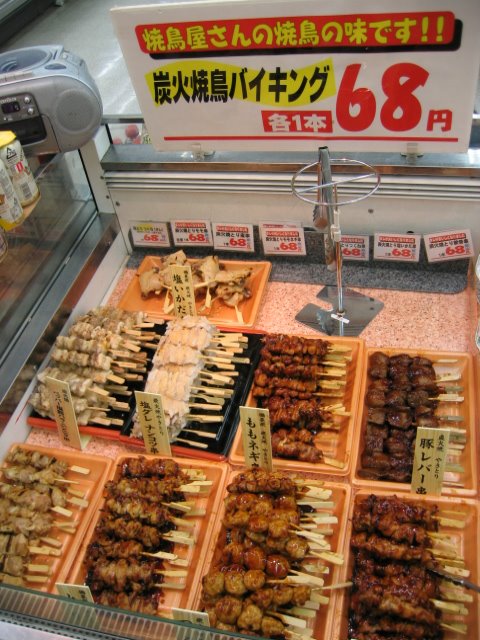 Skewer lady competes with the singing meat display near the frozen food aisle inside. A portable stereo mimics the meat. It chirps at shoppers, “we like meat, take your pick” in a treble that only Alvin & The Chipmunks can match. One might expect higher prices and lack of music to drive skewer lady out of business. But jingles can backfire.
The voices were cute, at first. But the tune turned repetitive, and then harassing. Now I restrain myself from gouging out eardrums with nearby toothpicks just to make the voices stop.
I take refuge out of earshot in the snack food section. Despite serving sizes fit for a gerbil, rice crackers, cookies and traditional sweets come individually wrapped within larger packages. It’s the equivalent of encasing each Dorito in plastic (which hasn’t been done here…yet). While the concern for freshness is admirable, the means to achieve it are an environmentalist’s nightmare.
Indeed, Japan is the land of small portions. Although now I’ve adjusted to thinking of their size as sensibly adequate, I used to eat at McDonald’s just to get enough calories. Sympathetic supermarket workers have taken notice.
“Delicious,” I said to one, satisfied after sampling his seafood salad. I reached for a container marked ¥462 ($4), but the employee pulled it out of my hands. He pried open the lid to slip in additional shrimp, jellyfish and cellophane noodles, but left the price sticker unchanged.
Another time, a young man at the gyoza station flagged me down for a taste test. After dishing out seconds, he directed my attention to baskets lined with clear plastic bags filled with what looked like melting intestines. 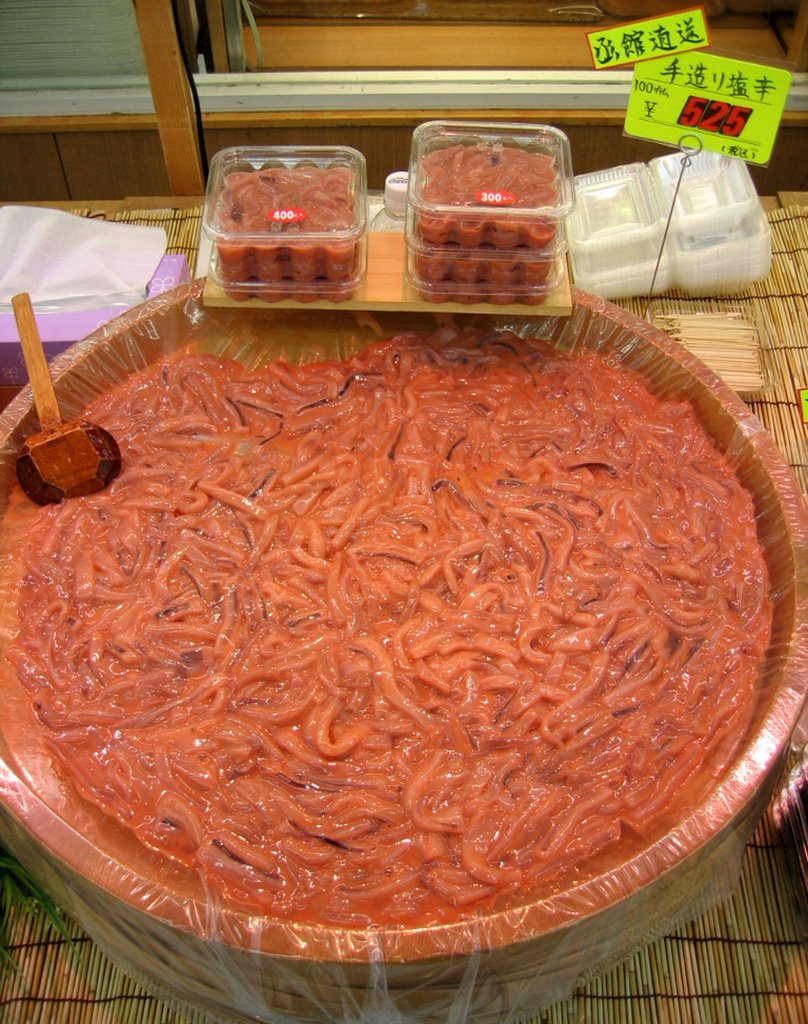 “Ika,” he said. It sure didn’t look like squid. He jabbed a toothpick into the basket brimming with pinkish worms, and extended the slimy offering. Although raw fish is a favorite food, even I paused at the sight of this freebie.
“Mexico,” he said, jiggling it. Mexican squid? What the hell, I thought, closing my eyes as it slithered onto my tongue and down the hatch. “Indonesia,” he pointed at the next basket. Just swallow, I told myself. “Japan,” he said with hometown pride, reaching for yet another toothpick. After cleansing the palate with some seaweed from Hokkaido, I thanked him for the world tour.
Free samples subsidize my strategy of eating supermarket cheap. Why pay more when you can’t afford it? Cutting costs on food in one of the world’s most expensive cities is a necessity. At Akafudado, I barrel down the aisles with Olympic athleticism in search of tofu, gyoza or anything left unwrapped. Insider’s tip: making a few rounds amounts to a free appetizer. I then head to the rear of the building (dangerously close to the singing meat) to select a bento box entrée. I regularly set my cell phone alarm to ring for 7 p.m. This begins the evening competition with salarymen and bargain-hunting biddies to snatch up marked down items. One reduced by ¥75 (65 cents) catches the eye. I never know quite what I’m buying, but bento beggars can’t be choosers.
While queuing for the register, people peer into my basket to see what the foreigner is feeding on for dinner. Doritos and Coke? On the contrary: bento, edamame, walnuts and sardine mix and a drink. I feel the urge to defend my strawberry milk selection by staring back and saying, “Yeah, well nice radish, lady!” It’s usually the thickness of my lower leg (or daikon ashi, but don’t say that “radish-legged” insult to a woman).
The checkout line gives me time to whip out my point card. It offers few financial rewards. Instead, the card confers status. I deliberately fiddle with it to advertise that I live here, too, and am not some stray tourist with the temerity to forage among the locals.  Arms saddled with plastic bags, I exit past the ¥290 ($2.50) apples. Murmurs of singing meat fade away. Skewer lady’s grill smokes as a customer looks on. Although often ignorant as to the species of mammal, vegetable or fish I’ve purchased, one thing’s for sure: grocery shopping in Japan sure works up an appetite.
Tuesday, April 25, 2006
Sushi Place
 When it comes to sushi, Japan – not surprisingly – is bar none. My neighborhood is just up the subway line from the world’s greatest fish market, Tsukiji. I wasn’t making it another supermarket mystery meat bento night. I decided to revisit a sushi place private student Aiko showed me one “lesson.” This time would be different. Without a crutch, I was intruding into a salarymen stronghold feeding on the bedrock of Japanese cuisine in old town Tokyo.
Approaching the storefront set gastric juices in motion. But you can’t just walk in and seat yourself. Well, you can, if you’re Japanese. I paced past the entrance to check seat availability along the two bell-shaped counters. It’s always packed. Making a U-turn after entering invites humiliation. Standing and waiting along the perimeter feels too exposed when you’re a foreigner, not to mention the only one under 40.
The glass of the double sliding door is frosted almost to the top, but standing on my toes enables reconnaissance without commitment. I already had peered in twice. Cigarette smoke blurred dark salarymen suits. I pretended to thumb text messages while waiting for someone to walk out, but hunger soon trumped insecurity.
Unlike typical establishments here, don’t expect an audible welcome upon entering, which at least doesn’t draw more attention. Other customers aren’t looking for polite service. The freshest, cheapest sushi on this side of the Sumida River keeps them coming back. I feel their gaze, but hone in on my goal – sliding into an empty stool without knocking it or anyone else over. I cringed stuffing my knees under the counter.
The grey-haired lady poured jugs of sake into customers’ overflowing glasses. I recalled her stern disposition from last time, sort of like the sushi Nazi. Apparently I wasn’t a stranger either. “I never forget a handsome face,” she said through a customer translator. Ack. I let out a breath and looked up to order. Instead, I caught people staring at me from behind beer mugs and raised chopsticks. Can he speak Japanese? Can he eat raw fish? Can he handle chopsticks? Let the games begin.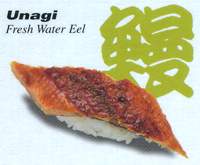 In such situations, I fall back on a fail-safe recipe: draft beer. I wanted small, but ordered 1 liter. Murmurs of approval. First hurdle cleared. Next I whispered “unagi” (boiled eel) just like I had eaten when with my private student. Its mouth-watering richness makes it taste more like dessert than sushi, although it’s not raw. The sushi Nazi turned to the kitchen and yelled, “Do we have unagi today?” loud enough for everyone to overhear.
I sensed laughter before it became audible. One observer challenged me, in English, as to why I was ordering cooked fish in a place known for its raw delights. My cheeks turned the color of a maguro slice. The lady's answer was no, followed by a sentence I couldn’t catch. The only word I recognized was anago, unagi’s salt-water cousin (conger eel). I didn’t really want it, but quickly accepted.
“Maguro,” I called out, adding the house staple of tuna to my order, which appeased any remaining detractors. I wasn’t in the clear just yet. Furtive stares anticipated how I would eat what I had spent so much effort ordering. I treated chopsticks like a surgical tool and poured less than usual soy sauce. The conger eel arrived dripping in delicious sweet eel sauce. I steered clear of the accompanying bottle filled with seasoning. Unfamiliar lids with unfamiliar contents only increased chances for embarrassment. Anago in chopstick, I raised it to my lips and stopped. Was that someone speaking to me? When you can’t understand the language, you begin to sense these things. A well-dressed gentleman in his twilight salaryman years had uttered “saisho,” or first. I knew what he meant. I had skipped a step. The eel was still undressed.
I imagined drowning it in green flakes. When nothing came out, I tapped harder and the prophecy fulfilled itself. I causally smeared the sprinkles around my plate like I was seasoned expert. I looked up to find the salaryman nodding. I toasted him with a green slice of eel.
Tuesday, March 07, 2006
It’s My Party, and I Can Order Chicken If I Want To
Running a fashionable 20 minutes late to my own party only added to the confusion since some of the dozen people waiting under Shinjuku’s huge Studio Alta screen didn’t know one another.
I picked through the crowd of 100 others waiting in the same spot to round up the group, and led the charge to Kaikyo, a cheap izakaya (Japanese-style pub restaurant) I had scouted out. I saw the outing less as a birthday party and more of an excuse to jilt my usual Saturday night date with the washing machine.
I worried about the dinner reservation because we only had the table for two hours, and were now running half an hour late. 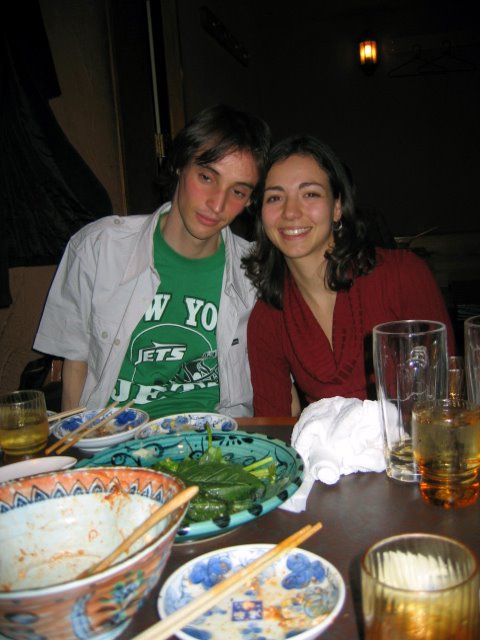 “We can’t go yet!” Lawrence called out. “Delphine’s not here.” Pretty name, but who’s Delphine? I wondered. The eclectic group included Lawrence of France, his Fumi, his friends Delphine and Koya, the Napoli girls (of Naples, Italy), a teacher who quit my company, his Japanese friend Ken, my friend Maki, and Takafin, the T.G.I. Friday’s waiter I befriended last month.
I chose Kaikyo because it was an alternative to traditional izakaya fare with Western influences that I craved. Like rock music, big portions and popcorn otoshi (obligatory table snacks, usually pickled things in neon colors). Oh, and fried chicken. Actually, the biggest portion of fried chicken this side of the Mississippi. The Colonel’s got nothing on Kaikyo. Maki’s eyes rolled out of her head and onto the floor. She got full just looking at the platter.
“We’ll need two more orders of this,” I asked Fumi to tell the waitress. “And a forklift.” The Napoli girls, forever lamenting the sorry state of pizza in Japan, exclaimed, “This place is just like America – fried chicken all over the place!”
I sided with Takafin’s take: “let’s fuckin’ eat!” Takafin enjoyed eating and drinking as much as he enjoyed lacing profanity into his English with grammatical predictability. His construction of choice was: let’s + fuckin’ + verb (limited to eat or drink).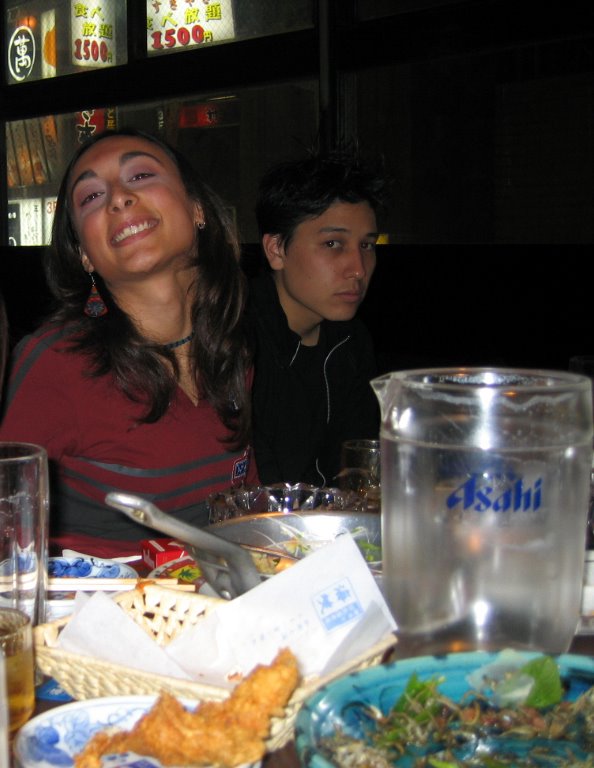 And eat we did. Communal bowls of Kim chi tofu, spinach salad sprinkled with baby sardines, radish the consistency of steak (or, “radish steak”) and baked curry bread smothered with melted cheese — not for the calorie phobic. If this doesn’t sound like your ideal birthday menu, then you clearly haven’t spent enough time in Japan. The concoctions grow on you. Of course, my priority was the fried chicken, which, depending on the batch, could have used a dunk in soy sauce or spicy Japanese mustard.
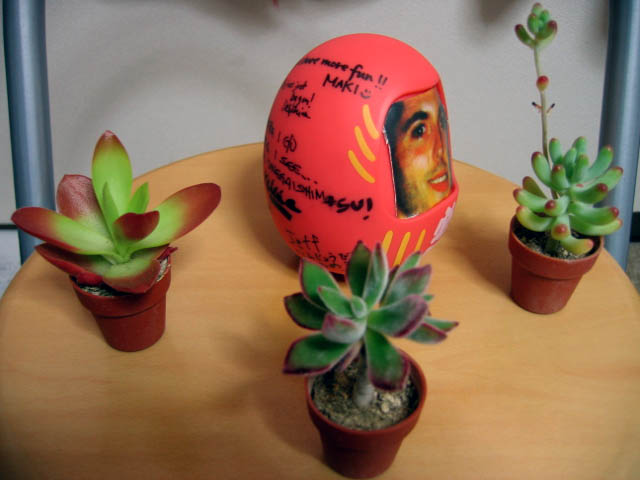 A few pitchers of beer helped wash down the juicy pork and egg dish, but nobody got silly. We saved that for karaoke. But first, a few thoughtful gifts – a bouquet from Maki, potted plants in proportion to my apartment from Fumi, and a personalized
daruma signed by the group. I looked up to smile. It was a Fuji Film moment. But then I stopped.
Gregory? Was that really he, the freaky Greek? Who the hell invited him?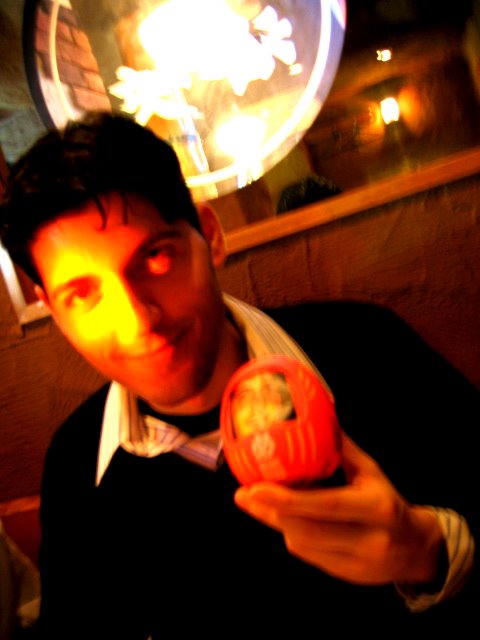 Two friends of friends of friends joined the karaoke train rolling out of the restaurant and through the alleys of Kabukicho, once the seat of traditional kabuki theater and now the underbelly of Tokyo’s red light district of sleaze and sex and the gangsters who profit from it. Sort of like Times Square in the 80s, but without the garbage, graffiti and drugs.
“I know just the place,” I assured the group. Of course, all karaoke parlors are the same, but I felt loyal to one after researching it for my 24-Hour Tokyo article.
Gregory the photographer asked me how I had been, and if I had gotten any jobs. I was surprised he remembered. “There’s this Greek guy who has the same clean cut look as you,” he said. “He’s doing really well. Gets lots of jobs for suit shootings.”
We had met when I was considering getting a book of portraits photographed to show off at auditions to launch my now fizzling modeling career (okay, flat-line). Gregory was known to have the best price in town. But $200 was still too much of an investment at the time.
He offered a discount when we met at his studio one hot July afternoon. I had nearly blocked the encounter out of my mind. When I got home, I banged on my keyboard for an hour, saved the document, and haven’t opened it since. That is, not until tomorrow….
Thursday, January 19, 2006
An Eye for IQ
 Instead of Aiko’s regular Tuesday night private lesson at my apartment, we took a field trip to a neighborhood sushi restaurant. It’s always packed. The salaryman next to me was watching live soccer on his phone.
The place is known for its swimmingly fresh and stunningly cheap seafood. Aiko did all of the ordering, and I did most of the eating – tuna, octopus and squid sashimi and conger eel tempura. The fish was so fresh that for once I didn’t gag at the normally briny stench of sea urchin when it hit my tongue. I nibbled at shredded radish garnishing the sashimi plates.
Just when I didn’t think I had room for any more, soup arrived. Aiko described it as ara shiru, a clear broth with fish bone, head and meat. I cupped my hands around the warm bowl and raised it to my lips. Clean and refreshing.
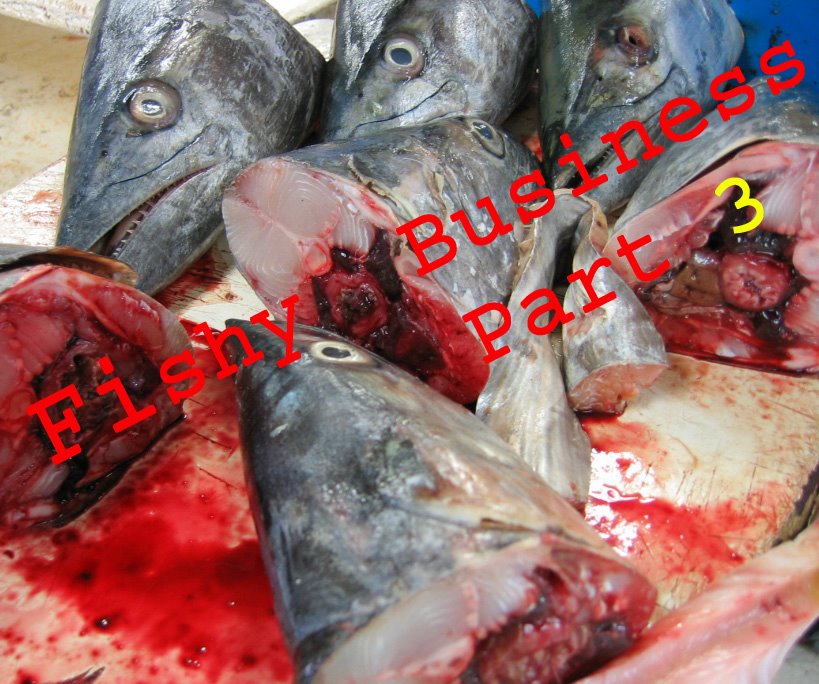
All that remained was an unidentifiable chunk. Aiko’s bowl was empty. I looked into mine. The meat looked back at me. I couldn’t believe my eyes. I had an epiphany like when your brain unscrambles a Magic Eye optical illusion. From the bottom of my bowl stared a fish eye. Strands of meat clung to the socket, but there was no mistaking the opaque bubble in the middle.
“Are you supposed to eat this?” I cried as quietly as possible.
“Yes, it’s delicious,” Aiko said.
I poked the eye in the eye with a chopstick.
“It’s hard! It’s an eye!”
I can’t remember the last time I got squeamish over food, but the cold look of the eye was jarring. I wanted the waitress to clear my plate, yet out of curiosity I kept poking it as a warm up for the inevitable.
The grey-haired waitress detected my indecision, and told Aiko that boiled sakana no me (fish eye) was good for the skin and intelligence. An eye for IQ.
“Maybe it’s best if you eat it with another food,” Aiko suggested. “Like tofu, if you are scared.” I was scared, but intrigued. Curiosity won, but my taste buds had the final say. My nostrils flared. It was crunchy like plastic. Was it the cornea? Sweet gelatin oozed onto my tongue.
I wanted it out of my mouth and fast, but only had a moist washcloth for a napkin. I pursed my lips, and breathed heavily through my nose. The shredded eyeball sloshed around in my mouth. Teeth cracked on a pachinko ball. Is this what they mean by eyeball? My throat closed. There was nowhere for it to go but back out. I raised the bowl and spat.
Aiko had been watching my contorted facial expressions, which now eased with relief. A swig of beer neutralized the aftertaste. Check, please.
Wednesday, January 18, 2006
Breaching Sashimi Borders
 I took a stool at Daruma restaurant, where the scene has been rather quiet the past several visits. I told Masa I was hungry and wanted something “bigger” than my usual meal of kawaebi, the Japanese equivalent of popcorn shrimp. She knew just the thing, and yelled something at the cook, who greased up an already greasy iron pan.
As I awaited the mystery meal, a salaryman on the adjacent stool startled me by striking up a conversation. It was the standard where was I from and where did I live now. He picked at a plate of sliced fish the color of blood. “Do you like kujira?” he asked. I like all types of raw fish, but this looked a little too raw for my taste.
Kitchen hand Nao came over to translate by pictograph. My eyes lit up. This wasn’t just any fish. It was whale. It’s only on the menu of two countries – Japan and Norway – that haven’t banned the practice despite international pressure.
“Some foreigners think it’s rude for Japanese to eat,” the man said, sliding a piece onto my plate. I was surprised to see it served at a hole-in-the-wall like Daruma. Whale is expensive, and its consumption on the decline. It’s now considered a delicacy instead of an entrée at school lunch, which remains a childhood memory one art teacher would rather forget.
The blood-red chunks didn’t look appetizing. Unlike smooth slices of tuna, whale looked more fleshy than fishy. It didn’t dissolve inside my mouth like tuna either. I couldn’t spit it out in front of everyone, and kept chewing until the lump felt masticated enough to wash down with beer.
Squid eyes. Whale. What’s next to cross my lips? Sakana no me. Stay tuned for Fishy Business Part 3.
Monday, January 16, 2006
Squid Eyes
 How can you tell if you’ve been in Japan for too long? When hankering for a snack, you bypass the Kit-Kats and Doritos and beeline to a supermarket’s raw fish section.
I needed an after school pick-me-up, and picked up a container of baby squid. At first I wasn’t sure if its contents could be eaten on the spot. I had never seen squid eyeballs as white beads. Were they supposed to be cooked? My stomach growled. The enclosed packet of mustard was enough to convince me that raw was the way to go.
I lamented the unofficial no eating while walking rule in Japan, but stuffing slimy squid tentacles into my mouth on the way to the train station did seem a little messy. Yet, I couldn’t resist. I looked both ways, and popped the seal. The unexpected crunch of the eyeball almost chipped a tooth. I spit out the rock on the sidewalk, and carefully continued chewing.
My midday snack wasn’t as tasty as it had looked. Once I in the privacy of my apartment, however, the de-eyeballing process was easier. Adding mustard and soy sauce turned raw taste into a tasty treat. 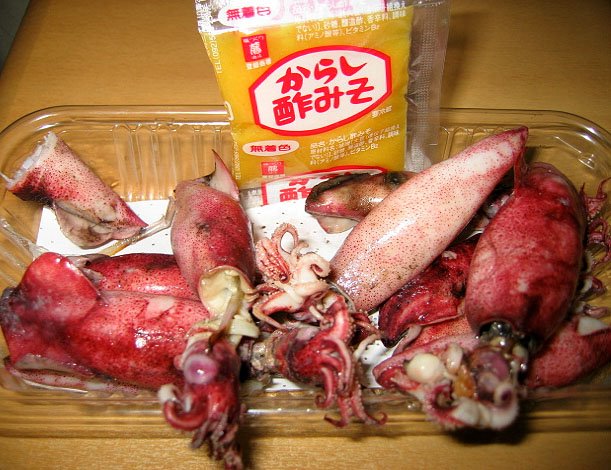 I e-mailed an American friend about crossing new fishy frontiers. She shot back, “That is absolutely DISGUSTING – sounds like you need a care package and quick!!!!!!!”
Now that you mention it, yes. Everything bagels, pizza without corn and mayo toppings, non-Asian ethnic food and anything else that doesn’t contain dried baby sardines, rice or squid eyeballs would be fine, thanks.
Wednesday, August 10, 2005
Dinner with the Fam (Part II)
Whenever I’m feeling a little sabishii in this impersonal city, I seek out my parents for camaraderie and home cooking. My Otosan and Okasan, that is. They own Daruma restaurant. Daruma is a rare inviting place in a land where I constantly play the intruder. Jerry, another gaijin patron, said it best: “This is one of the few places that foreigners aren’t just tolerated, but are welcomed.”
 I approached the glowing red lantern. Something was amiss. Where was Otosan? I always run into him before entering the restaurant. From his doorstep perch he flags down the regulars walking along the alley. They require no beckoning. Like conditioned animals they know where to find food, and habitually have done so for 5, 10, 15, or 20 years. Few females penetrate this good ol’ boys atmosphere. The wood paneled interior and cigarette haze clouding naked bulbs ooze masculinity.
Hicca, another familiar face, has also vanished. Her increasing duties at the radio station have forced her to abandon her part-time post behind the counter. Naaoki (“Now”), her 38 year-old replacement, refills customers’ glasses while sipping his own draft beer. His signature style includes overalls and a Slice trucker cap to keep his dyed golden brown hair from covering his eyes. Now’s casual style fits well with Daruma’s no frills service. I spotted Now ashing into the sink soaking plates. Later he filled sho chu glasses with chunks of ice that had splintered onto the floor.
With Hicca gone, Jerry restored my bilingual lifeline. This native New Yorker is as much of a regular as anyone else on a stool. He feels so at home that he lobs scallion stalks into the garbage behind the counter. “It’s the one good thing I do for my body,” he said of his nightly plate of vegetables. A kindergarten teacher by day, Jerry is a chef at a sports bar he co-owns in Shinjuku 3-chome. He’s the size of an industrial refrigerator at his restaurant, or 10 times that of one of his students. His recently shaved head adds to his unmistakable presence.
The stools flanking me are both occupied, but a man relocates himself so that the two English speakers can chat. Jerry’s arrival enabled me to catch up on family affairs; the language barrier had really kept me out of the loop.
Otosan was in the hospital. Liver cancer. My stomach churned at the news. He’s been battling the disease for some time and undergoes periodic checks, but is slowly losing the pitched battle. “The Old Man,” as Jerry calls Otosan, gave up smoking years ago, but occasionally hits the bottle. I recalled his flush nose and cheeks on prior visits. Although beyond 70, his heart remains full of generosity even though his mind sometimes misses a beat.
Such as the time when I ordered ika malu (grilled squid rings). Otosan removed the white creature from the freezer, only to put it back and select a larger one. Instead of unwrapping the plastic and popping my meal into the oven, he placed it on a stack of empty crates next to the oven. 10 minutes later, with a small gesture, I politely reminded him to turn up the heat on the box.
Daruma’s aura wasn’t the same without him. Miles Davis was silent. Absent were toothless grins, friendly pats on the back, and announcements that I was an English teacher…and looked like Tom Cruise. “The first thing I notice when he’s gone is that the prices go up,” Jerry dryly stated. “The Old Man’s been discounting my meals for 15 years. Probably yours, too.”
That leaves Okasan in charge. “Ma” on occasion has welcomed me with a free sampling of edamame, sashimi, or carrots in fluffy paste. “She’s got a real mean streak in her,” Jerry warned, signaling for another beer. Ma hangs on to her husband’s bygone habits and also mooches off customers. She catches her breath from cooking to inhale a cigarette with a businessman before moving down the line to help herself to a swig of a customer’s beer. She freely fingers a cuttlefish tentacle from my neighbor’s plate. Nobody complains. We’re all family at Daruma, even the white overseas relatives.
More shocking news: the family tree has to be redrawn. Otosan and Okasan have two daughters, but Hicca was not one of them. Jerry’s revelation saved me the embarrassment of expressing concern over Hicca’s ailing father, who I should have realized is far too old to be her father in the first place.
Daughters include Masa, who is on her second husband, and Aya, who works only Fridays. 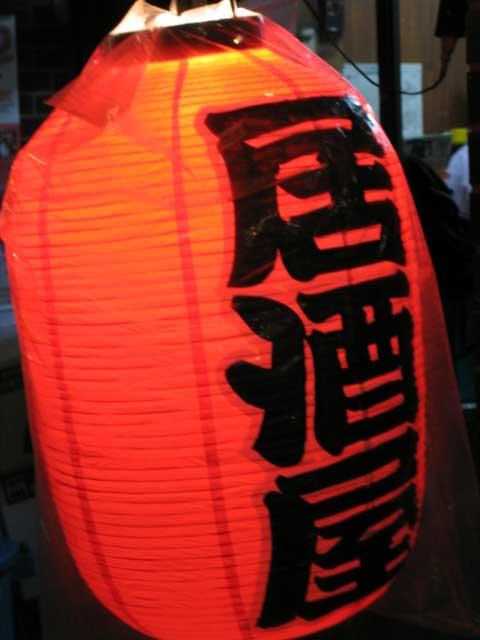 Masa’s makeup is a pleasant feminine touch amid a grimy interior. Aya, however, radiates beauty. She’s a former supermodel. A picture of Arnold Schwarzenegger pecking her on the cheek hangs on the wall. According to Jerry, the parents used to “pimp out” their daughters to lure male customers. Their flirtatiousness was a proven recipe to drive up drink tabs. But those days were a few husbands ago. Aya since “has put on some pounds,” and is a married mother.
I popped bite-size kawa ebi (river shrimp) into my mouth. It was 22:30, and customer traffic had switched to a net outflow. Jerry and I continued to talk. He mentioned how he lost his own Japanese wife a few years ago, but didn’t want to dwell on it. 22 oz. bottles of Sapporo piled up between us, which Jerry corralled to his side to indicate they went on his tab. He was in a generous mood after settling a lawsuit with a cab company. Three years ago, while waiting on a corner, a cab maneuvering close to the curb to pick up a passenger crushed his ankle. The settlement wasn’t as much as he had hoped for, but he risked not getting one Yen if litigating.
We bid farewell to the family as the plastic wall clock struck 23. Ma was on her last cigarette, and ready for a good night’s sleep. “You interested in some debauchery?” Jerry asked, mounting his bicycle. The night was young. “Go down to the end of this block, turn right, and then make your first right. Wait for me there.” “You mean just right over there?” I said pointing to the supermarket straight ahead. “Don’t point! Just meet me there,” he scolded. The darkness of evening was just a Silhouette…[to be continued].
Sunday, May 15, 2005
If It’s Pickled Salad, It Must be Thursday
The bell tones at 12:45 p.m. The lunch cart is already waiting outside the classroom. Some students dismantle rows of desks to form clusters while others slip on white robes and plastic gloves and begin dishing out today’s special. I, too, queue for miso. In the absence of a cafeteria, students feed themselves in the same room where they take every class.
As a guest teacher, I choose my dining companions. Most often it’s a rambunctious 6th grade section because of their propensity to blabber with a mouth full of partially chewed bananas and stab one another with chopsticks.
Subsidized school lunches rock! $2.81 buys a well-balanced meal. For example, Monday’s feast featured bland miso soup, tuna potatoes, bread sandwich with microscopic layer of jelly, mini-milk, and last but not least, cinnamon sticky bun.
Like everything else in Japan, eating is regimented. Lunch isn’t a bowl of cherries; it’s a trial in speed eating. Thirty minutes are devoted to this disruption from learning. But by the time students have served one another (officially noted when a designated child stands and delivers the all clear, or maybe it’s grace), no more than 12 minutes remain. Eating to beat the clock, I shovel rice into my mouth with tweezers – I mean, chopsticks. Urgency is audible as classical music crackles over the PA system.
Finishing in time isn’t the only challenge. Refuse must then be sorted. The Japanese are experts ensuring every scrap has its place. Unfinished morsels get deposited back into their original serving containers (perhaps to be recycled for next week’s discounted lunch). Plates, bowls, and utensils are stacked. Milk cartons must be drained, deflated, and folded as detailed in step-by-step pictographs hanging in each classroom. Even the plastic straw wrapper gets recycled.
The 1:15 p.m. bell signals students to stow trays, realign desks, and wheel the organized cart back into the hall. Breakdown is complete, but digestion is not. Fifth period begins as scheduled.
Sunday, April 24, 2005
Dinner with the Fam
It’s 9 p.m. Friday night. I need fuel before going out for three hours before the subway stops. With my neighborhood sushi joint packed, I tried a family-run place without menus in any language. With plates of adjacent customers picked clean, the “I’ll have what he’s having” lifeline was severed. Then I spotted a familiar sight: a cooler filled with 22 oz. Asahi beers. “Biiru!” I pointed.
An older daughter floated behind the counter, stabbing blocks of ice with a pick and refilling the glasses of “salarymen” with jagged chunks, shochu, and a splash of water. The mother said something in Japanese about rice, so I just nodded. Whatever they cooked up I would consume. This was an anything goes kind of night. Four salty rice balls (triangles, actually) appeared. Chow time, I said to myself, piercing the grains with my chopstick. Laughter from all sides. Nervously I looked up for an explanation of my faux pas. Sure a plate of rice seemed austere for a meal, but I was just playing along, right? I set down my utensils and reached for the safety of the beer glass.
“Would you like something with your rice balls?” the older daughter asked. Lost without a safety net of plastic models to pick from, I simply expressed satisfaction. “Miso!” mom suddenly chimed in. That much I understood, but when she pulled a water bottle filled with pale yellow fluid from the fridge, concern crossed my face.
Waiting for my soup concoction to arrive, dad chirped at me in Japanese. I replied in a few rehearsed phrases: my name is Jeff. I am from New York. I am 25. I am single – sometimes. Ha, ha. Please be careful, the coral is dangerous!
Mother caught her breath from cooking, and had a swig of beer - from a customer's glass. The father cupped his lips around the water bottle used to refill guests’ glasses, and hummed along to Tony Bennett singing in the background. Then his youngest daughter entered and tied on an apron.
“Hello, my name is Hicca,” she said in perfect English. “Like hiccup.” Thank God, I thought to myself, grateful for a translator. To plan future dinners, I asked what days she helped out and their hours of operation. “We open at 4 and close when the last customer goes home.”
With the youngest daughter now at work, mom mingled by bellying up to the regulars at the counter. She inevitably wound up next to me, remarking how I looked like Tom Cruise while stroking my back. This compliment is commonly directed at any tall, dark-haired, young Westerner, as I learned from my resort days in Guam. Any boost in ego quickly vanished when she grabbed my Jewish nose, eliciting laughs.
Poking fun was a house rule. Hicca’s father made a scene about something, which she demurred to decode. I got the picture when dad inserted a soup bowl under his shirt to emphasize the flatness of his youngest.
The man next to me was filled with his fair share of whisky, and upon rising to the restroom, bowled over two stools. Hicca’s father cut him off, but slipped me another Asahi on the house.
This is how family restaurants should be. A loving couple with supportive daughters in a homey setting that hasn’t changed in decades, serving up cuisine that hasn’t changed in centuries, and frequented by loyal locals who have assimilated into extended family.
***
Price for four rice balls, two miso soups, two large Asahis, and a plate of chicken bits: $9.37 (equivalent to a pint of Asahi at Legends sports bar). Highly entertained with local culture, I had no motivation to trade Monzen-nakacho for the neon lights of central Tokyo.


