
Less than an hour from Tokyo, "Little Edo" (小江戸) is a throwback to what bigger Edo might have looked like. A beloved bell tower, the city's symbol, presides over a well-preserved block of distinctive black kurazukuri (fireproof merchant houses). Nearby, dozens of confectionery shops do brisk business from passing sweet tooths. Cherry blossom season is an especially rewarding time to explore Kawagoe´s landscaped temples.
Click here for more pictures of Kawagoe (川越).
Showing posts with label domestic travel. Show all posts
Showing posts with label domestic travel. Show all posts
Wednesday, April 30, 2008
Kawagoe

Thursday, January 31, 2008
Snow Gleaming

A year ago I called in sick to work while boarding a plane to Hokkaido, Japan's northernmost island. I was bound for frosty Sapporo, the site of an international snow sculpture festival and the hope of the eponymous beer. During my week up north, I detoured to the fishing port of Otaru, which was holding its own wintry festival that I recently wrote up below.
Sunday, October 21, 2007
Color Coordinated
I've previously blogged about autumn's beauty in Japan. In 2005, I delighted in Nikko's seasonal transformation. A year later I strolled through Kyoto and Uji for an even more impressive pageantry. This year I put it all together (thanks to some armchair research) and came up with the top 10 spots for foliage viewing across Japan. The result is a subdued but sophisticated spread in Japan's elite cultural magazine, J Select.


Tuesday, August 21, 2007
Ashikaga
Below is a published recap of a day trip I took with Jen back in January.
To view the Ashikaga photo set, click here. 
Monday, January 29, 2007
Traditional Takayama
 I never got around to blogging about my trip to Takayama (高山) last summer, but here's my recently published article about the city.
Additional photos here.
Saturday, December 23, 2006
A Fall Pageant
 I’d like to finish the year with some images from Kyoto, Japan’s ancient capital and modern day tourist magnet. This leafy city rivals Tokyo as Japan’s tourist hub, and easily surpasses it in beauty and preserved heritage. Like Kanazawa, Kyoto with its geishas is the Japan that foreigners envision, but in reality it exists only in isolated pockets. Nonetheless, the many UNESCO sites here attest to Kyoto’s being a unique window into this country’s feudal past.
For a brief period at the end of November, nature turns the tables and pushes Kyoto’s architectural gems to background scenery. Like leafpeeping in New England, momijigari is popular in Japan, but New England doesn’t have five-storied pagodas and expansive temple grounds dating back centuries.
Accordingly, the two best spots to view the foliage combine nature with national treasures. Last year I blogged about Nikko. This year I took a bullet train to my date with the belle of the autumnal ball.
There wasn’t a hotel room left in the city. I joined the throngs lining up to enter temples and their outdoor rock gardens (above photo). Mobbed doesn’t even begin to describe the pedestrian traffic, but gazing up at the leaves made the dark coats with clicking Canons fade from consciousness.  You have to be there to appreciate it; my Canon couldn’t capture the delicate intensity of leaves that catch fire when sunlight strikes. The colors, bold and complex, were juxtaposed against a spiritual setting, such as a blue sky, golden pavilion (above), or wooden-framed temple. I was mesmerized. Absorbing the warmth radiating from these colorful trees helped fight the chill in the November air.
Despite being peak season, most of the trees remained green. However, certain species like the Japanese maple and gingko turned the spotlight on themselves and vied for my attention. In Japan’s premier architectural setting, nature, too, was at its finest. Foliage in Kyoto combines the best of nature’s and man’s accomplishments, so sit back and enjoy the pictures.
Kyoto in late September 2006.
Kyoto in late November 2006.
Before heading back to Tokyo, I stopped in nearby Uji for a look at Phoenix Hall (below), which is featured on the back of the 10 yen coin. Uji is also famous for tea. At a teahouse near Phoenix Hall I participated in a private ceremony, which got off to an inauspicious start when I slammed my forehead into the doorframe just after removing my shoes. Participate isn’t really the right word, as the only thing I did was get bowed to. Two kimono-clad ladies prepared a cup of rich green tea before my very eyes, which took a little more precision than adding hot water to a mix. The ceremony was short but highly formal and complex.
Uji in late November 2006.
Tuesday, December 19, 2006
Buddha in Black
 I thought I had seen them all, but alas, another remained. I’ve already described the spiritual satisfaction I get from visiting enormous Buddha statues, which I now realize number four in Japan. Two are famous and two are not. Buddhas at Todai-ji in Nara (60 feet) and Kotoku-in in Kamakura (44 feet) are dwarfed in size but not reputation by Nokogiri-yama’s 102-foot giant carved into the mountainside.
The missing member of Japan’s Buddha family was only one express stop on the Tobu-Tojo line from Ikebukuro. While the closest to the capital, Tokyo Daibutsu (東京大仏, or The Great Buddha of Tokyo) is also the smallest (43 feet).
Sleepy side streets with well-appointed houses near Jouren-ji Temple felt far from the vertical bustle that characterizes the commercial hubs of Tokyo. Behind the temple, a grove of bamboo and a thick carpet of crunchy leaves were two pleasures of nature I’ve never encountered within these city limits.
Except for a leaf blower, the temple precincts were quiet. Yellow ginkgo leaves had finished for the season, but aggressive carp looked as active as ever, opening their gullets wide to fight over air bubbles or fish pellets that my Hawaiian friend Lahela tossed into the pond.
The presence of the main attraction was felt all over the grounds. Tokyo Daibutsu’s silky black bronze body contrasted to the weathered green of Kamakura’s bronze Buddha cast in 1252. Tokyo Daibutsu, however, is about as ancient as I am, and was honored as a New Tokyo Landmark after its completion in 1977.  Yet this is a landmark few know about, and on a Tuesday afternoon in December the seven stone gods of fortune outnumbered human supplicants. I found the smaller Jizo statues in red bibs to be more photogenic. For ¥500 these guardians of deceased and unborn children, pregnant women, and travelers could be purchased and placed on larger Jizo statues to fulfill wishes.
The outing was a chance to test drive my snappy new camera equipped with a powerful zoom lens and advanced auto focus unknown to my old point and shoot. I was able to capture writhing carp, smoking incense, and Jizo statues with as much or as little detail as I pleased. Later on, Lahela caught me performing magic tricks in the leaf pile out back.
Click here to see the results.
Tuesday, November 28, 2006
White Heron
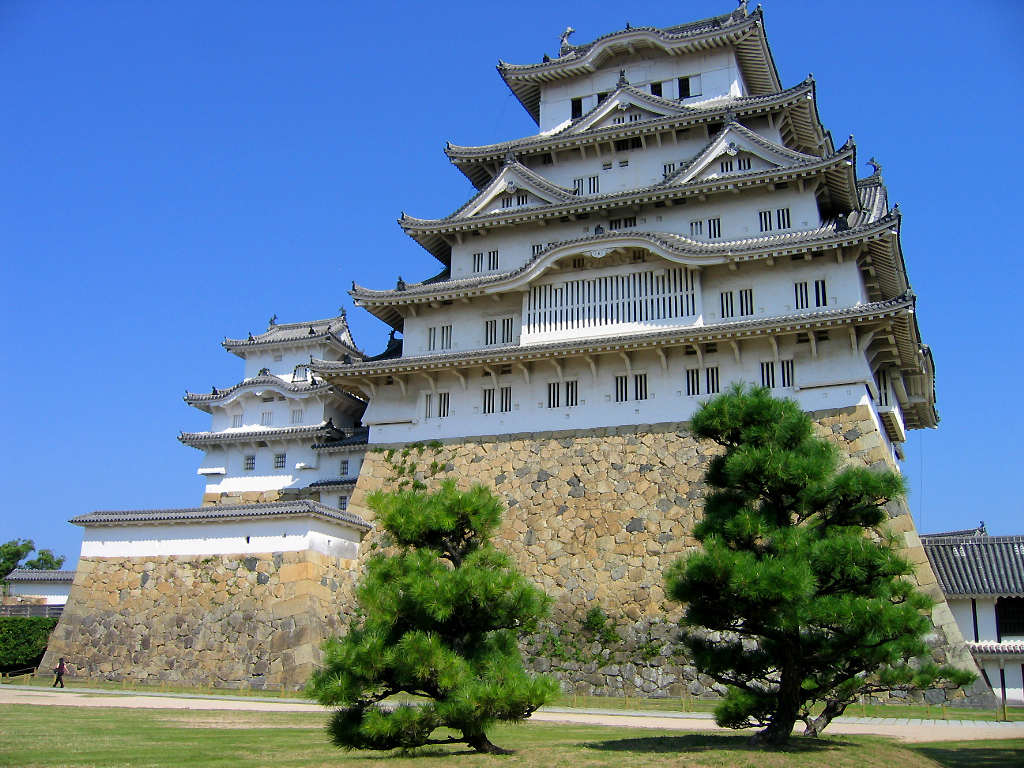 About 400 years old and 400 miles west of Tokyo, Himeji castle stands elegantly, white, and layered like a wedding cake (or a flying heron, take your pick). Being Japan’s best-preserved castle and a UNESCO World Heritage Site make it the belle of fortresses once protecting this feuding island. Unlike the recently reconstructed castle in Kanazawa (or Nagoya, Osaka, etc. take your pick), Himeji owes its longevity to being a virgin to fire and battle. Himeji somehow dodged WWII bombs that rained down on the rest of the town, and today exhibits its original and impressive fortifications surrounding the photogenic five-story donjon.
Himeji, however well preserved, is a one-castle town, so after a self-guided tour and a bento lunchbox on the sidewalk, it was time to fly.
Monday, October 23, 2006
Spiritual Natadera
 Riding a newfound Buddhist kick, I was lured to the rocky caves of Natadera (那谷寺) after seeing a dreamily landscaped picture while in the Kanazawa tourist office. For a day trip, I headed west to Kaga Onsen station, where I disembarked, looked up, and saw a white elephant towering above the trees. Upon closer inspection, it was neither white nor an elephant, but rather golden and a mutant cross of the Virgin Mary and Buddha. At the risk of sounding blasphemous (all sanctity was lost after The Grope), what the hell is this thing?
No such iconic tawdriness existed on the forested grounds of Natadera, a temple of the Shingoh Sect of Buddhism. Founded by monk Taicho in 717 A.D., this sanctuary continues to harmonize humans and nature through religion. It was refreshing to have spirituality and the environment overshadow man in Japan, a capitalistic country paved over in asphalt and coated in concrete. 
For a closer look at some greenery, view my pictures here. Click on images to read descriptions.
Wednesday, October 04, 2006
Kanazawa: Marsh of Gold
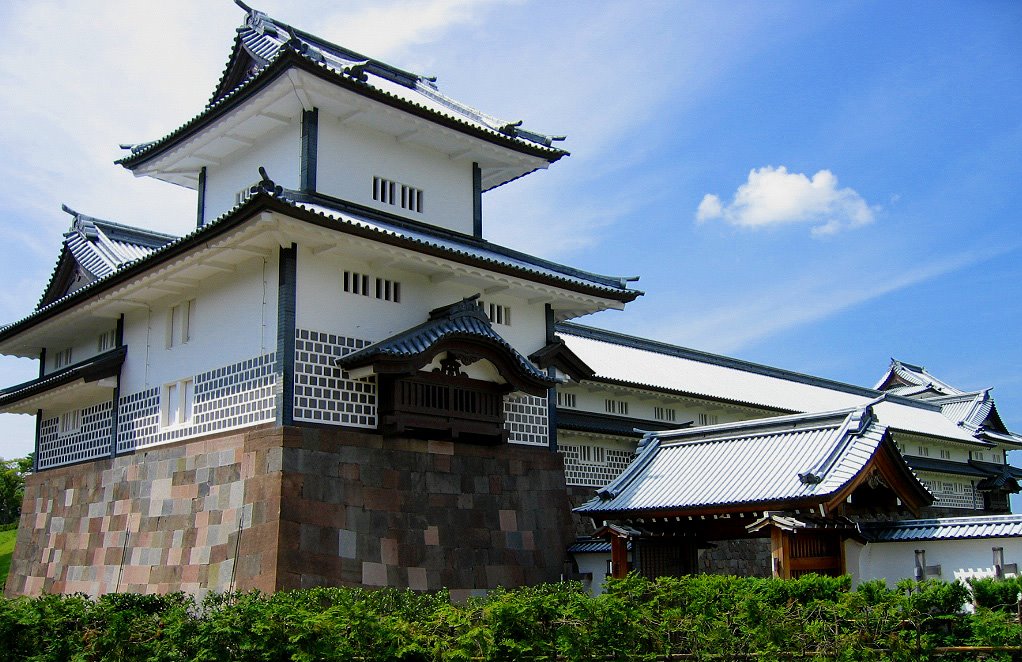 On paper, Kanazawa (金沢) had all of the traditional trappings that foreigners associate with Japan: geisha districts, samurai villas, meticulous gardens, a castle, and a ninja temple.
After a seven-hour coach ride from Tokyo, the capital of Ishikawa Prefecture greeted me as it does most travelers: with a downpour. Rain-streaked windows blurred my first views of a city where Hideki Matsui played high school ball. Kanazawa averages 178 days of precipitation a year, so it’s fitting that the train and bus transit hub is designed like an open umbrella.
Once the weather cleared, I set out along doublewide sidewalks with far fewer pedestrians than in Tokyo, whose steamy asphalt I had escaped for four relaxing days. For an ambitious walker like myself, Kanazawa’s well-labeled sites (in English!) are navigable by foot. And unlike in Tokyo, shady benches are on hand to spell your feet.
Parks, gardens, and sculptures give the city a pleasantly landscaped feel that’s lacking in Tokyo. Kenrokuen Garden (兼六園) is known to be Japan’s finest, and if the crowds are any indication, it’s true. The “garden with six sublimities” opened to the public in 1874; in 1922, it was designated as a National Site of Scenic Beauty. In 1985, it was designated as a National Site of Special Scenic Beauty. I’m not sure what the difference is, or why that took 63 years to designate.
What a recently recreated castle lacked in historic charm, the surrounding park made up for in beauty with rolling lawns and flowerbeds that contrasted to cloud-white castle walls seemingly floating in the blue sky.
My favorite part of Kanazawa was exploring temples clustered at the base of Mt. Utatsu. After walking through the Higashi Chaya Geisha District – the best of the three in town – I wandered along winding lanes of a residential neighborhood where I had the streets and temples all to myself. It was tempting to get lost, but even cemeteries hidden in the woods had directional signs in English.
Of all of Japan’s temples and shrines, Myoryuji was by far the most memorable. Erroneously dubbed “ninja-dera” (ninja temple), no agents of assassination and espionage ever inhabited these grounds, yet the crafty layout would sure make them proud. The building appears to be two stories from the outside, but like most things at Myoryuji, appearances are deceiving.
The inside revealed four stories (or seven levels, counting mezzanines) with no fewer than 29 staircases. Plenty of contraptions baffled intruders and probably the Kaga clan who used the building in Edo times. Trap stairs, a fake offertory box in the floor, and a kitchen well rumored to link to a tunnel leading to the castle kept past enemies and present tourists ever guessing.
Far more confusing, however, was a Noh performance later that evening. Kanazawa specializes in one of the five schools of this traditional drama popular during the 17th-19th centuries. Reputedly one of the most boring performing arts ever known to man (at least those from Western countries), the drama made me wish I had brought toothpicks to prop my eyelids open.
The lone actor’s subtle gestures and lyricism went right over my sleeping head. In the first of two acts, a man in baggy, old school attire paced around the stage while taking his pointy straw hat on and off. Occasionally he let out haunting laughs. Action climaxed when he threw the hat on the stage and stomped off stage right. Rousing applause.
Even Japanese kids held their heads up better than the only foreigner in attendance. Nevertheless, I found it a relaxing way to spend $10 and an hour and a half. It was sort of like going to the opera, where I also can’t understand anything, but the rhythmic tones therapeutically clear my mind. 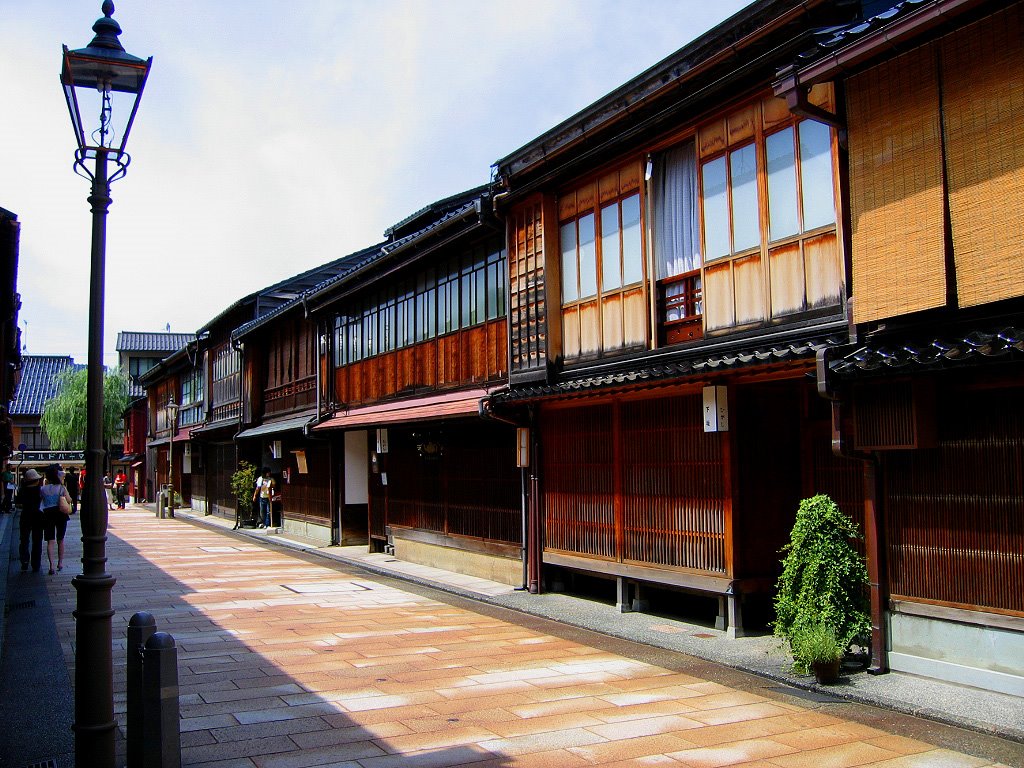 To that end, a Kanazawa retreat comes highly recommended to anyone in Japan needing a change of scenery or recharge of batteries. Check out the rest of my pictures here.
Thursday, September 07, 2006
Saw Mountain

There’s something about seeing Buddha that always puts me in a good mood. Maybe it’s his restful pose, assuring gesture, or level mind free from desire. Whatever it is, he makes for a good role model if there ever was one.
Although Japan’s population is 84 percent Shinto/Buddhist, it’s a secular society. So unlike other Asian nations, Buddhas are few and far between the massive department and electronic store temples enshrining Japan’s dominant consumer culture. Of Japan’s two famous Buddhas, I already made a pilgrimage to Kotoku-in in Kamakura. Todai-ji’s Buddha in the ancient capital of Nara is even larger (60 feet). I will pay respects later this month when my parents visit.
Rising more than 100 feet is Japan’s largest daibutsu, yet also its most obscure (unreferenced in Let’s Go). Nihon-ji temple dates from 725 A.D., but its Buddha arrived 1,058 years later. This stone beheamouth sits about halfway up Nokogiri-yama, or “Saw Mountain,” so called because it’s shaped like the teeth of a saw thanks to bygone quarries chipping chunks out of the mountain’s face.
The mountain is only 329 meters (1079 feet) high. Getting up took a few minutes in a cable car. Getting there took three hours. To halve my transportation costs, I opted for local trains that required four transfers, one taking an unprecedented 45 minutes (I’ve never had to wait that long for a train here). My destination was worth the wait. 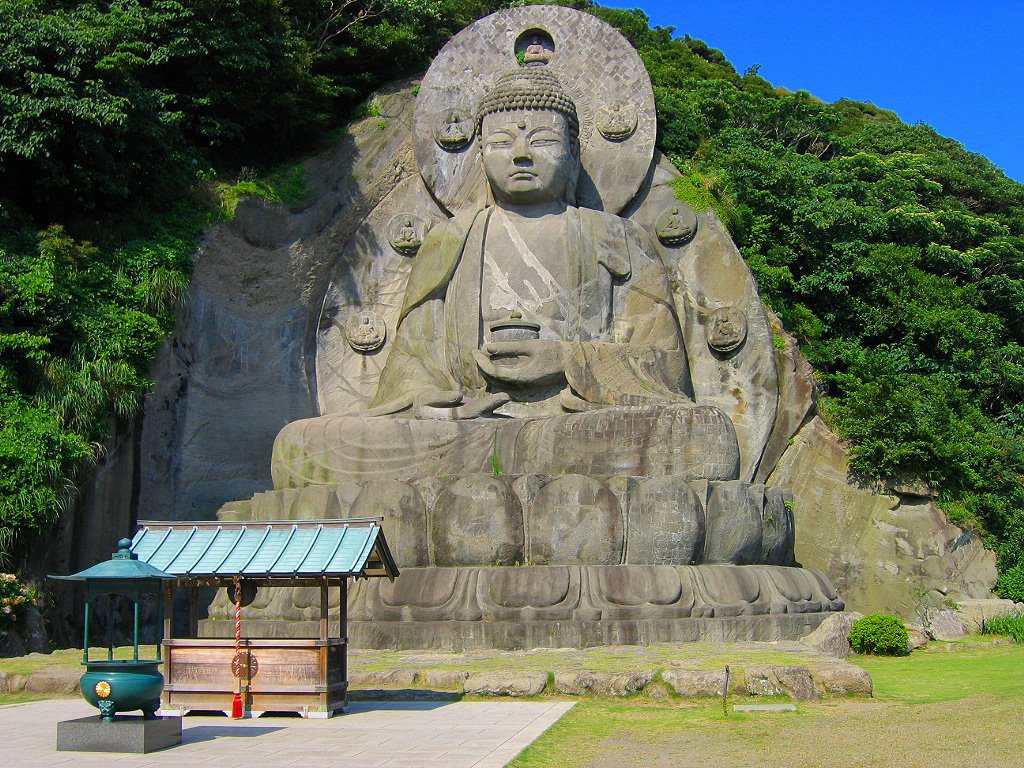 Cool mountain air whisked away sweat as I soaked up panoramic views of Tokyo Bay. Hawks soared overhead in cloudless skies. Sunlight percolating through the leaves lit shady footpaths. I walked alone along mountainside paths, but 1,500 stone arhat figurines (novice buddhas) – each said to have a different expression – kept me company. They were wedged into rocky ledges and perched on trees. Moss, lichen, and faith held them in place. If I had to be a statue (and hopefully not one of the headless variety), this would be where I’d want to sit gathering moss.
  Later I found another Buddha-like icon carved into the mountain. A 30-foot high image of Kannon, the Buddhist Goddess of Mercy, towered from within an alcove. Dating from the 1960s, however, it’s a recent addition to the mountain’s attractions.
Under the watchful gazes of Buddha and Kannon, I paused for water and to reflect on life. Around 4:30 I climbed down the mountain and happened upon a beach. I stopped first at a 7-11 for dinner: soba noodles, a riceball, and a “freeze lemon -196C” chu-hai (canned cocktail). You know, just the essentials. I sat and sipped on the beach as daylight departed. It wasn’t Thailand, but it wasn’t Tokyo either, and that’s all that mattered.
Click here for more scenes from Nokogiri-yama.
Thursday, August 24, 2006
Mt. Mitake
 Continued from last post.
The next morning I awoke at 6 a.m. with a dry mouth and pounding headache. I had to get out of here. Anywhere but here. Fresh air would clear my mind, and hopefully erase last night’s episode.
An aging orange Chuo line train would lead me out of town. Actually, I technically wasn’t leaving metropolitan Tokyo, but was heading for a corner remote enough to wipe the bars off my cell phone.
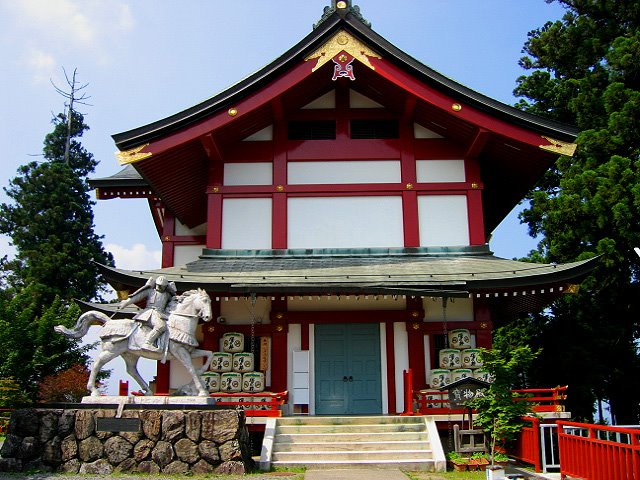
I rode the train for two hours to the edge of my Japan Rail map. At Mitake Station I set out on a two-mile walk, some of it up a 15% grade. Nobody clued me into the bus service until it passed me. A six-minute cable car ride hoisted me up to 930 meters. After a 15-minute walk through a mountaintop village, I climbed 300 stairs to reach my destination: Musashi Mitake Shrine. A red X had replaced blue bars on my phone. I felt better already.
Here at this Edo-era shrine to the God of farming, I sat down and scribbled two pages of notes that evolved into the Dating Disaster blog. I capped the pen, and chugged a water. The cool mountain air buoyed my heavy heart. I had the day to myself, and was unreachable to the outside world.  Mount Mitake offered peace, quiet, and solitude. Although thanks to elementary school day-trippers, it was hard to feel alone. Packs of them in color-coded caps clambered up and down the stairs, pausing to raise thermoses of green tea to their lips.
I initiated konnichiwa greetings, and got high-pitched group responses. I’ll always remember the pudgy boy lagging behind. Sweat rolled off his face as he puttered down the stairs.
"Konnichiwa!” I said, breaking his concentration.
He looked up from the handrail and stared. “Who are you?” he sneered in Japanese. Kids are priceless.
The only good thing about the humidity was an excuse to spoon up kakigori, my favorite summertime treat. At a shop on the mountain I asked for green tea flavored shaved ice, which wasn’t on the menu. The only flavor I could make out was strawberry, so I settled for that. I relaxed at table with a panoramic view of the green valley below. I had just been hiking in the woods, where I sang to a captive audience of trees and rocks.
The friendly proprieter urged me to return again, and on my way out handed me seasonal brochures with the moutain ablaze in autum orange and spring’s pink cherry blossoms. So long as I don’t have any more dating disasters, I’ll relish this as my only visit.
For more scenes from Mitake-san, click here.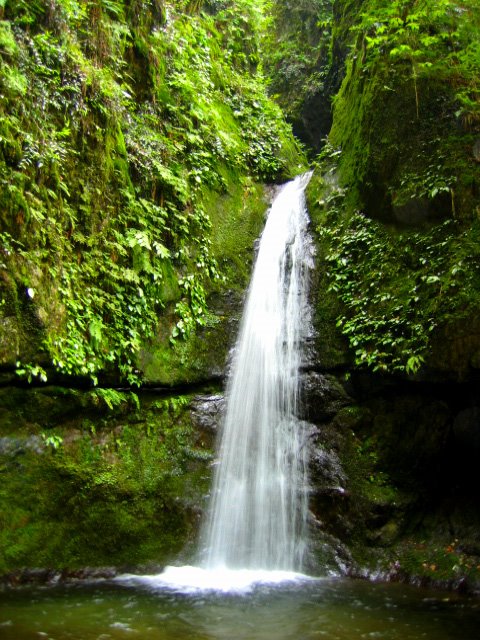
Monday, February 06, 2006
Lucky Charms
 A late model BMW 330 series honked at me. My ride was on time. “Where we goin’?” Hiro rolled down the window and shouted at me outside of the Nakagawa sports center where we had met one Friday night playing hoops.
I welcomed the change of plans after Mike from Flamingo agency called to say that I hadn’t passed photo selection for the soccer movie. I brushed off my bruised ego, and instead pretended to look forward to spending Saturday at the radish festival in Asakusa. Thankfully that wouldn’t be necessary.
“Takasu-Takasa-Takasomething,” I said fumbling for my guidebook. “Takasaki!”
“Where the hell is that?”
“Gunma prefecture.” (Think New York’s Dutchess County.)
“Gunma!” Hiro boomed, as if I had suggested driving to Hokkaido, Japan’s northern island.
If we left now, I explained that we’d arrive just in time for the end of a festival. The poor timing or 115 km (70 miles) trip weren’t problems. Hiro was up for driving anywhere. But if we were gonna go to Gunma, he needed maps.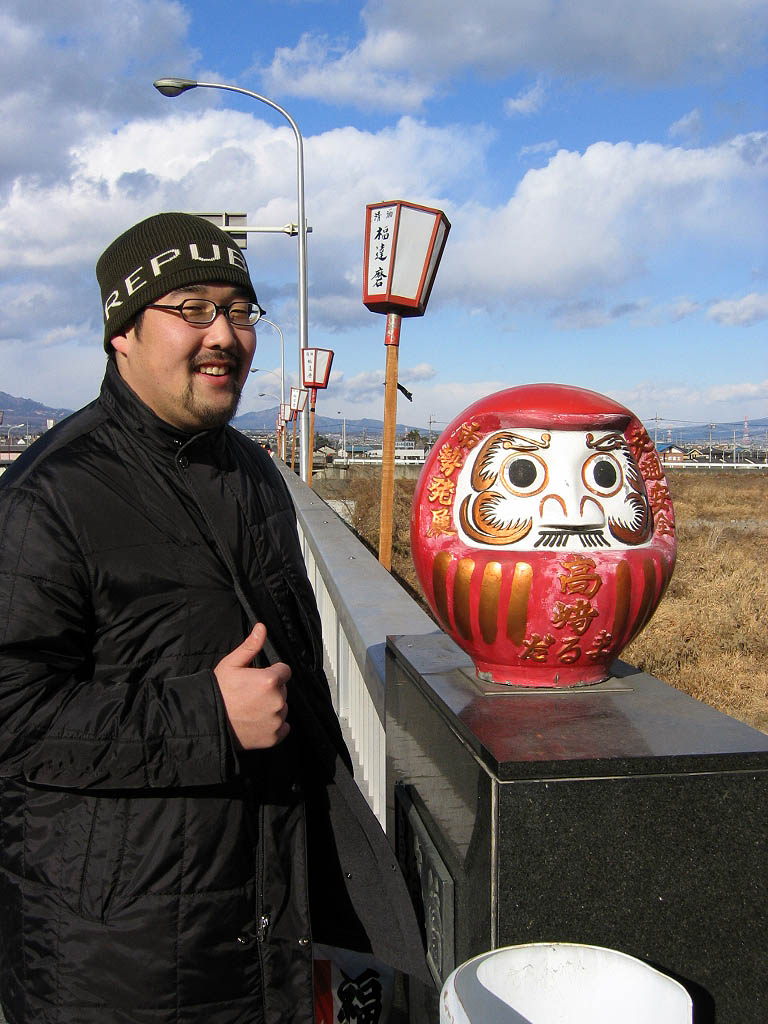 “This is my daddy’s car. He doesn’t know how to use GPS so there isn’t one here,” Hiro said. I smiled every time the 29-year-old referred to his “daddy.” Educated in Colorado, Hiro quit his import-export auto parts job the day before, and was now helping out at his daddy’s ramen shop two stations away from me. Sitting comfortably in the BMW’s leather interior, I assumed business was boiling over.
Highway tolls (emphasis on high) made the trip about as expensive as a slow train, but German automotive engineering beats the wheels off Japan Rail. The air was crisp; we were in the countryside. An elementary school cashed in by transforming its dirt playground into a parking lot where streams of festival-goers were returning to their cars laden with armfuls of daruma dolls.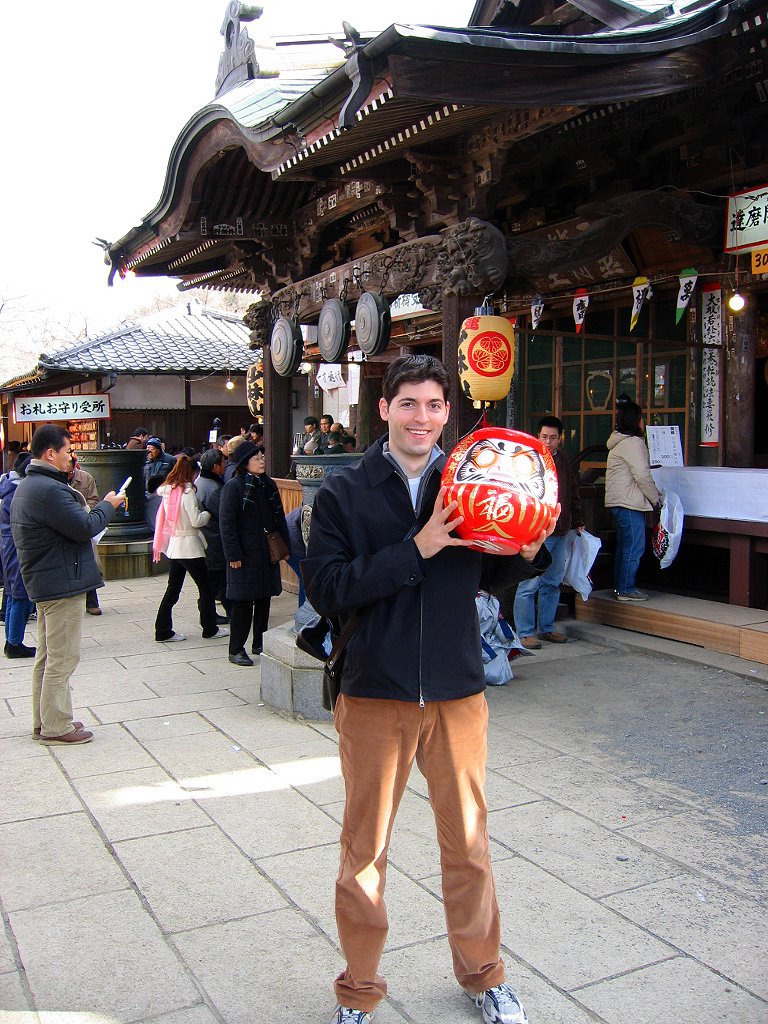 Takasaki is the birthplace of these good luck charms that represent a famous Zen monk. Legend has it that after meditating in a cave for nine years, he lost use of all limbs. This city of 240,000 manufactures 80% of Japan’s limbless, mustached dolls with vacant white eyes. They are purchased in the beginning of the year, and one pupil is painted when a wish is made. The other is added when the wish comes true. At the end of the year, the doll is returned to its shrine of origin and ceremonially burned.
Hiro was huffing at the top of the 100 stairs leading to Shorinzan Temple. The daruma doll festival had lasted all night.  We arrived as vendors were packing up, but just in time to snatch up bargains on merchandise and the last batch of tako yaki dripping in barbecue sauce. There’s nothing like fried batter balls of octopus bits to send my stomach into gastronomic bliss.
The round dolls piled on top of one another reminded me of pumpkins at the country market. Like pumpkins, daruma came in assorted sizes. And when in Takasaki…well, I wanted the biggest one my thin wallet could support.  Hiro helped negotiate, and I walked away holding one with both hands. I named it Takaruma, and bought him some smaller friends.
“The girls in the countryside have better fashion than girls in Tokyo,” Hiro said as we walked down the mountain and passed two sets of short skirts and long legs shivering in the dead of winter. “But country girls can be shy.” Although married, he sometimes calls after the uniformed high school girls.
We decided to explore downtown. Leaving Starbucks, a rainbow-colored sign in English caught my attention. “We Go used clothing 7F.” I was feeling lucky already having purchased charms in bulk. “Can we go?” I asked, persuading Hiro to scale seven flights of escalators to take a closer look.
I was in luck. The store was having its January 50% off sale. Worker jackets stitched with random nametags hung on a rack outside the entrance. Parting the hangers, I saw myself. “Hey Jeff, can you fix my flat?” Hiro joked. I shared first names with an employee of Sterling trucks (or plumbing). It fit well, and my green tea frappuccino cost nearly as much. The sales clerks’ eyes widened at the novelty of the match.
The music inside was thumping, and I could tell that Hiro wanted to get out of Gunma and back to the city. I re-racked a burgundy velvet blazer, and after a fruitless detour to HMV in the basement, we bid Gunma goodbye. Takasaki’s lights twinkled in the sunset.
View the Daruma slideshow here.
* * *
The only flaw with the jacket was its wrinkled fabric. Hiro suggested pressing it at the cleaners. The label confirmed that dry cleaning was an option.
But after wishing me a happy New Year, the fatherly owner of Fashion Cleaners said he couldn’t help me. So, I walked down the block for a second opinion. A voice welcomed me from the depths of racks of clothing wrapped in plastic, but trailed off upon seeing a foreigner.
I apologized in Japanese for not speaking Japanese, and used gestures to indicate I wanted the wrinkles removed. This prompted the woman to talk up a storm. I deduced that she couldn’t help me either, and that it had to do with the polyester and cotton shell.
I humbly admitted I didn’t understand one word of what felt like a three-minute explanation. She asked me where I was from and why didn’t I understand Japanese (this I did understand).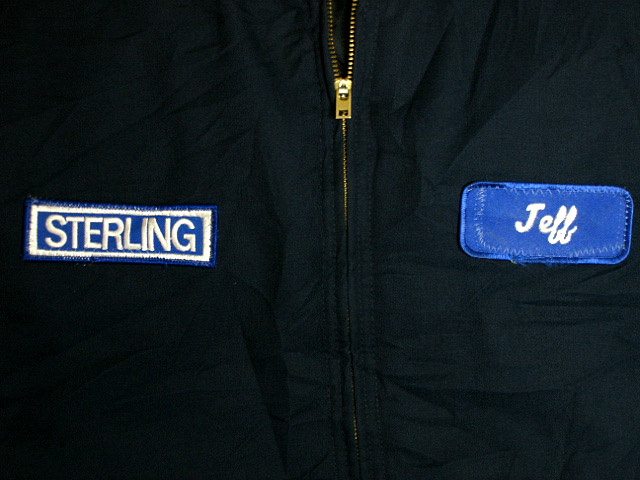 “It’s hard,” I conceded, continuing to stretch out the fabric to make the creases disappear. I wanted them out. This sparked more babbling. It must be the ESL teacher in me, but when I know that a listener doesn’t understand much English, I talk as slowly and simply as possible.
This woman had no such sympathy. I watched her mouth like a spinning slot machine, waiting to match up three recognizable words in a row and cash out. The best I could determine was that the material couldn’t be ironed, and that the jacket looked cool the way it was.
Wrinkled or not, this ¥750 ($6.50) jacket is actually warmer than the spring shell I’ve been skating by on to shield against winter. After I make a few house calls around the neighborhood, I’ll earn enough to upgrade to proper gear. Now if you’ll excuse me, I think I hear the muffler or toilet tank running.
Monday, December 26, 2005
Jam-Packed Road Trip
 Japanese mass transit is predictable to the minute, and its workers don’t have pension issues (right, New York?). However, cattle cars are a predictably boring and hectic means of movement. I was eager to trade darkened tunnels with unpleasant odors for the freedom of an automobile with fresh air on the open road.
Shuichi, the English student of my American friend Michelle, would chauffeur with his own wheels. Would our getaway vehicle be one of the 10 I cited as having head-scratching names? The side door automatically rolled opened on the white 2003 Honda Stepwgn, which might hve mde my tp 20.
Michelle packed typical Japanese road trip fare: squid jerky, octopus bits, and sweet potato soft chew sticks. I had the foresight to bring two “international-style” CD mixes of top 40 hits. Otherwise, Michelle and I were poised to commit double suicide in the back seat as O-zone’s hit single “Ma Ya Hi” was stuck on repeat during the 45 minutes were circled around trying to find the Shuto expressway out of Tokyo.
The confusion was in spite of a GPS system onboard, an indispensable gadget for anyone daring to drive to an address in this city. While such systems in American cars display the nearest Six Flags or Burger King, Japanese GPS pinpoints soba noodle shops and ubiquitous convenience stores.
I quickly grew nostalgic for being pressed up against dark-suited strangers. Monday was a holiday, so you’d think that by Sunday morning people would have already headed for the hills. Not the case in a country where 7pm is early to leave work, even on a Saturday. I learned a new word on this trip: jutai. It means traffic, of which we faced 24 kilometers (15 miles) worth.
Not even purple Etc. toll lanes (think E-ZPass) could speed up the trip. Two mixes proved insufficient, and O-zone came back on with a vengeance. I love Romanian dancepop just as much as the next guy, but it’s best in small doses. Really, really, really small doses.
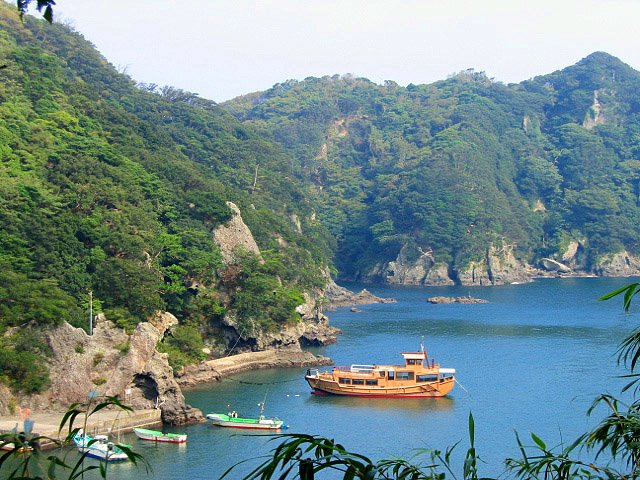
Traffic snarled again at the gateway to the Izu Peninsula, a popular getaway for its onsen, or thermal hot springs. Route 135’s one-lane roads hugging the coast were illuminated with red brake lights.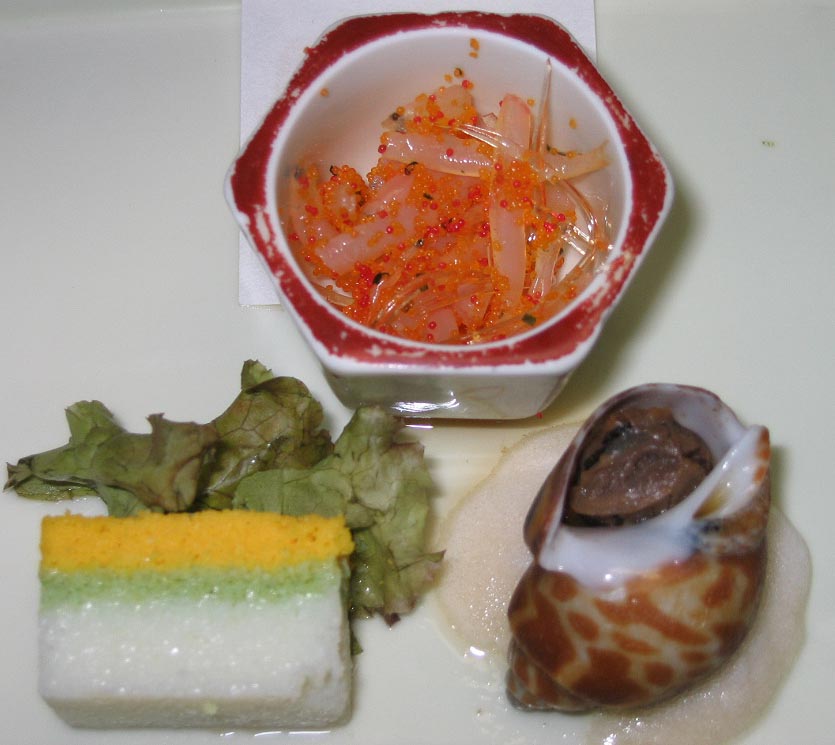 After a sumptuous feast (click right for a yummy close-up) and relaxing night on futons in a traditional ryokan inn and scenic sightseeing the next day, I anticipated a long haul back to Tokyo Monday night.
Night fell on the Shuto expressway, but all was not dark. Brake lights shined 40 kilometers (25 miles) towards Tokyo.
Thursday, November 17, 2005
Nikko IS Nippon
 Like Kamakura and Kyoto, Nikko is a foreigner’s idealized conception of Japan. Ornate temples, traditional shrines, sculptural trees, and moss-covered statues make it a storybook setting of a bygone era – the early 17th century to be exact. The Nikko-San’nai area is one of Japan’s 12 UNESCO World Heritage Sites, and in autumn Nikko’s structural beauty is matched only by the vivid landscape.
A scheduling error allowed me to ditch a day of policing Kanokita’s underachievers and instead tour Nikko’s tranquil temples in peak kouyo (literally, “leaves turning red”) season. Nikko was in full bloom in November, a month after the Lake Chuzenji trip.
An older Japanese man asked to sit beside me on the early morning Nikko-bound train that first stopped in Tochigi, his home. Eager to speak English, he shared a throat lozenge and stories from visiting New York five years ago. I asked what he was doing in Tokyo overnight. Apparently, his pension didn’t give him enough money to “play.” I raised my eyebrows when he told me that he drove a taxi in Tokyo “twice a day in one week.”
To come across a driver who speaks English is like finding a seat on the Yamanote Line. Not that I’ve ever tried asking around, as the meter starts at more than my bento box dinner costs – ¥660 ($5.60). The size and jumbled layout of metropolitan Tokyo has got to make it the world’s most challenging taxi driver job.
Yet, I broke free of this congested city for another refreshing outing in the countryside. The air was crisp, but the sun warmed my hands. The sky was blue. The leaves were red, yellow, orange, and green. Sunshine illuminated fall in its most colorful moment while I wandered around some of Japan’s most acclaimed attractions.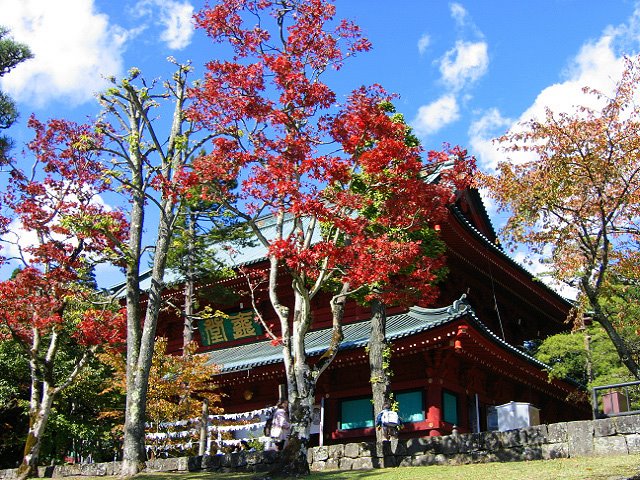 Rinno-ji. My first stop included Eastern Japan’s largest wooden structure, Three Buddha Hall, which houses – you got it – three large golden statues inside.
 Five-Storied Pagoda. This is another postcard image of Nikko. I also saw a great marketing opportunity for Vodafone to increase its spotty coverage by converting the spire into a cell tower.
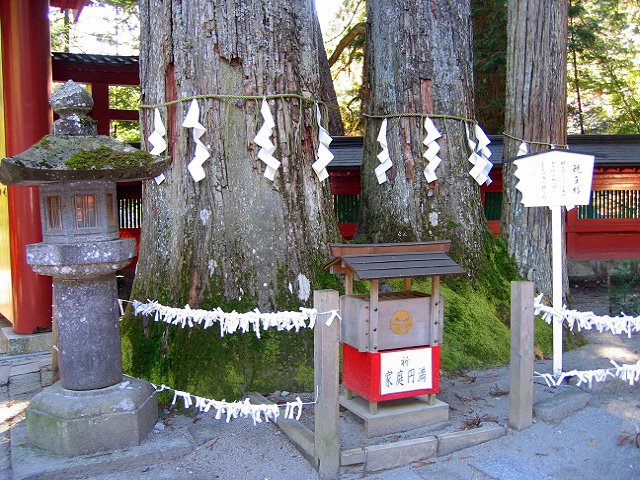 Futarasan Shrine. Nikko’s oldest structure (rebuilt in 1619) is dedicated to the area’s three holy mountains, including Nantai-san. The forest backdrop was especially peaceful.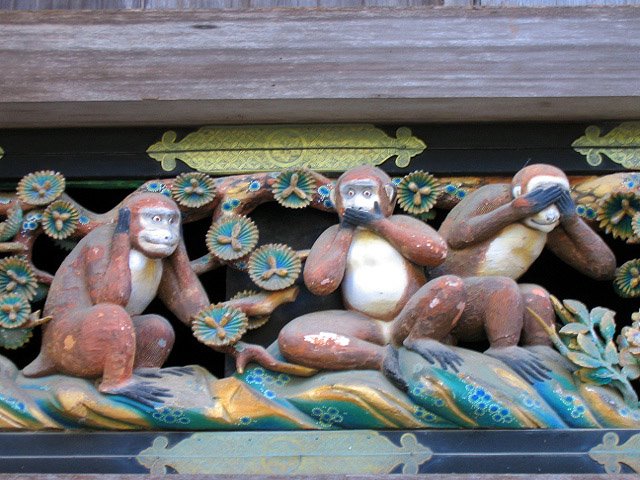
Tosho-Gu. With 55 buildings, this complex is the largest and home to perhaps Nikko’s most famous feature – woodcarvings of monkeys above the Sacred Stables. The three monkeys that depict the “hear no evil, see no evil, speak no evil” principle of Tendai Buddhism are better known than the prime minister. Let’s just say that the hype is just that; I prefer their San Francisco counterparts.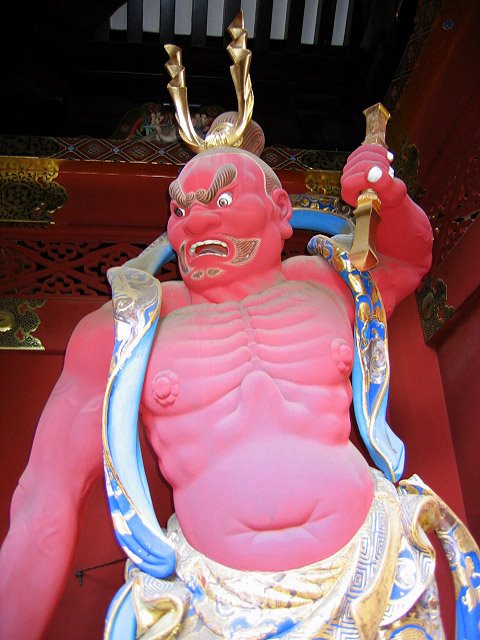 Taiyuin-Byo. Tomb of the third Tokugawa Shogun, Tokugawa Iemitsu, is a damn good place to rest in peace. The mausoleum is a grandiose yet impeccably designed complex on the forested edge of Nikko. The afternoon sunlight percolated through towering cedars hiding this jewel. When my number is up, someone please dig a hole for me here.
 Shin-Kyo. This vermillion icon, the Sacred Bridge of Nikko, is in reality a puny disappointment. Rather than pay to cross its 100-meter expanse, I opted to photograph it from the shoulder of the four-lane highway running beside it.
I quickly moved on to Kanman Ga Fuchi. This is an easy hiking trail through a Stone Park lined with weathered statues of Jizo, the guardian of deceased and unborn children, pregnant women, and travelers. The adjacent river completed the timeless setting.
Tourism posters proclaim “Nikko IS Nippon [Japan].” Nikko wo minakereba “kekkoh” to iu na is a famous expression that translates to “Don’t say ‘magnificent’ until you’ve seen Nikko.” Another dimension to this Japanese pun is “See Nikko and say ‘enough.’” I say, Juu-ichi gatsu no Nikko wa gen so tekki desu. Nikko in November is magical.
Blogger’s Note: I’m leaving all things Japan behind for one week to celebrate Thanksgiving in New York. Sayonara bento box, it’s turkey time! Expect the next entry to appear after 11/28.
Tuesday, November 15, 2005
Lake in the Mountains: Chuzenjiko
 Nostalgic of New Hampshire autumns, I ventured two hours north of Tokyo to the temple-studded town of Nikko. Bestowed with UNESCO World Heritage status in 1999, Nikko is also a gateway to a large National Park.
Nikko’s leaves were still green in mid-October, so my Japanese friend Makiko and I pushed another hour west into the mountainous Lake Chuzenji region, about 1270 meters (4167 ft.) above sea level. The coach bus navigated Irohazaka winding road and its 30 hairpin curves. Trees ringing the lake, however, were only just beginning to bare their fall coats.
Nearby roared Kegon no taki, considered one of the three most beautiful waterfalls in Japan. Water cascaded 97 meters (318 ft.) into the mist below. Instead of taking the traditional leap like lovers with no prospect of marriage, we hopped aboard another bus to transport us 15 miles deeper and higher up into the woods.
Our pursuit of peak foliage ended at Kotoku Onsen. We followed a trail lined with birch trees. The air was redolent of wet bark. I inhaled the scents of fall. Finally, I had found nature in Japan, and escaped the endless urban landscape of concrete apartment buildings that matches October’s overcast skies. The dirt path led to an elevated track through the woods. The trees thinned to reveal a field walled in by mountains ablaze in seasonal color. A cloud belt encircled the midsection of Nantai-san (2484 m., 8150 ft.). This sacred mountain is the topographical godfather of the region. Now an extinct volcano, its lava flows created Lake Chuzenji by damming up a river.
Sunshine pierced fast-moving storm clouds to ignite the dried pampass grass field of Senjogahara. The wheat-like stalks contrasted with the dramatic patchwork of color in the mountains. Birch trees rose from these alpine marshlands in the watchful shadow of Nantain-san. These shirakamba are known as “noble women” of Senjogahara plateau. Their slender, white figures make shirakamba a fitting description. I could have spent the whole afternoon soaking up a setting reminiscent of New England.
A school trip of spirited 11-year-olds was taking the same hike. For once, the kids were clad in their choice of mismatched sportswear, and not school uniforms that make them look like naval cadets. My passive serenity as a day hiker disappeared. The shift to energetic schoolteacher was automatic. We traded greetings in both languages, and I handed out a few high-fives. A boy wearing a Yakult Swallows hat grinned when I began rattling off their roster. “Now I know what you are like in school,” Makiko smiled.
Ryuzu Falls marked the end of our forest wandering, and the beginning of a late afternoon downpour. Ryuzu’s water flows 210 meters (689 ft.) and feeds Lake Chuzenji. The deck from a nearby teahouse provided views of the foot of the falls, where rocks split the stream of water. The formation is said to resemble the head of a dragon, from which the falls take their name.
The hike worked up an appetite. The local specialty of yuba, thin layers of coiled bean curd, was a meaty supplement to ramen. Makiko said the succulent skewers of yakitori were among the best she’s had. For dessert, it was blueberry soft serve and a bag of addictive potato chips for the train ride home. Flavored with rich Hokkaido butter, they are only available during fall, so I’ve begun stocking up for the long winter ahead.
Foliage is the best thing about fall. To seek nature is the best reason to leave Tokyo. It wouldn’t be long before I returned to visit Nikko itself.
Take a hike! Well, a virtual one.
Monday, October 31, 2005
Around the World in 01 Days: Aichi Expo 2005
“Nature’s Wisdom,” the Expo’s environmental theme, was lost on most visitors, and perhaps the organizers themselves. Forests outside of Nagoya, home to the endangered goshawk and Gifu butterfly, were felled to pave the way for the sprawling 462-acre complex. 22 million visitors flocked to the Expo during its six months of operation. By comparison, New York City attracted 38 million tourists and Britain 28 million in all of 2004. On the Sunday I visited, it felt like all 22 million also showed up.
The hottest tickets were for corporate pavilions like Toyota, Hitachi, and Mitsui-Toshiba that showcased the technology of tomorrow: a robot music band, one-person concept car(“i-unit”), and movies featuring digitized faces of the audience. Never underestimate the patience of this race. The Japanese came prepared with folding chairs, picnic blankets, hand-held video games, and playing cards to queue up to six hours. I wouldn’t wait half that long to meet the Pope, president, or anyone else for that matter, and certainly not for a 20-minute show.
Plenty of alternative exhibits entertained this former geography major. From Angola to Zimbabwe, pavilions for 121 nations displayed Disneyified renditions of world cultures. A more authentic experience was possible when striking up conversations with staffers, often flown in from their native countries for the event. I treated the outing like a travel expo to plot my next intriguing vacation destination (Libya, Tunisia, Armenia, Vanuatu) or to rekindle memories of old stomping grounds. Despite the oversimplification in pavilion presentation, I wandered around feeling like I had traded Japan for somewhere more foreign, yet simultaneously more familiar. In the Czech Republic, I met Marta, a fellow Charles University alum majoring in Japanese and foreign studies. I dusted off a few Czech phrases, and reminisced about the University neighborhood, trams, and the world’s best beer.
Further east, while not the only American to visit the Lithuanian pavilion, I was the first to have laid eyes on its capital Vilnius. A Cambodian worker approached me under a stone replica of a temple. “You are handsome man. You must make a lot of Japanese girls pregnant.” “Angkor Wat truly is a wonder of the world, isn’t it?” I replied before sailing off to paradise.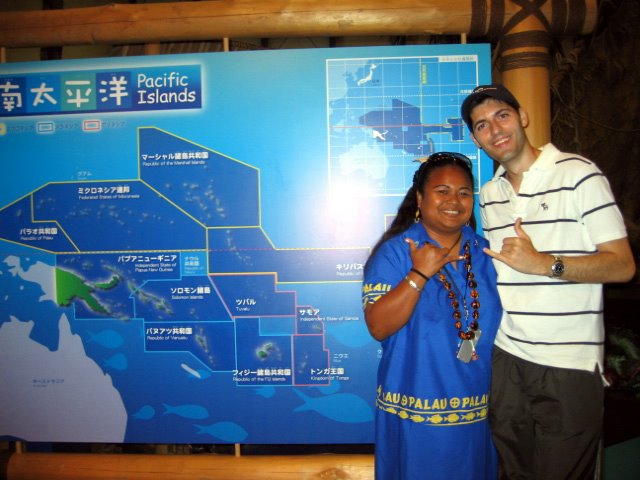 At the Pacific islands pavilion, I chatted at length with Marshallese and Palauan girls. I dredged up war stories of Guam’s super-typhoon. I watched meeting highlights of Kiribati’s Refuse Containment Committee, and noted the contradiction between “the drastic effect” of tourism being brought to a “stand still [sic] by the ethnic turmoil” on the Solomon Islands’ tourism homepage with their Expo exhibit claiming them “now one of the most peaceful countries in the world.”
In Tunisia, I most enjoyed the Expo’s hidden human element. The majority of visitors, 60%, resided in the surrounding region. Foreigners, mostly Koreans and Chinese, made up only 5% of visitors. On this given Sunday, I generously estimated 0.6% of the crowd as non-Asian. I got the feeling that domestic visitors viewed me as if I were on a lunch break from manning one of the pavilions. As it turned out, they were almost right.
Mustafa looked up from his necklaces. He was surprised to see a Westerner. Was I part Tunisian? No, but I enjoy Middle Eastern culture and cuisine. He reached under the table and produced a container of baklava and Arabian sweets, and offered me a seat behind the display counter. “Ikko ¥1000,” he chimed at browsers while confiding that most necklaces were made in India for a fraction of the $10 Expo price. Mustafa, 28, ditched his job at an Italian restaurant for this enterprising opportunity. In fact, the whole family was cashing in. His mother, 48, stitched traditional dresses in the corner. She had brought many over from Tunisia to gouge Japanese tourists who will pay just about anything for anything. His two brothers, 24 and 17, had also made the voyage to staff the exhibition hall’s pottery studio.
We exchanged hardship stories about our common ground as foreigners in this strange, often unwelcoming land. Other pavilion workers I spoke to echoed this sentiment. Mustafa claimed to have a Japanese wife, yet in the same sentence admitted to “playing around too much.” Perhaps life here wasn’t so bad.
I began assimilating to this enclave of Tunisian culture, alluring images of which flashed on plasma screens. “Ikko ¥1000,” I called out, tidying up the selection of necklaces. I didn’t seem out of place. To the Japanese, all of us hairy-forearmed foreigners look alike.
Geography is great, but missing out on the corporate pavilions meant my technology fix remained unfulfilled. I’m not leaving this place until I see a [expletive deleted] talking robot, I muttered to myself. I would not be denied a face-to-face encounter.
Resolve paid off. An hour before closing, the robot station was deserted. Electronic friends were free for the making. I charged at the robots. Feeling a little frisky, I began stroking them. Oh, robots! The staff looked up from checking their watches, and saw a chance to practice their English. I met SuiPPi (“Sweepy?”) and Alsok who did their respective programmed tasks of cleaning and security in silence. Unimpressed, I was introduced to a childcare robot able to repeat two words, but bandying “konnichiwa” grew tiresome. We bid each other “bye-bye.”
I had read about robots proficient in 40,000 phrases in Japanese, Korean, Chinese, and English. I extended my hand to Wakamaru, a 3-foot sunshiny yellow creation from Mitsubishi marketed as companion to independent elderly people. “Sumimasen, Eigo ga hanase masuka?” [Excuse me, do you speak English?] Nothing.
“No, no, no,” an assistant said running up to me before ducking behind Wakamaru to plug him (her?) into a laptop. He handed me a small microphone, and asked me to repeat what appeared on the computer screen. I guess this ’bot was still building its vocabulary. 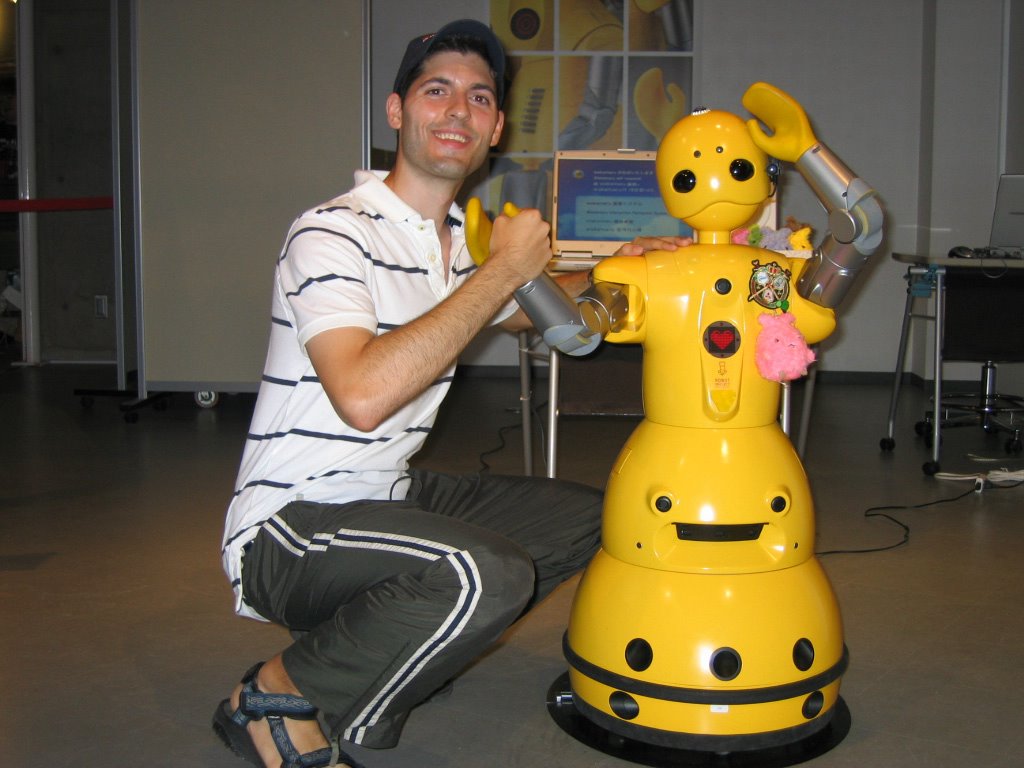 “Directions,” I had to say twice before Wakamaru asked me where I wanted to go. I looked at the next menu of options. “Maintenance yard,” I said, wondering myself where and what that was. Where I really wanted directions was back to the Tunisia pavilion, where I stayed until they kicked me out to close up.
Cyber companions may be the wave of the future, but while in their prototype stage they make for better photo ops.
Subscribe to:
Posts (Atom)


