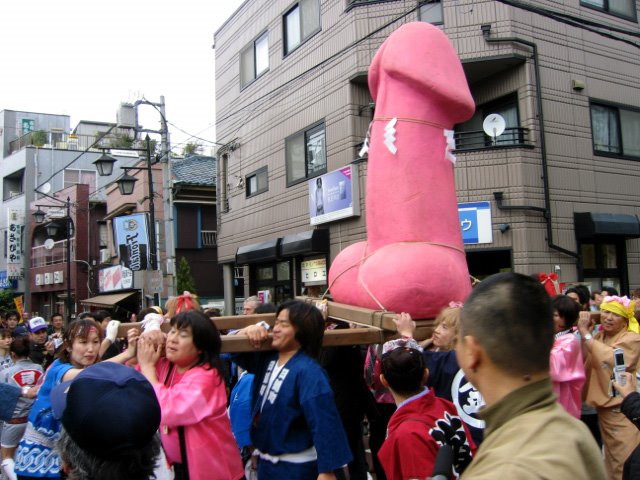
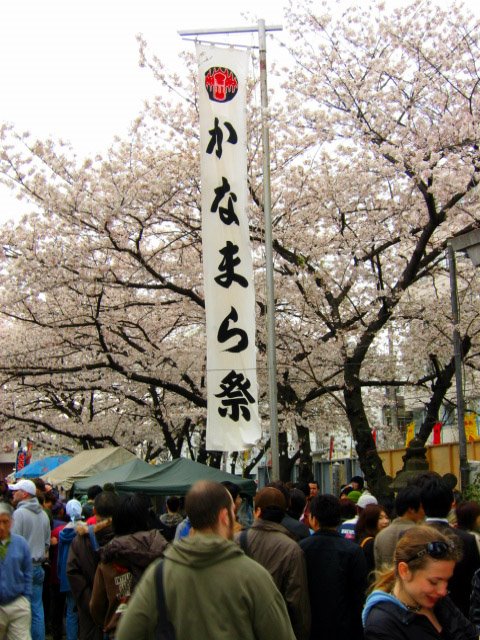
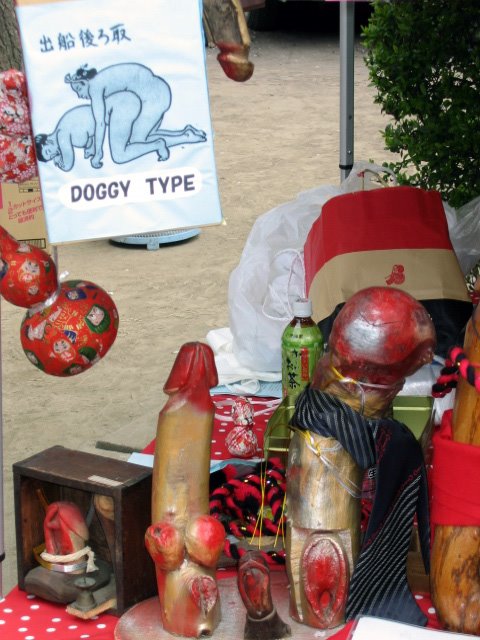
 Japanese schoolboys’ asking about my American body parts or inappropriately touching them has been well documented on this blog (with further outrages to come). But now I have proof that the problem isn’t me. It’s them – their repressed culture. Immaturity hit a new low yesterday in Kawasaki at the Kanamara Matsuri, or Festival of the Steel Phallus.
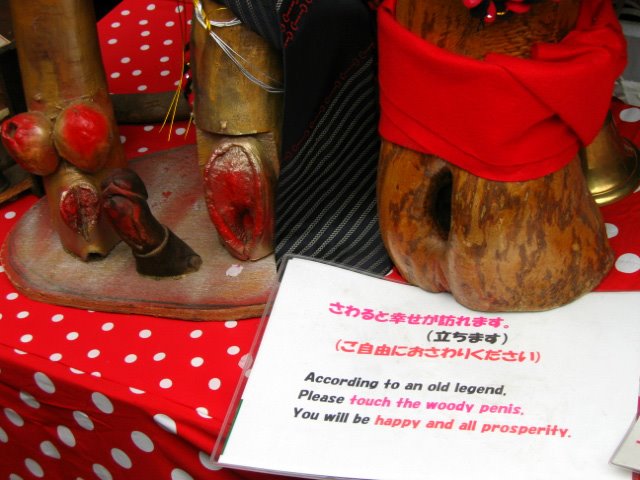
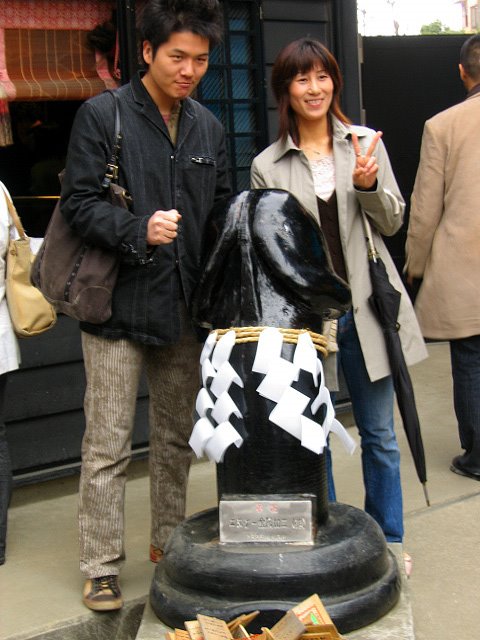
With its origins in the Edo era, this festival is held at a shrine sprouting several smooth mushroom-headed sculptures. The festival coincides with the cherry blossoms when Kawasaki women used to pray to ward off syphilis.
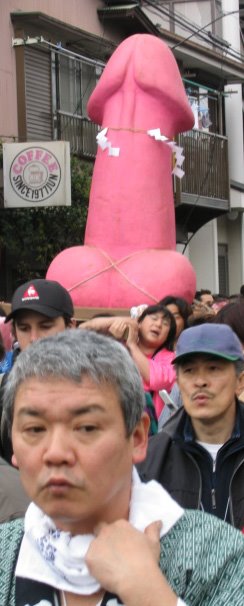
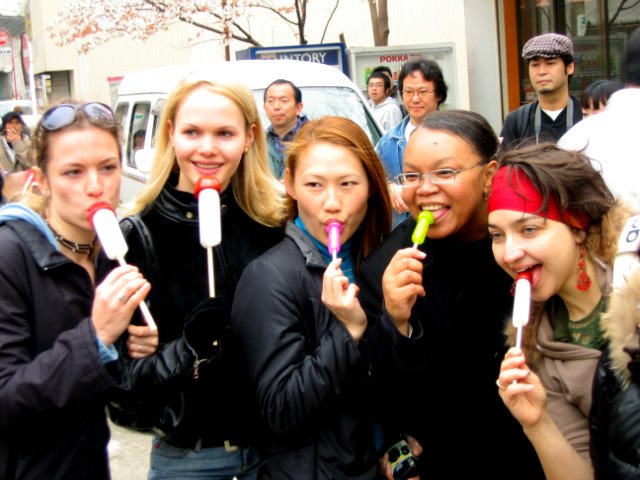
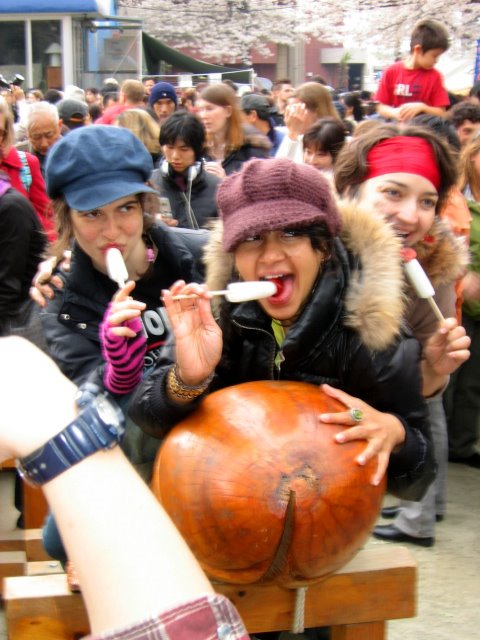
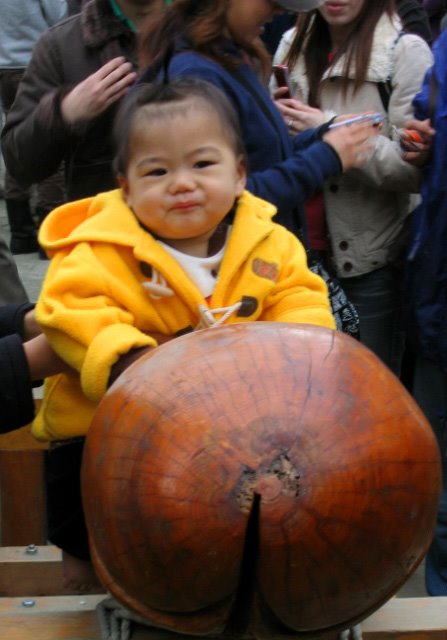
The event attracted more gawking foreigners than Japanese. Penis paraphernalia and themed sweets were available, and photo-ops were aplenty. The highlight was when a mother and her baby (not the one below) slid off the wooden shaft and tumbled to the dirt.
You know what a picture’s worth; I’m not going to waste my breath.




Sunday, April 02, 2006
Penis Festival

Tuesday, February 14, 2006
Red Day
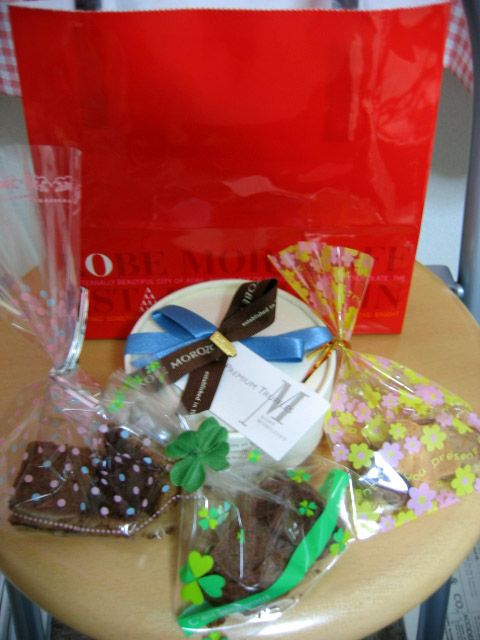 “Jefu, stop!” commanded an 8th grade girl. I obeyed out of surprise. I had exactly 35 seconds to get to my seat in the teacher’s room before the bell sounded the morning meeting. She took precious moments to dig out a small bag of sweets from a shopping bag.
How could I forget? It was Valentine’s Day. Another girl scouting out boys from the stairwell presented me with a bag of mini-brownie squares. This being Japan, the packages were sized proportionately—three bite-sized sweets in each. 12 seconds. I could have amassed a month’s worth of dessert samples had I hung around for their friends to also open their hearts to sensei.
Valentine’s Day in Japan is a spin-off of the Western tradition. Cards aren’t exchanged, but it’s almost obligatory for schoolgirls and OLs (office ladies) to dispense sweets to their male counterparts, regardless of affection. That’s how I scored premium Kobe truffles from a math teacher, and a box of six chocolates from a private student.
Men sit back and let the loot roll in. Until March 14, that is. In a savvy ploy by confectioners (think of the Simpson’s episode where Hallmark devised a new summer card-giving holiday), on White Day men must return the flavor with white chocolates symbolizing pure feelings (or so I read in a book). A month is plenty of lead time to make good on IOUs. Luckily I’m not working then, so for me the flow is one-way. Delicious.
Or disgusting. That’s how one girl introduced her offering in bag festooned with four leaf clovers. Only in Japan…or Ireland.
In another moment of puppy dog love, on Friday I received two love letters. It was my last day at Omiyada School, which proved too much for two 8th grade girls to bear. To be sure, I think they were just appreciative to have received pink New York pencils during an overstock fire sale their final class.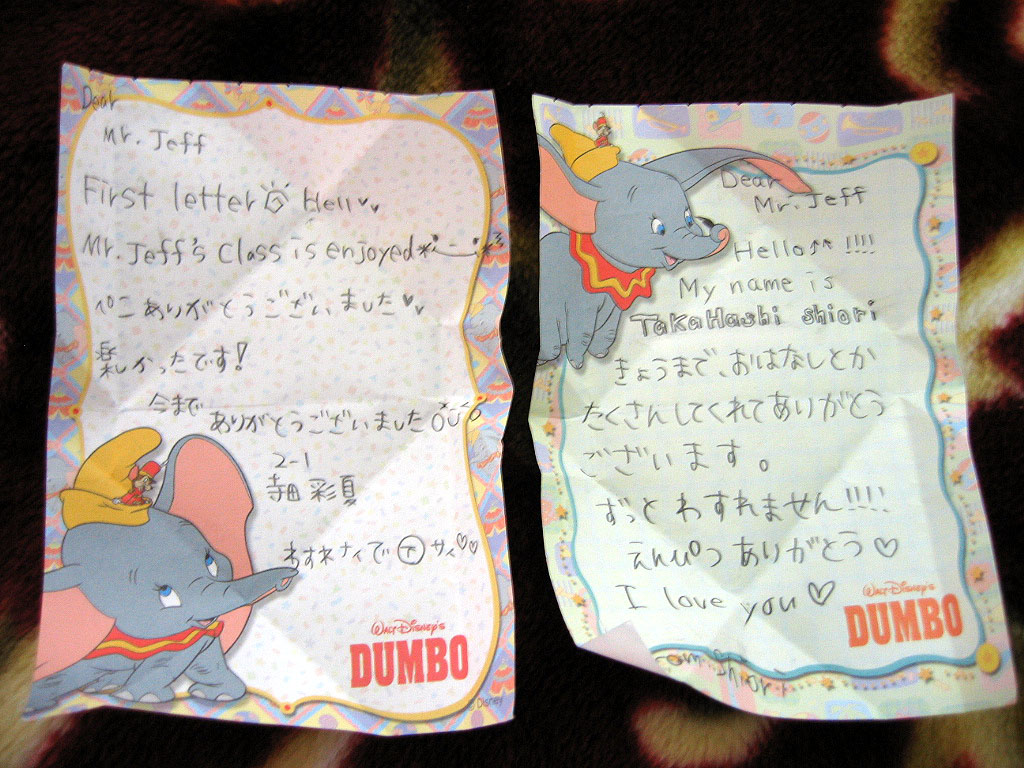 Shortly before I walked off school grounds forever, they tracked me down and, giggling, handed me slips of paper folded with origami precision. They even attempted to emote in English. I made sense of the Japanese by slowly sounding out the hiragana, which drew curious (jealous?) stares from semi-retired salarymen on the 15:06 train home.
Here’s a rough translation:
Dear Mr. Jeff, First letter. Hell. Mr. Jeff's class is enjoyed. Thank you very much for the pen. I had fun. From now, thank you very much. Please don’t forget me.
Hello. My name is Shiori. From today, I enjoyed talking with you a lot. Thank you very much. I will never forget you. Thanks for the pencil. I love you.
If you're reading, girls: kochira koso. Same to you.
Monday, February 06, 2006
Lucky Charms
 A late model BMW 330 series honked at me. My ride was on time. “Where we goin’?” Hiro rolled down the window and shouted at me outside of the Nakagawa sports center where we had met one Friday night playing hoops.
I welcomed the change of plans after Mike from Flamingo agency called to say that I hadn’t passed photo selection for the soccer movie. I brushed off my bruised ego, and instead pretended to look forward to spending Saturday at the radish festival in Asakusa. Thankfully that wouldn’t be necessary.
“Takasu-Takasa-Takasomething,” I said fumbling for my guidebook. “Takasaki!”
“Where the hell is that?”
“Gunma prefecture.” (Think New York’s Dutchess County.)
“Gunma!” Hiro boomed, as if I had suggested driving to Hokkaido, Japan’s northern island.
If we left now, I explained that we’d arrive just in time for the end of a festival. The poor timing or 115 km (70 miles) trip weren’t problems. Hiro was up for driving anywhere. But if we were gonna go to Gunma, he needed maps.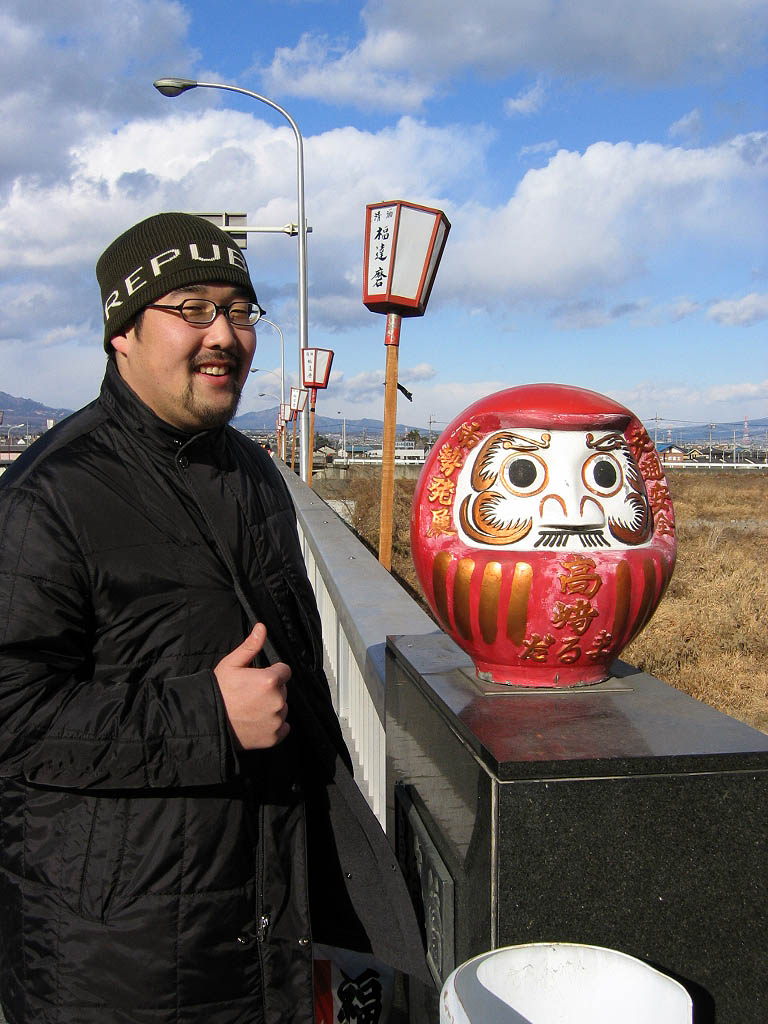 “This is my daddy’s car. He doesn’t know how to use GPS so there isn’t one here,” Hiro said. I smiled every time the 29-year-old referred to his “daddy.” Educated in Colorado, Hiro quit his import-export auto parts job the day before, and was now helping out at his daddy’s ramen shop two stations away from me. Sitting comfortably in the BMW’s leather interior, I assumed business was boiling over.
Highway tolls (emphasis on high) made the trip about as expensive as a slow train, but German automotive engineering beats the wheels off Japan Rail. The air was crisp; we were in the countryside. An elementary school cashed in by transforming its dirt playground into a parking lot where streams of festival-goers were returning to their cars laden with armfuls of daruma dolls.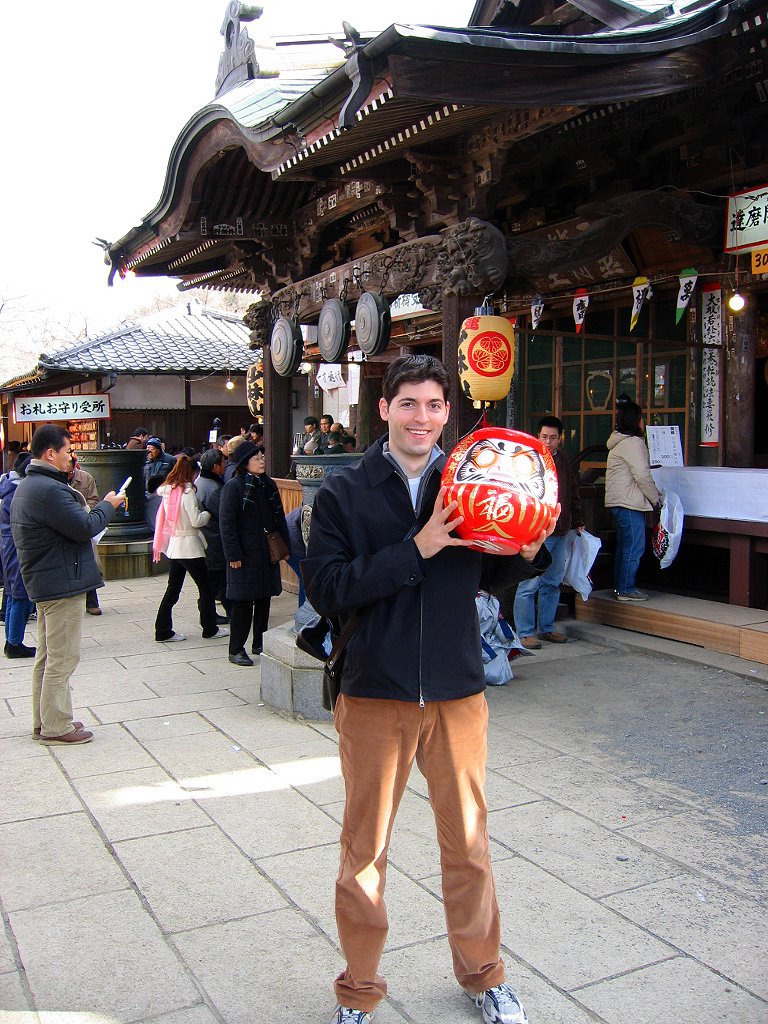 Takasaki is the birthplace of these good luck charms that represent a famous Zen monk. Legend has it that after meditating in a cave for nine years, he lost use of all limbs. This city of 240,000 manufactures 80% of Japan’s limbless, mustached dolls with vacant white eyes. They are purchased in the beginning of the year, and one pupil is painted when a wish is made. The other is added when the wish comes true. At the end of the year, the doll is returned to its shrine of origin and ceremonially burned.
Hiro was huffing at the top of the 100 stairs leading to Shorinzan Temple. The daruma doll festival had lasted all night.  We arrived as vendors were packing up, but just in time to snatch up bargains on merchandise and the last batch of tako yaki dripping in barbecue sauce. There’s nothing like fried batter balls of octopus bits to send my stomach into gastronomic bliss.
The round dolls piled on top of one another reminded me of pumpkins at the country market. Like pumpkins, daruma came in assorted sizes. And when in Takasaki…well, I wanted the biggest one my thin wallet could support.  Hiro helped negotiate, and I walked away holding one with both hands. I named it Takaruma, and bought him some smaller friends.
“The girls in the countryside have better fashion than girls in Tokyo,” Hiro said as we walked down the mountain and passed two sets of short skirts and long legs shivering in the dead of winter. “But country girls can be shy.” Although married, he sometimes calls after the uniformed high school girls.
We decided to explore downtown. Leaving Starbucks, a rainbow-colored sign in English caught my attention. “We Go used clothing 7F.” I was feeling lucky already having purchased charms in bulk. “Can we go?” I asked, persuading Hiro to scale seven flights of escalators to take a closer look.
I was in luck. The store was having its January 50% off sale. Worker jackets stitched with random nametags hung on a rack outside the entrance. Parting the hangers, I saw myself. “Hey Jeff, can you fix my flat?” Hiro joked. I shared first names with an employee of Sterling trucks (or plumbing). It fit well, and my green tea frappuccino cost nearly as much. The sales clerks’ eyes widened at the novelty of the match.
The music inside was thumping, and I could tell that Hiro wanted to get out of Gunma and back to the city. I re-racked a burgundy velvet blazer, and after a fruitless detour to HMV in the basement, we bid Gunma goodbye. Takasaki’s lights twinkled in the sunset.
View the Daruma slideshow here.
* * *
The only flaw with the jacket was its wrinkled fabric. Hiro suggested pressing it at the cleaners. The label confirmed that dry cleaning was an option.
But after wishing me a happy New Year, the fatherly owner of Fashion Cleaners said he couldn’t help me. So, I walked down the block for a second opinion. A voice welcomed me from the depths of racks of clothing wrapped in plastic, but trailed off upon seeing a foreigner.
I apologized in Japanese for not speaking Japanese, and used gestures to indicate I wanted the wrinkles removed. This prompted the woman to talk up a storm. I deduced that she couldn’t help me either, and that it had to do with the polyester and cotton shell.
I humbly admitted I didn’t understand one word of what felt like a three-minute explanation. She asked me where I was from and why didn’t I understand Japanese (this I did understand).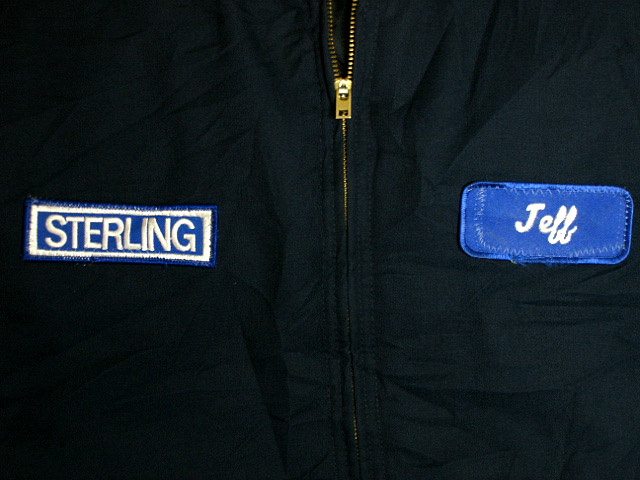 “It’s hard,” I conceded, continuing to stretch out the fabric to make the creases disappear. I wanted them out. This sparked more babbling. It must be the ESL teacher in me, but when I know that a listener doesn’t understand much English, I talk as slowly and simply as possible.
This woman had no such sympathy. I watched her mouth like a spinning slot machine, waiting to match up three recognizable words in a row and cash out. The best I could determine was that the material couldn’t be ironed, and that the jacket looked cool the way it was.
Wrinkled or not, this ¥750 ($6.50) jacket is actually warmer than the spring shell I’ve been skating by on to shield against winter. After I make a few house calls around the neighborhood, I’ll earn enough to upgrade to proper gear. Now if you’ll excuse me, I think I hear the muffler or toilet tank running.
Tuesday, January 03, 2006
Gongs At Midnight
 Fifty minutes to midnight, I was in my apartment with a sixer of Sapporo munching on day-old sushi and gizzard skewers. The television was on. I was exactly where I wanted to be.
The New Year’s Eve tradition of kohaku uta gassen was in full swing. J-pop stars were pitted in a battle of the sexes while kimono-clad enka singers waxed about unlucky love to sway the older demographic. Gorie, the transvestite comedian, sided with the girls’ team. While the parade of talent featured a few too many feathered boas for my taste, not so for the average Japanese household, 50% of whom tune into the program (down from 80% in the 60s-70s).
Unlike in the West, New Year’s in Japan is steeped in tradition more meaningful than champagne, Dick Clark and Times Square. The holiday is similar to Thanksgiving in that it’s the one time families get together. Bamboo and pine ornaments adorn entrances, soba noodles symbolizing longevity are slurped whole and bizarre seasonal foods crowd supermarket aisles.
Also unlike in the West, I was having trouble getting myself invited to a year-end celebration. Time was running out, and so were the contacts in my phone book.
Hidemi was with her family in Mie prefecture. Basketball buddy Takahiro was down the street, but also with his parents. Sweet Kaori was texting me to arrange a follow up to her trial lesson in June. Nao (male) was going to Yokohama for an event staff party. Nao (female) wasn’t returning messages. And I wasn’t returning Fumiko’s.
Yoichi was having a party in his apato, but then suddenly changed plans for Chiba. Michelle and Nobu were in New York. Lawrence was in France. Hicca, of restaurant and radio fame, was in the hospital with a brain tumor. I almost thought about texting Satoshi. Almost.
So, like most other days here, I spent omisoka alone, but not lonely. Another tradition is to visit a shrine at midnight, or sometime during the three-day holiday. About 70% of Japanese make a pilgrimage for ceremonial rather than religious reasons. More than three million descend upon Tokyo’s Meiji Shrine, which is about the number of salarymen swarming into my Otemachi-bound subway car on non-holidays.  Luckily, my neighborhood is home to Tomioka Hachimangu Shrine, perhaps one of the five most important in Tokyo. At 30 minutes to midnight, I set out to rendezvous with the god of war. Just Hachiman and I would ring in the New Year together. Little did I expect such a crowd to vie for his attention.
 The shrine was packed with people waiting to make a wish. Food stalls cooked up tempting treats in a haze of scented smoke. Never mind champagne, it was tako-yaki time (fried octopus-filled golf balls, right).
I exchanged greetings with two basketball acquaintances who spotted me while awaiting their fortune slips. Not wishing to wait in line for a custom I didn’t understand, I played roving photographer. I nudged my way up to the front of the shrine just before midnight, and videotaped the clapping crowd as gongs boomed. Some drunken guys hoisted one of their own, and bounced him as if he had just scored the winning goal.
The best part about the New Year, however, isn’t the anti-climatic countdown. It’s wishing random people well. This was made more satisfying in Japan where I was a foreigner unexpectedly equipped with the right phrase, and – after five Sapporos – emboldened to startle strangers.
Among those I bestowed New Year’s wishes upon were the supermarket checkout clerk (to purchase said Sapporo), the muffin girl in the silly hat working the bakery aisle, grandma Yoko the Chiyoda Sushi lady where I order out three times a week, a gang of high school troublemakers sitting on a park fence and a couple walking a dog down a quiet side street.
I spotted another young couple. “Sumimasen, shin nen no hofu wa nan desuka?” (What’s your New Year’s resolution?). Waiting for the walk signal, they were trapped. In typical Japanese style, the woman repeated my question. She then shot her boyfriend/husband the look. Traffic stopped. He laughed to end the conversation. The response needed no verbalization: more sex in ’06.
I continued to indulge in Japanese tradition on New Year’s Day, as I made a McTeriyaki burger my first meal of 2006, and watched the 85th Emperor’s Cup soccer match in bed (the red team won).
While I received no fortune at the shrine, I got an e-mail from Atami, a Douyoto 9th grader. His message was one we can all embrace: “2006’s ambition is ‘Don't forget progress spirit always.’” Amen, little guy. It’s going to be a good year here in Tokyo. Akemashite omedetou gozimasu to you, too.
Wednesday, May 25, 2005
Make Way for Mikoshi

I headed for the granddaddy of Tokyo’s three major festivals on May 21. A week after Kanda festival, Sanja festival is larger and more boisterous. Up to one million people visited Senso-ji temple over the weekend, highlighted by an unending parade of mikoshi. Teams of area residents lug these portable shrines around neighborhood streets, and pass in front of Senso-ji temple to pay homage to the goddess of mercy enshrined within.
I arrived early, but the grounds had already swelled with onlookers. Wanting the best view, I muscled my way to just opposite the entrance of this Buddhist temple. There was no room to second-guess my location. I could barely raise my camera without elbowing old ladies in bucket hats. An hour later, thousands of shutters captured the first of 100 mikoshi to reach the temple.
Whistles, drums, and chants heralded their arrival. These gold and black lacquer portable shrines transport local deities, who apparently get restless being confined to their precincts. So, once a year residents air out the mikoshi with a spin around the block to throngs of admirers.
This must feel refreshing for the deities, but grueling for participants who tread for miles barefoot or in thin slippers while shouldering wooden beams on which mikoshi rest. With devotion the bearers press on, clinging to the beams like driftwood. The sun saps their energy as sweat soaks through their bandanas and symbolic happi coats. Chanting helps maintain morale, as do designated team cheerleaders who clap, pump fists, and clear the path ahead.
Mikoshi aren’t just carried. They’re bounced. Legend says that shaking the deities will bestow blessings and prosperity upon the neighborhood and its parishioners for the coming year. As a result, the mikoshi list from side-to-side, sometimes careening into the crowd, which collectively recoils. Elevated above a sea of supporters, shrines bob like buoys. Because of the backbreaking work, a rotating team of two to three dozen carries the shrine. With pained expressions, some must be counting the steps to their next cigarette break.
The festival emphasizes harmony through group unity. Young and old, male and female, shoulder-to-shoulder they balance colorful burdens. Pride and sweat drip from their brow as participants shuffle towards the shrine, saving their last few breaths for this culminating point of their journey.
Popularized during the Edo period (1603-1868), the Sanja festival embraces all generations and aspects of Japanese culture. Children pull special miniature mikoshi while grandparents flank the procession. I spotted legendary geishas and notorious yakuza who use this occasion to brandish their mafia tattoos, which is normally against the law.
Food stalls include the standard festival victuals that make my sweet tooth ache: chocolate covered bananas, cotton candy, crepes, toffee apples, and syrupy shaved ices. Finger food abounds, with grilled squid skewers and tako yaki (barbeque octopus dumpling balls) being my fuel of choice.
Relive my Sanja experience through these pictures.
Friday, May 20, 2005
Kanda Festival
 I attended one of Tokyo's "three grand festivals" at Kanda Myojin Shrine on Saturday, May 14. I missed the mikoshi (portable shrine) parade, but did enjoy the festive atmosphere and taiko (fat drum) performances.
You can view my Kanda Festival pictures here.
Tuesday, May 10, 2005
Large Men, Little Silken Belts

Sumo is one event where, when it comes to front row seats, buyer beware. The dohyo (ring) is two feet high and only 15 feet in diameter. Unlike boxing, no ropes separate spectators from a piece of the action. In this case, it’s a very large piece.
These guys embody human wrecking balls; sitting ringside seems about as safe as picnicking at a construction site. Averaging between 350-400 lbs., rikishi (competitors) can’t stop on a dime when being forced out of the ring. Sometimes an unlucky kimono-clad gyogi (referee) gets tangled up in the takedown, drawing “ohhs” from the crowd.
For three hours I marveled at the head-on collisions unfolding before me, but from the safety of the cheap seats. Before the belly-bashing begins, however, rituals dating to the 8th century are observed. The chiri-chozu ceremony (hand-clapping while squatting on the toes) attracts the attention of the gods. Sumo originated as a religious ceremony to pray for bountiful harvests. The thigh-slapping and buttocks-smacking must have evolved later on as warm-up scare tactics. Fleshy echoes resonated up to the portraits of past champions hanging in the rafters. Unlike women’s tennis, grunting didn't seem en vogue. My favorite ritual was the shiko (foot-stomping), which at 1.0 on the Richter scale was more than enough to drive evil spirits back underground. Yet, just to be sure, wrestlers scatter 100 lbs. of purification salt into the sand and clay ring over the course of each day.
To see stills from the big guys in battle, click here.

