...Continued from previous post.
The Shinjuku Ward tax office was a nondescript building in a nondescript section of Shinjuku, just beyond the shadows of the district’s celebrated skyscrapers. At first I walked right by, mistaking the four-story structure set back from the road for a school – a class of building molded from a similar concrete cookie-cutter batch.
Inside, the room of bureaucrats silently shuffled papers at retro metal desks under light fixtures yellowed with age. Lines snaked on the worn salmon carpet as people waited to turn in forms I didn’t have and couldn’t read.
Not sure of where to start, I walked up to an unstaffed counter. My strategy for assistance was one of entrapment. Looking helpless becomes an advantage when playing upon the innate sensibilities of the Japanese to deliver superior customer service no matter who the client.
I set myself as bait, standing tall and vigilant. One glance and Hiroshi was hooked. Our eyes met. I reeled him in with a smile and wave of papers (actually just the map the Oracle had circled).
Short spiky hair and acne-scarred cheeks gave him a fresh out of school look. Hiroshi was easily the most junior on the graying staff, and as a result was probably under 9-to-5 orders to serve whoever the wind blew in, such as clueless gaijin like myself.
Even though we couldn’t communicate, he dutifully ushered me to a long table with a wood pattern laminate peeling from the corners. I had seen this before. I flashed back to elementary school lunch tables on which I unwrapped the tinfoil around a PB&J sandwich my mother packed with two Saran-wrapped Oreos and a napkin inside a brown paper bag.
Instead of taking out my lunch, I handed Hiroshi the earnings slip that prompted the Oracle to steer me here. Turning in the paper was like loading batteries into a robot. Hiroshi sprung into action, picking up a form that looked like an accountant’s crossword puzzle. He plugged numbers into formulas, tapped on a calculator and juggled the results into rows of white boxes.
“Maybe you owe money!” echoed the Oracle’s haunting forecast.
That outcome worried me. Here I was going out of my way to do the right thing, and I prayed to be rewarded with a tax payout, not punished with penalty for a balance due. I watched Hiroshi’s tabulations with the fixation of a tennis line judge. Refund, refund, refund, I chanted to myself, holding my breath for the sum to settle. Totals climbed with additions and tumbled with subtractions. I felt like I was on some kind of personal finances game show hanging on to see which way the balance would tip.
¥26,820. Hiroshi put his pen down. Positive or negative? I sought clarification in his eyes, but he directed them towards his senior who had appeared behind him to supervise the calculations and translate the result into English.
“This number is your refund,” the man said of my approximately $240 windfall.
I exhaled. In my next breath I naively asked for my winnings in cash, drawing laughter from both employees. A casino this was not.
As I scribbled my bank account information on a deposit form, another sheet of paper appeared. It was a letter – in English and addressed to someone else. Apparently I had to do some off-the-books work to secure my money. No matter what a foreigner’s occupation in Japan, no one is immune from at least some degree of teaching English. Spontaneous tutoring arises without warning and in unusual places, like here at the local tax office. I ignored irregular capitalization as I proofread the letter about a foreigner’s double filing mistake. When I, too, rested my pen, we traded bowing thanks over the long table.
Outside the rain had stopped, and the pavement gleamed under thinning clouds. On my way home I decided to stop by the Oracle to share news of my good fortune.
Sunday, September 09, 2007
Tax Office Jitters

Friday, August 31, 2007
The Oracle of Shinjuku
“There are only two things you have to do in life to be a good citizen,” the Honorable Justice Evans pleaded to the half-filled central juror room at County Courthouse. “Pay taxes and do jury duty.”
After two postponements, there I was reporting for duty less than a week after returning from Japan, which doesn’t have such a legal system, but is considering adopting it. In the meantime, were Justice Evans addressing Tokyoites, he might substitute proper disposal of household garbage for jury duty. Paying taxes anywhere is a given, except maybe in Dubai.
As I looked forward to fulfilling civic duty in America, I thought back to qualms I had about shirking it in Japan. I had cleaned up my act on garbage after initial infractions. And I never had to think about taxes since they were automatically deducted from my teacher’s paycheck.
Complacency with being a good foreign resident changed with the arrival of an official envelope from the Shinjuku office of Tokyo’s city government. Not lost among its thick contents covered in small, indecipherable characters was a bolded bottom line: ¥104,200 with four pay stubs for ¥26,050 each. I only had to read numbers to know I had debts equivalent to $900 due two weeks before I departed.
With time of the essence, I sought a one-stop authority. I asked for an audience with the Oracle. Unlike her predecessors from ancient Greece, China and Mesopotamia, this glasses-rimmed granny didn’t look particularly divine behind a bare desk with a nine button telephone. And rather than “ask for an audience,” I simply walked into the Shinjuku ward office. Nonetheless, her advice was not to be taken lightly. She dispensed such wisdom that I consulted this bilingual bureaucrat four times in my final two weeks. To her, it was a day job. To me, a personal concierge ready to tackle the nitty gritty of getting a pension refund or recycling a water-logged laptop. Charged with helping Japanese-challenged foreigners figure out affairs, the Oracle became a lifeline to wrapping things up in Japan before I shipped myself back to New York.
Frustration preceded reverence. With a grasp of two languages and within reach of a telephone, the Oracle delivered a painful reading at my first consultation. She decoded the suspicious envelope, which was an unwelcome parting present for residence tax owed. While coincidence rather than prescience delivered the bill before my checking out, its bottom line could not be ignored before my imminent departure.
The Oracle was not sympathetic. “You must pay now” became her patented response to each sour face I threw up in opposition to parting with such a hard earned sum.
Pouting to the Oracle would get me no where, but another foreigner waiting in the Oracle’s on-deck chair offered advice of his own. A Japan veteran, the Ph.D. student gently interrupted to explain how changes in tax laws had hit everyone hard. Residence tax in particular had skyrocketed. He knew of people who owed double or triple what they had paid last year.
“But I didn’t pay anything last year!” I cried.
“That’s because your first year in Japan is free,” he said. I was getting nailed for my second year just days before I left for good. He understood the temptation. From the corner of his mouth he insinuated for me to drag out the installments for as long as possible, and to leave without saying good-bye, especially not to anyone official. The Oracle observed the exchange while brooding from her seat.
To pay or not to pay wasn’t the question. It was a matter of how much. Posts from online forums steered wannabe evaders to pay just enough to keep names off the top of the delinquent pile on the tax collector’s desk. I wrestled with how much was just enough. One installment? Two? Or get installments further subdivided and pay even less before slipping away.
I couldn’t block out the Oracle’s uncompromising tone ringing in my ears: “You must pay…you must pay NOW!”
A whispering voice on my other shoulder countered, “Drag it out for as looooong as pooossible.”
Battle lines were drawn in a fight for my morality. Rules were rules, but the Oracle’s do-right demands were hollow; if I wasn’t renewing my visa to stay longer, there was no mechanism to force my compliance before jetting off for good. In the unlikely event that immigration asked for proof of payment, I might be detained until I cleared my name. According to the online community, the specter of such a scenario was about as remote as locusts descending upon the concrete of Tokyo.
Here at the end of my Japan adventures, however, I felt a moral imperative to do right. After all, hadn’t I broken enough laws in this honesty first, by-the-book country? The number of smiling lies I fed to immigration about my intentions for visiting. The three months I taught on a tourist visa. The mega amounts of prescription drugs I smuggled in my luggage to avoid headaches from customs and monthly shipping charges from overseas. To make up for the past, my conscious was guilting me into full compliance.
A few days later I decided to pay the Oracle another visit. A smile of recognition gave way to an eye of suspicion.
I confessed immediately. “I already paid one installment!” It was due before I left, so paying that one was never in question.
I already knew the Oracle’s stance on the rest. Yet I was here for a different issue – getting a refund for payments I made into the national pension scheme. I showed her an assortment of confusing paperwork. One small slip of paper caught her attention. It was an earnings and tax statement from the current year. The Oracle revealed that if I was leaving, I might qualify for an income tax refund, but only the national tax office could tell me for sure. This building housed, among other departments, the tax office for Shinjuku ward where my residence tax would be collected.
A pension and income tax refund would help offset losses from the remaining installments of residence tax. I would be doing everything by the book while reducing the blow to the balance in my bank account.
Just then, the Oracle had a second thought. Storm clouds massed outside.
“But maybe you must owe more taxes,” she warned. “I don’t know.”
Thunder crackled. Lighting flashed. It rained locusts. The thought of voluntarily walking into the income tax office and coughing up more money made me choke, but the Oracle had spoken. I would heed.
She pulled out a map made illegible from countless reproductions, and circled my meeting place with Tokyo’s taxation tribunal. Twenty minutes later I reached their office, and it began to pour.
To be continued….
Saturday, July 14, 2007
Afternoon at the Arcade
I'm no fan of boxing or the bland Ikebukuro district of Tokyo, but the other day I had a little fun with both. Thanks to Michelle for finding this gem, to Jen the videographer, and to my video-skilled sister for pasting it together.
Ka-POW!
On a sad side note, this will be my last post from within Japan proper. Although after two years I have decided to move on, the backlog will ensure the blog's continuation for the foreseeable future.
Thursday, June 14, 2007
Day of Denim
In the five years since I’ve graduated from college, peers have outpaced me with more framed pieces of paper and larger bank balances. Now this weekend it’s time for our first reunion, where no doubt I’ll have better stories over beers in the Class of 2002 tent, but I’ll also need something more to measure up. Style.
Of particular concern is what to wear on my bottom half. Go-to Diesel jeans have worn away at the most inconvenient place – the crotch. So, too, have A+F boxers, compounding the exposure of a private area in public places. Sitting on the subway leaves me especially vulnerable.
Over two years, clothing expenditures in Japan have totaled $20 for a new belt and second-hand jacket. Stylistic differences and size realities have ruled out flirting with Japanese fashion, which is probably for the better. Purple tank tops under three-quarter button-down stretch shirts look fine on their rail-thin frames, but would leave me feeing self-conscious even at a gay mixer.
Unsure of where to hunt for men's denim, I guessed that OIMEN department store would be a good start. I tensed up walking into the ground floor, also ground zero for accessories. Snakeskin shoes, belt buckles larger than my fist and enough glittering chains to make Mr. T blush all screamed high fashion out of my league. Despite sounding like a narcissistic brand snob, I find shopping to be stressful and degrading (hence buy only brand names to make myself look positively stunning).
Boutiques and responsive attendants filled OIMEN’s eight floors. Some enthusiastically engaged the lone foreigner by pulling recommendations off the rack as I walked by (see above remark about J-boy fashion). On the second floor I hovered around a promising shelf with jeans in hopes of sending a silent signal for help. I even unfolded some and held them against my legs. Why was no one running over? Was my booty that out of proportion? Or worse, were these women’s jeans?
I built up the nerve to ask the teenage sales girl if she had the paint-splattered denims in large. She acknowledged the request with a nasal shriek and shuffled off – literally jogging in baby steps – and returned with a counter-question: would I like to try them in medium?
I didn’t realize it at the time, but I made a classic gaijin (foreigner) mistake by walking into the fitting room with shoes on feet. The footwear foul must have incensed the clothing gods; the jeans wouldn’t budge above my knees. Salvation knocked on the door and handed me a large, but in a style so splattered that the jeans were almost white. Out of politeness I tried them on – up until my thighs.
I was just pulling my old jeans back up when the door swung open. The head salesman looked in without apology. A more suitable client stood behind him with two pairs in hand. I stumbled out of the fitting room as casually as possible, clutching sneakers in one hand and belt loops in the other.
I buttoned my fly and tightened my belt on the up escalator, and contemplated the challenge before me. Jeans in Japan had to fit three criteria, the second of which was fitting me. First they had to pass a style test – funky but not flamboyant. Next I had to pass the physical challenge – squeezing American thighs into pants designed for a people with pencils for legs. Finally came the price check. With tags often $175 and up, would fashion come at any price?
On the third floor, directly above the fitting room fiasco shop, I spotted another rack of denim, and parted it with authority. I stepped back. The style was exactly what I was after – whitewashed creases radiating out from the groin (looks better than it sounds, trust me).
I sucked in air through my teeth as fingers fished for the size tag inside. Actually, one glance at the thighs said enough. I could fit my arm through the leg hole, but not much else. Criterion two failed. Game over.
Out of curiosity I checked the price of what would have been. My eyes lit up – they were under $85. Momentum restarted. Behind the small size was a larger pair – LL to be exact. The planets were aligning.
I rushed to the nearest attendant, who was folding sparkly skull and crossbones t-shirts. His sun-kissed skin complemented hair dyed auburn. Manicured bangs swept over one eye. He was a textbook example of かっこいい (cool guy). His jeans were ripped and roped, and studded with brass buttons down the leg seams. A white t-shirt matched his smile, or chagrin at having a foreigner on his hands. In haste, I yanked off still-tied sneakers and ran into the dressing room.
I emerged.
“Such long legs. I’m jealous,” he said.
“No, no. My thighs are a little big,” I admitted while testing out the hip huggers, which did the job without turning legs numb.
“They look good on you,” he said, bending down to examine the cuff that flared out. “Just right.”
I turned to put on sneakers that, tightly tied, I had kicked off outside of the fitting room. They now sat neatly aligned and undone. The thought of this superstylish guy laboring over my New Balance laces brought out an “only in Japan” smirk.
He folded my purchase like it was the emperor’s robe, and sealed it inside a plastic bag that he lowered into a shopping bag over which he slipped another plastic bag to guard against the morning’s drizzle.
His duty wasn’t done until he walked me five feet to the door, bowed and politely asked for my continued patronage. I dually thanked him (as well as the clothing gods). With solar eclipse-like odds of finding jeans in Japan, expect me back around 2087.
Wednesday, June 06, 2007
Outing in Akihabara Part II
...continued from last post.
Some passages of this post are sexually explicit. Reader discretion is advised.
I had been conditioned to seeing the boys in black uniforms, but on this Sunday we were far from locked school grounds. Noki arrived so camouflaged that I didn’t recognize him, although he stood out like Rambo dressed head to toe in fatigues from a hunting hat down to black combat boots laced high. He slung a matching backpack over one shoulder. Oversized brown sunglasses completed the enthusiast’s ensemble.  I fumbled for words, but only laughter let loose. The kind of knee-jerk snort like if you saw your dad in drag. Honda picked up on my poorly disguised reaction.
“This crazy boy,” he said, maxing out his conversational English.
Honda (center) had his own look. He was grooming himself to be a typical Japanese pretty boy. A diamond glinted from one earlobe. Snug jeans rested low on his hips with a Louis Vuitton wallet peeking out from the back pocket. A dark velvet blazer hugged his shoulders while neatly tied around the neck was a fake Burberry scarf, a ubiquitous accessory among trendy teenagers like his friend (left).
In our distinctive outfits – solider, fashionista and off-duty teacher in khakis – we marched off to explore the urban jungle of Akihabara with Noki of course leading the charge.
One subset of geeks is perverts, and bookshelves in Akihabara are packed with perversions. On this day I saw enough bulging cartoon breasts on magazine covers to satisfy me for a lifetime. The industry trend seemed to be the bigger the better, and boobs inflated beyond the size of beach balls were not uncommon.
Permutations for erotic poses were endless. Some girls wore skimpy school uniforms. Others, bikinis dripping in cum. Boobs came bound in chains and rope while another popular theme was girls’ caressing the chests of playmates.
Once you’ve seen a few, you get feeling you’ve seen them all. That was until I came across a cover with a wolf-human clawing into bleeding vaginas. Nearby, penile-shaped tentacles of an anthropomorphic octopus penetrated all orifices of a gagging schoolgirl.
Honda typed Japanese into his electronic dictionary. The translation read, “This causes sour relations between Japan and countries concerned.” I was more than concerned. I was nauseous, and was about to feel worse.
Up and down stairs Noki weaved through floors with narrow aisles of paperback fantasy worlds with twisted illustrations. Grisly graphics were not bound to the printed page. A video game running on demo mode challenged players to select an animal and rape chained girls with ferocity. Success was measured by the level of white liquid dripping into a pot at her feet.
I asked Noki if he was ready to leave.
“I must check this floor,” he said with diligence. “Checking many floors is very important.”
I, however, had seen more than enough, and wondered if they were even allowed to be seeing any of this. Honda typed again and showed me the result: “Persons under the age of 18 are not admitted.”
“How old are you!” I accused them once we were back outside.
“Sixteen!” they chimed in unison as I followed them into the next store. Filled with endless volumes of comics, this basement bookshop was at least tamer. Curious collections included: Chrono Crusade, Venus Versus Virus, Arrivederci Alicevenice, Lunatic Saga, Butt Backraid and the not-so-Shakespearean, As You Like It featuring a not-so-studious schoolgirl.
Noki showed me his favorite, a series called Rozen Maiden. I recognized the girls on the cover as those on his fan and day planner he brought to class.
“I don’t like real girls,” Noki confessed. “I hate them.”
As Noki explained the characters, their strengths and the battles they faced, I sensed his kinship with the maidens. The books about these girls now seemed normal compared to other subjects in stock like Love Doll Hole, How To And More.
Browsing further, I noticed an evolution in cartoon chests on covers. Muscled arms and exposed torsos were locked in group embrace. I picked up a paperback called “Brothers,” but the men looked more intimately familiar than just family. Contrary to my first thought, this was not the gay manga section. Noki said that “Boys Love,” or BL, was a genre for girls. It seemed only fair that if men can flip through pages of girl-on-girl action that women could fantasize about groups of amorous guys.
The final fantasy adventure in Akihabara was a reality check. As soon as we stepped back outside, two uniformed officers moved in on Noki.
“Are you here shopping in Akihabara?” the policeman asked.
“Yes, we are going to some stores,” Noki said. Honda and I backed up a step.
“So you’re here shopping?” the policeman reiterated in typical Japanese-style interrogation. Passersby slowed to whiff the unfolding drama.
“Actually, he's here to wage guerilla war on soft targets,” I wanted to interject. I lacked the language skills to do so, but saw an opportunity to practice.
Since there were two officers, I engaged the one not frisking Noki’s fatigues. I told him that Noki was a friend, but that I was no otaku. He asked me what country I was from and how long I had been in Japan. Sensing the next question would be about my job, I changed the subject. I didn’t want Honda implicating me and piping up about my being their teacher.
“Tokyo is so safe,” I marveled. The cop cocked his head in doubt. “Well, my hometown is New York.”
His head straightened and he smiled in agreement before turning to his patrol partner who was wrapping up his search. Failing to find a knife, pistol or other 凶器 (murder weapon), the policeman released an embarrassed Noki.
Interest in us faded, and so did my feelings towards Akihabara. I warned Noki and Honda not to be late for English class tomorrow morning and disbanded.
Thursday, May 31, 2007
Outing in Akihabara
Akihabara means different things to different people. For technophiles, it’s mecca for the latest gadgets that hit shelves here before they do in the States. Meanwhile, technophobes can dig up a spare part to a dinosaur desktop or score an original Legend of Zelda Nintendo game cartridge from 20 years ago (used to love that one). Representing more ordinary tastes, I have browsed Akihabara for an iPod and a digital SLR camera.  Tokyo’s Electric Town also has an underbelly. Akihabara is ground zero for a nerd subculture drawing devotees of anime (animation), manga (comics) and cosplay (costume play, photo left) to its glowing precincts. Words can’t do justice to this fantasy world that for otaku is the only reality for these “obsessed house-broken geeks.”
Noki is an otaku. He’s also my 11th grade student, and one of the friendlier ones, too. Shirking the school’s required black blazer, he stands out like a flamingo on an iceberg full of penguins. The next layer of the uniform – a white button down shirt – flaps untucked and unbuttoned to reveal his true character: a t-shirt with anime characters.
Anime obsessions do not earn respect among high school peers, but Noki wears his hobby like an honorary shield, which must magically give him protection. The boys’ dress code dictates that blazers be buttoned up like straightjackets. Teachers reprimand those who casually keep two top buttons open, one over the limit. Yet I never saw anyone challenge Noki for sitting in class naked, relatively speaking.
The bell ends the struggle of students’ listening to another language. They file out of the room happily chatting in Japanese, but Noki lingers to reassemble. During the course of class he’s kicked off his shoes – and if summer, socks – and littered the floor around his desk with handouts.
I confer with the Japanese teacher about the lesson plan for next class, which falls every Monday and Wednesday morning. From the corner of my eye I catch Noki creeping up. He’s waiting to tell me something, and I know exactly what it is.
“I went to Akihabara last weekend,” he announces if it’s a Monday. (Wednesday’s opener is, “I will go to Akihabara this weekend.”) Noki is admittedly an Akiba-kei, a pejorative term for an Akihabara-type person. The label still seems benign at his age, at least more so than for those in their 30s branded for similar obsessions.
Noki answers my question before I’ve asked it by showing me his newest anime acquisition. During class I saw him keeping cool with this plastic hand fan, which turned out to be decorated with cartoon girls busting out of maid’s costumes and brandishing weapons far more dangerous than dust mops.
“Which one do you like best?” he asked.
The question caught me off guard. Did he mean sexually? I mean, how else would I “like” them? Lust mulled their heaving chests and oh so slender figures.
“Um, I’ll take the one with blue hair and nunchuks,” I said, slightly ashamed over where my mind just went.
“I, I like this one.” He pointed to a character with sharp red hair cascading down to black socks hiked up to the knees. As I checked her out, oversized auburn eyes flashed at my intrusive gaze. Her raised sword forced my eyes to surrender.
I looked up. Noki was one of the few students who conversed with me willingly, so I was happy to be engaged on any subject. In due time, polite interest earned me and Honda an escorted tour through Akihabara’s subculture that made the sworded maids seem realistic.
Honda and Noki made a curious pair. Honda played the class clown when not otherwise preening his spiky hair, which he fussed over to the exclusion of anything topical. Although he sat in front of Honda, Noki’s position on the totem pole of high school coolness couldn’t have been more distant. Girls extended a sympathetic wince if a friend got paired with Noki for conversation drills. But who was Noki to care? His mind wasn’t bound to the realm of realism anyway.
Perhaps admiring Noki’s rebelliousness, Honda courted him as an ally for in-class mischief, but I never expected them to join forces outside of it. On this occasion, however, temptation was too great. For Honda, a journey beyond classroom boundaries into his classmate’s passion while with his English teacher would be something to brag about come Monday morning, just in time for our first period class.
That class began at 8:50, but punctuality wasn’t in Noki’s or Honda’s vocabulary. They were usually the last two in their seats after the second bell. Honda reveled in any reproach that shifted the bad boy spotlight on him.
It wasn’t surprising, therefore, that while waiting at our meeting point in Akihabara station, my phone buzzed with a text message:
GOOD MORNING p(>o<)q
I am sorry , may be we will late to meeting. so Please wait . for us w(oOo)w It was from Honda’s number, but with Noki’s name as the author in the subject line. Honda could barely introduce himself in English while Noki was the only student I knew who didn’t own a cell phone. Reasoning was a matter of finance mixed with obsession: why pay a monthly contract when such money could be saved for the next big game release?
Forty minutes later they arrived, whereupon irritation dissolved into speechlessness.
TO BE CONTINUED NEXT WEEK….
Tuesday, December 19, 2006
Buddha in Black
 I thought I had seen them all, but alas, another remained. I’ve already described the spiritual satisfaction I get from visiting enormous Buddha statues, which I now realize number four in Japan. Two are famous and two are not. Buddhas at Todai-ji in Nara (60 feet) and Kotoku-in in Kamakura (44 feet) are dwarfed in size but not reputation by Nokogiri-yama’s 102-foot giant carved into the mountainside.
The missing member of Japan’s Buddha family was only one express stop on the Tobu-Tojo line from Ikebukuro. While the closest to the capital, Tokyo Daibutsu (東京大仏, or The Great Buddha of Tokyo) is also the smallest (43 feet).
Sleepy side streets with well-appointed houses near Jouren-ji Temple felt far from the vertical bustle that characterizes the commercial hubs of Tokyo. Behind the temple, a grove of bamboo and a thick carpet of crunchy leaves were two pleasures of nature I’ve never encountered within these city limits.
Except for a leaf blower, the temple precincts were quiet. Yellow ginkgo leaves had finished for the season, but aggressive carp looked as active as ever, opening their gullets wide to fight over air bubbles or fish pellets that my Hawaiian friend Lahela tossed into the pond.
The presence of the main attraction was felt all over the grounds. Tokyo Daibutsu’s silky black bronze body contrasted to the weathered green of Kamakura’s bronze Buddha cast in 1252. Tokyo Daibutsu, however, is about as ancient as I am, and was honored as a New Tokyo Landmark after its completion in 1977.  Yet this is a landmark few know about, and on a Tuesday afternoon in December the seven stone gods of fortune outnumbered human supplicants. I found the smaller Jizo statues in red bibs to be more photogenic. For ¥500 these guardians of deceased and unborn children, pregnant women, and travelers could be purchased and placed on larger Jizo statues to fulfill wishes.
The outing was a chance to test drive my snappy new camera equipped with a powerful zoom lens and advanced auto focus unknown to my old point and shoot. I was able to capture writhing carp, smoking incense, and Jizo statues with as much or as little detail as I pleased. Later on, Lahela caught me performing magic tricks in the leaf pile out back.
Click here to see the results.
Sunday, December 10, 2006
I Didn’t Do It
Culture shock and the oddities of Japanese life have worn off, but every now and then something takes me by surprise. Such was the case waiting on the outdoor platform of Akabane station, the crossroads of northern Tokyo.  Winds sprayed a December rain onto trains and those waiting for them. I insulated myself with a scarf and gloves while iPod earphones warmed my eardrums. I didn’t look approachable. Firstly, I’m a foreigner. Few Japanese will risk the unknown and initiate interaction with such species. Furthermore, my ears were closed to conversation, and the corners of my mouth sagged in protest at heading to work on yet another Saturday.
But all that didn’t stop a 30-something-year-old man from pushing a book under my nose. The text was in Japanese, but penciled neatly above an image of Bart Simpson was one of his trademark lines: “I didn’t do it.”
The man pointed, and on cue this ever-ready English teacher read the phrase aloud. He pointed again, and so I repeated. His eyes flickered while processing the information.
“I didn’t do it,” he quickly muttered as if Bart had sprung to life.
“Yes,” I said approvingly. He repeated. “Yup, you got it!” I was less enthusiastic by the fourth go-around, and by the seventh time I wanted to unplug him.
I scanned the horizon for my train that would break this awkward encounter. He then flipped to a group picture of men from the cartoon “King of the Hill.” Unfamiliar with the program, I could not comment on the grunts and groans he uttered as he pointed to each character. After seven of them, he stopped making noises, and stared at me with widening eyes.
“I’m gonna kick your ass!” he seethed through his teeth at least three times. I didn’t know who he was imitating, but silently cursed the global influence of American television.
The weirdo wasn’t finished. He turned to a picture of the Simpsons family hanging off the Empire State Building. Homer grabbed the needle in one hand and pumped his fist in the other.
“Doh!” the childlike man cried as if Homer himself were standing next to me. He then imitated something unintelligible for Marge and Lisa before pointing to Bart. I knew what was coming next. “I didn’t do it,” he said once, twice, five times, before belting out a final “Doh!”
Platform bells announced imminent relief snaking towards me. Or maybe not. What if he clambered aboard after me to continue the unsolicited routine?
“I’m gonna kick your ass!” he hissed into his book while walking to the opposite track. The doors closed (another melody – aren’t they fun?), and by the time they opened at my stop, I had completed another blog entry.
Sunday, November 12, 2006
Train Bingo
How well do you know your fellow commuters? Play the game and find out. I'm behind the concept and text. My co-worker labored on the illustrations. Disclaimer: some squares may only apply in Japan. Click to enlarge.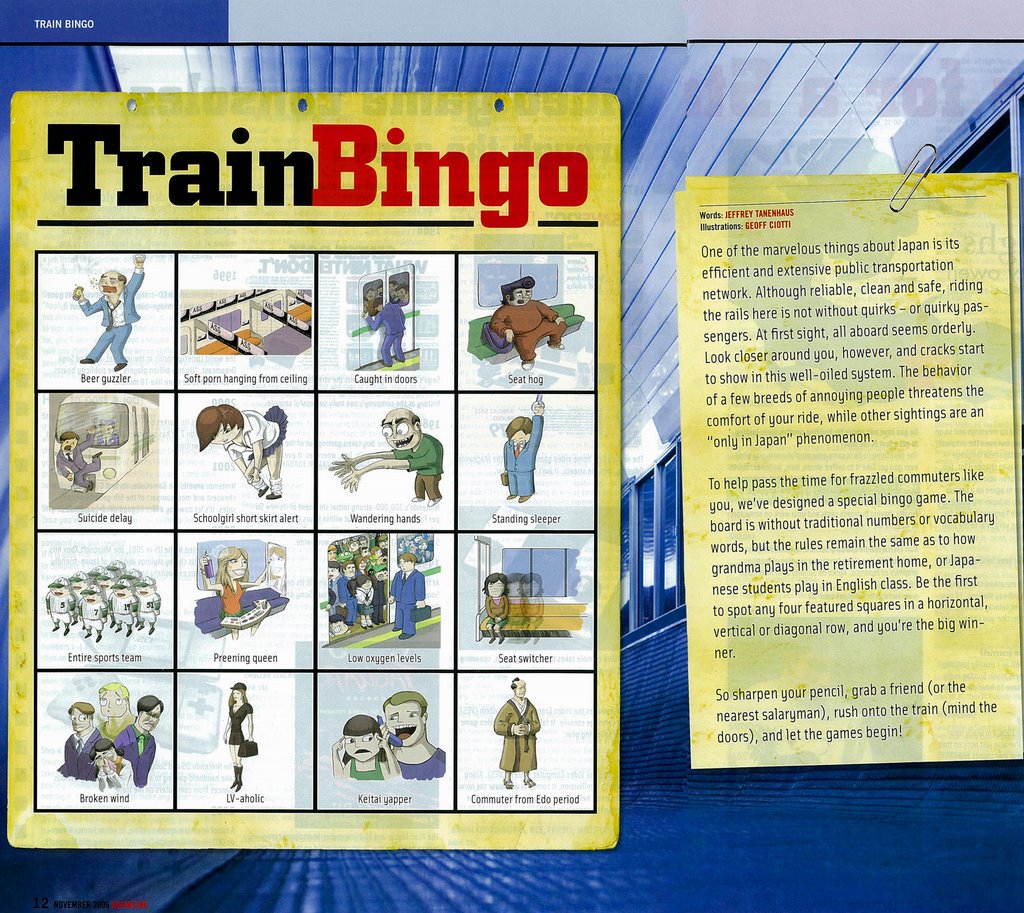
Tuesday, August 08, 2006
Under the Bridge
My favorite place in Tokyo is not where you’d expect. It’s not in the shade of blooming sakura trees lining Ueno Park. It’s not atop the Mori Tower sky deck. Nor is it on the tranquil grounds of an Edo shrine. Rather, it sits unceremoniously in the shadows, below bustling Tokyo life.
My favorite place is underneath Ryogoku Junction overpass. Here, Expressways 9 (Mukojimasen) and 6 (Komatsugawasen) merge over the Sumida River as vehicles circulate into the beating heart of Tokyo.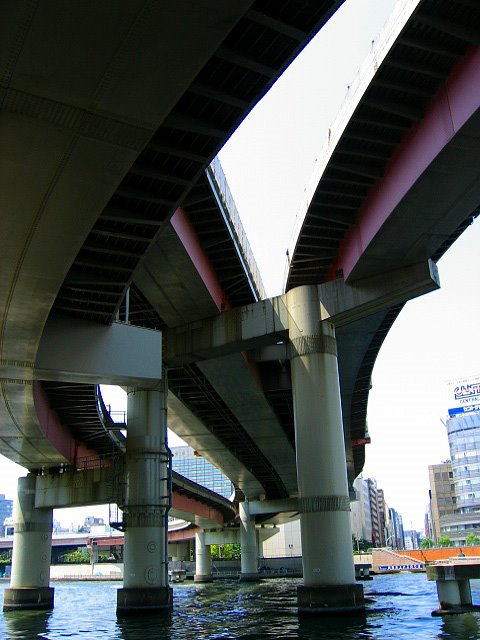
The overpass marks the border of Koto and Sumida wards. Sky blue tarpaulins of displaced urban campers color the opposite bank, which lies in Chuo ward. This spot along the Sumidagawa terrace offers glimpses of mundane activities in three different wards at once. Here I reflect on my relationship to this dynamic city passing me by.
To be frank, the Sumidagawa is no Seine. Commercial barges traffic this working river with unremarkable views, but look into the murky water and the Sumida’s character will surface.
This corner of the river’s terrace is outfitted with child-size concrete stools encircling a round table. The shape reminds me of a small-scale Stonehenge tea party, without the teacups or bucolic English countryside. Instead, trucks rumble above, sounding off at the bottleneck traffic. An ambulance requests permission to pass (It’s Japan, of course they ask – and politely so). I gaze up at perfectly aligned rows of rivets in steely harmony with their surroundings. Water laps the expressway’s concrete pillars below. Beauty is in the eye of the beholder.
This is also the point on my jogging route where I pause before turning around. Shaded from the sun, I catch cross-breezes while stretching out my throbbing knees. I stop to survey the land and water, and the multi-colored bridges spanning the two. Pod-like water buses shuttle people between Asakusa and Odaiba. I wave to small pleasure craft operators or even the rare foolhardy jet skier. Activities under the bridge vary depending on the time and day. During the week, salarymen chow down on o-bento. Anglers cast lines. A retiree practices Tai Chi. A homeless man rests out the midday heat. An amateur artist paints watercolors worthy of framing. A woman strums a traditional string instrument.
In the evening, couples pose for pictures as the sky glows orange. Under the cover of darkness youth ignite firecrackers, leaving charred remnants as evidence.
On warm weekends, the aging set in bucket hats and parasols stroll along the riverbank while shirtless men sunbathe on the benches. In winter, the homeless wrapped in blankets angle lounge chairs towards the sun. On Sunday, which seems to be designated dog-walking day, tiny pooches groomed to the teeth strut manicured paws and hair barrettes to owners parading their own canine pride. Wet noses rub; compliments are traded.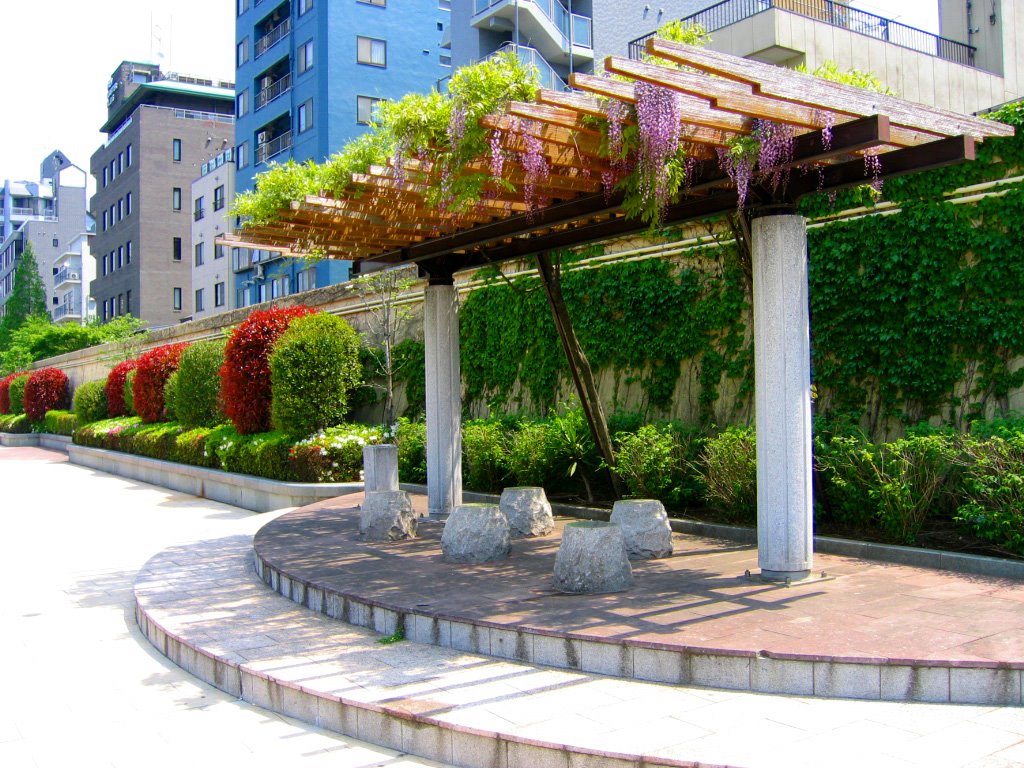 I value the Sumidagawa terrace for its colorful touches, like graffiti, bridges, and blooming bushes. The terrace provides ample jogging space, sheltering me from hard stares I otherwise receive on narrow city sidewalks when darting around old ladies laden with groceries. This narrow patch of green and gravel disrupts the mismatched concrete blanketing Tokyo. A bamboo grove or mountaintop it’s not, but beneath Ryogoku Junction overpass is my choice for a Zen moment.
Click here for a slideshow of scenes from the Sumidagawa.
Tuesday, April 11, 2006
Extra, Extra
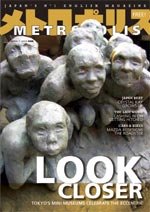 read all about it. I’m pleased to announce my biggest freelance assignment to date, this week’s cover feature for Metropolis magazine, the most circulated English language magazine in Japan. It took me more than a month to research, write and revise.
Click here to read about Tokyo's less visited museums. I also took the sculptural photograph for the cover and those that accompany with the story.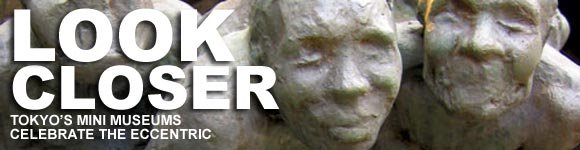
Tuesday, January 03, 2006
Gongs At Midnight
 Fifty minutes to midnight, I was in my apartment with a sixer of Sapporo munching on day-old sushi and gizzard skewers. The television was on. I was exactly where I wanted to be.
The New Year’s Eve tradition of kohaku uta gassen was in full swing. J-pop stars were pitted in a battle of the sexes while kimono-clad enka singers waxed about unlucky love to sway the older demographic. Gorie, the transvestite comedian, sided with the girls’ team. While the parade of talent featured a few too many feathered boas for my taste, not so for the average Japanese household, 50% of whom tune into the program (down from 80% in the 60s-70s).
Unlike in the West, New Year’s in Japan is steeped in tradition more meaningful than champagne, Dick Clark and Times Square. The holiday is similar to Thanksgiving in that it’s the one time families get together. Bamboo and pine ornaments adorn entrances, soba noodles symbolizing longevity are slurped whole and bizarre seasonal foods crowd supermarket aisles.
Also unlike in the West, I was having trouble getting myself invited to a year-end celebration. Time was running out, and so were the contacts in my phone book.
Hidemi was with her family in Mie prefecture. Basketball buddy Takahiro was down the street, but also with his parents. Sweet Kaori was texting me to arrange a follow up to her trial lesson in June. Nao (male) was going to Yokohama for an event staff party. Nao (female) wasn’t returning messages. And I wasn’t returning Fumiko’s.
Yoichi was having a party in his apato, but then suddenly changed plans for Chiba. Michelle and Nobu were in New York. Lawrence was in France. Hicca, of restaurant and radio fame, was in the hospital with a brain tumor. I almost thought about texting Satoshi. Almost.
So, like most other days here, I spent omisoka alone, but not lonely. Another tradition is to visit a shrine at midnight, or sometime during the three-day holiday. About 70% of Japanese make a pilgrimage for ceremonial rather than religious reasons. More than three million descend upon Tokyo’s Meiji Shrine, which is about the number of salarymen swarming into my Otemachi-bound subway car on non-holidays.  Luckily, my neighborhood is home to Tomioka Hachimangu Shrine, perhaps one of the five most important in Tokyo. At 30 minutes to midnight, I set out to rendezvous with the god of war. Just Hachiman and I would ring in the New Year together. Little did I expect such a crowd to vie for his attention.
 The shrine was packed with people waiting to make a wish. Food stalls cooked up tempting treats in a haze of scented smoke. Never mind champagne, it was tako-yaki time (fried octopus-filled golf balls, right).
I exchanged greetings with two basketball acquaintances who spotted me while awaiting their fortune slips. Not wishing to wait in line for a custom I didn’t understand, I played roving photographer. I nudged my way up to the front of the shrine just before midnight, and videotaped the clapping crowd as gongs boomed. Some drunken guys hoisted one of their own, and bounced him as if he had just scored the winning goal.
The best part about the New Year, however, isn’t the anti-climatic countdown. It’s wishing random people well. This was made more satisfying in Japan where I was a foreigner unexpectedly equipped with the right phrase, and – after five Sapporos – emboldened to startle strangers.
Among those I bestowed New Year’s wishes upon were the supermarket checkout clerk (to purchase said Sapporo), the muffin girl in the silly hat working the bakery aisle, grandma Yoko the Chiyoda Sushi lady where I order out three times a week, a gang of high school troublemakers sitting on a park fence and a couple walking a dog down a quiet side street.
I spotted another young couple. “Sumimasen, shin nen no hofu wa nan desuka?” (What’s your New Year’s resolution?). Waiting for the walk signal, they were trapped. In typical Japanese style, the woman repeated my question. She then shot her boyfriend/husband the look. Traffic stopped. He laughed to end the conversation. The response needed no verbalization: more sex in ’06.
I continued to indulge in Japanese tradition on New Year’s Day, as I made a McTeriyaki burger my first meal of 2006, and watched the 85th Emperor’s Cup soccer match in bed (the red team won).
While I received no fortune at the shrine, I got an e-mail from Atami, a Douyoto 9th grader. His message was one we can all embrace: “2006’s ambition is ‘Don't forget progress spirit always.’” Amen, little guy. It’s going to be a good year here in Tokyo. Akemashite omedetou gozimasu to you, too.
Friday, December 02, 2005
’Tis the Season
for warm butts. On the way to work, I snagged a seat when the doors opened at Kinshicho station’s outdoor platform. Nothing seemed out of the ordinary. And then one stop later, I noticed a pleasant sensation. My buns were roasting. The carriage’s air wasn’t noticeably heated, but the padded seats sure were.
But they weren’t yesterday, and I sat on the same train, in the same car. Outside highs remained mild – 50s and low 60s F. What had changed? The calendar. Now that it’s December and officially winter, heating is switched on in trains and in classrooms. School hallways and bathrooms, however, remain out of bounds, and freezing. The open windows don’t help either.
Outside temperature is irrelevant. The calendar guides dress code and indoor climate control. According to the government, summer starts on June 1. In order to reduce greenhouse gas emissions, the “Cool Biz” initiative mandated that office air conditioning not be turned below 28 C (82 F), and suggested that suit jackets and ties be left at home. Summer ends September 30, and in October “Warm Biz” kicks in. Heaters are not to be cranked above 20 C (68 F). Once the October page is torn off, Burberry-inspired scarves come out in force, coiled around the necks of schoolgirls despite it not being cold enough for a jacket (or pants – as the girls continue to trot around with exposed shins in their all-season skirts). Although an accessory, scarves have become an all but mandatory part of the fashionable winter work uniform for schoolchildren and many adults.
Inside the train, warmth radiated from my seat. I felt like cuddling with the two OLs (office ladies) flanking me, locking my arm underneath their elbow, nodding off on a shoulder, and riding the rails out to Chiba prefecture.
Thursday, October 20, 2005
E is for Earthquake
Last night I met up with my neighbor, Melo. He’s lived next door since August, but only recently have we interacted, after he tacked a note on my door apologizing for late-night noises. He rightly assumed that paper-thin walls betrayed the fact that he did not sleep alone.
About my age and height, Carmelo is an Aussie of Italian decent. He’s a minion for the infamous Nova corporation where he spits out cookie-cutter English lessons to those with ¥en to burn. Like me, he’s been in Japan for six months, but unlike his neighbor, he has picked up more girls than words of their language, so I did my best as a novice translator at Daruma.
Walking home, we passed a local dive bustling with energy that spilled out onto sidewalk tables balanced on plastic Kirin beer crates and rusting oil drums. Bright lights and a jovial crowd seemed inviting, but intimidation had always prevented me from walking in and standing up (inside are only counters to lean on). I needed someone to hold my hand, and while at it, order off the Japanese-only menu.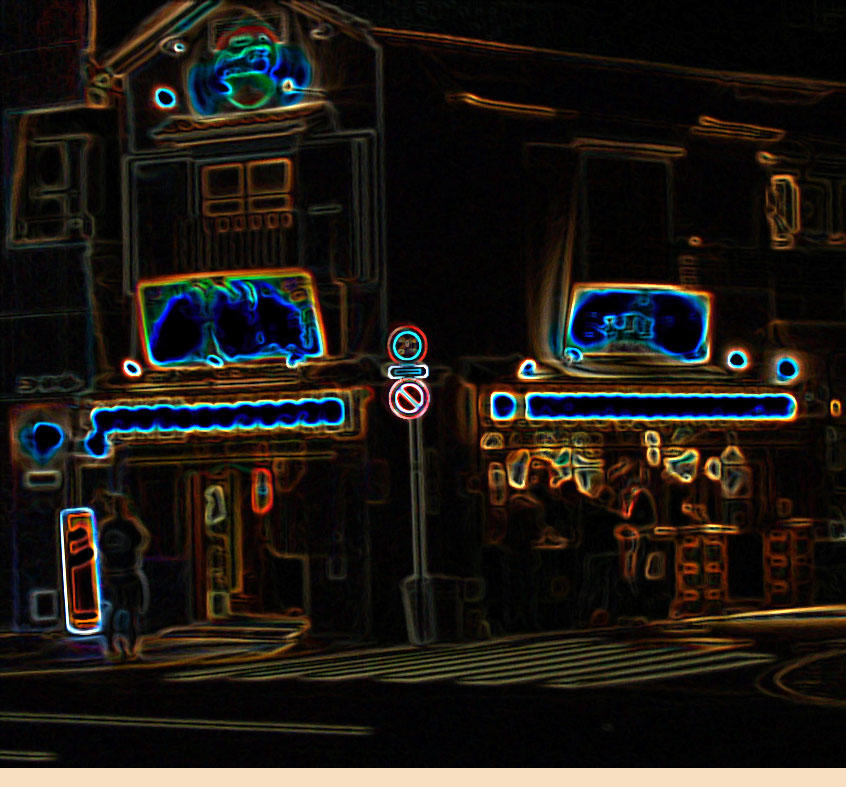
A female waitress stationed on the sidewalk to recruit passersby was the perfect opportunity. Although most izakayas have generic decor, this was a quirky spot. Advertisements for olden Japanese and Western products decorated the walls. The enormous steel bathroom door was of meat locker origin. Boxes of curry rice, spices, and other products dating from the 1950s lined bathroom shelves while jazz gently pulsed from an ancient radio.
At the counter, we took spots at the end by the kitchen, staffed by three energetic males sporting “retro style” Japanese headbands rolled tightly into the thickness of an udon noodle. One served us obligatory beers, and asked something I didn’t understand. I just said yes, and ordered two. Skewers of mushrooms and scallions arrived just as a salaryman leaned over to test his English idioms.
He asked whether we were newcomers. “Ahh,” he said, lighting up. “This your virgin time!” I nearly coughed up a shitake mushroom. I shook my head, and noticed that naked bulbs above the counter also disagreed.
“Earthquake, earthquake, EARTHQUAKE!” I wanted to yell like the first person at the beach who spots a shark, but nobody else looked concerned. Nobody except the waitress outside, who wedged herself in the doorframe as the shaking continued. Melo and I stared at each other in that way foreigners do when an earthquake hits. “It’s still going,” he said, eyebrows raised. “What has it been, like 40 seconds?” I replied. By now the natives had begun to acknowledge the strong tremors. 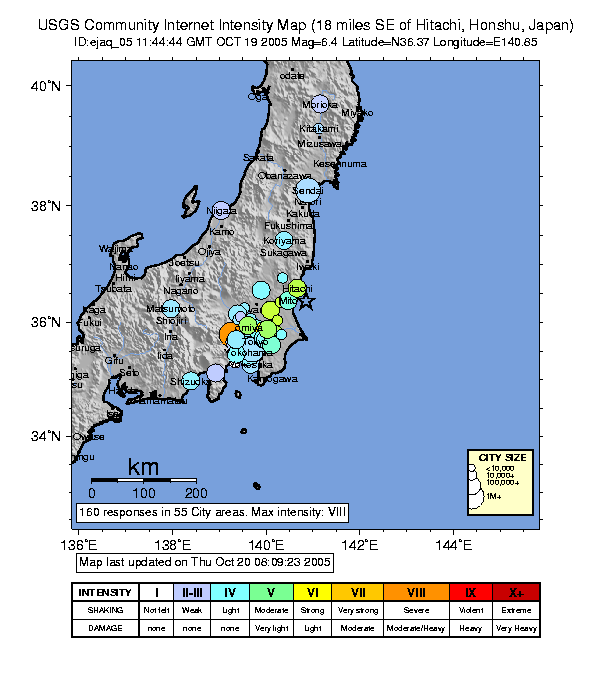
The staff switched the channel from a moronic game show to a news agency’s EarthquakeCam of swaying office buildings. Footage inside included jumpy workers at their desks with rattling monitors. After a few instant replays, a map appeared with intensity numbers and a big “X” at the epicenter offshore. “Ahhhh Ibaraki,” the crowd mumbled, noting the prefecture shaken the hardest at 6.5 on the Richter scale. Everyone fixated on the screen for reports of injury or damage except for the waitress who remained cowering in the doorway looking skyward in anticipation of structural collapse.
My interest in the setting waned until James walked in. A 31 year-old Chicago native of Irish descent, he reports financial news for Reuters. He’s spent six years in Japan (but only 5 months at the wire service), and not only had to master the ins and outs of finance, but learn so in Japanese. He reads local newspapers and conducts interviews in Japanese. This is an entry-level position. I took advantage of his fluency to order lamb skewers, and spoke to him in English about freelancing.
On Tuesday we’re going to The Foreign Correspondents’ Club of Japan’s open house so that I can learn more about membership and the opportunity to network with reporters, perhaps as another step beyond the blog to pick up freelance assignments.
Tuesday, September 27, 2005
Take Me Out to the Yakyu Game
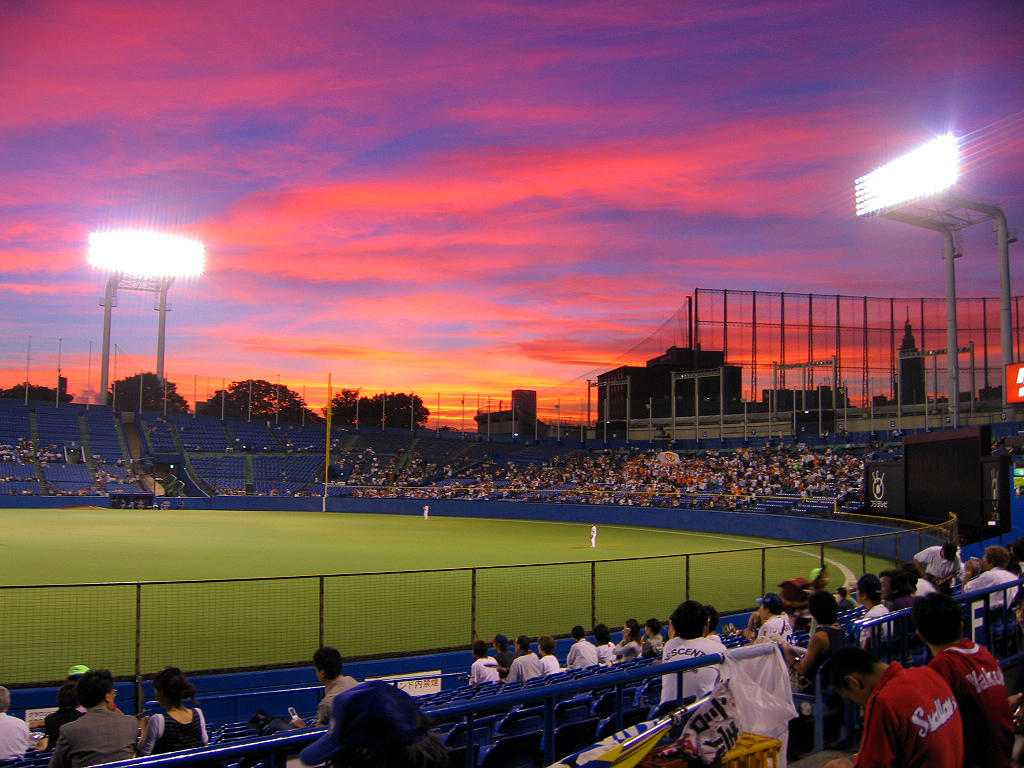 Scratching out a combination of remedial Japanese and English, Omiyada students arranged to meet me at 17:30 at Shinanomachi station’s turnstiles. In a rush and taking an unfamiliar route, by the time I realized that Suidobashi was not the same as Shinanomachi, I was stuck on a Sobu line train in the wrong direction.
It wasn’t my first Japanese baseball game, or even first at Jingu Stadium. In early July I visited the Tokyo Dome, home to the famous Yomiuri Giants, to see the Chiba Lotte Marines take on Hokkaido’s Nippon Ham Fighters. Which was the home team? Last year the Ham Fighters (sponsored by a meat packing company) moved to Japan’s northern island, but still play token home games in Tokyo to please fans that didn’t migrate.
Loyalty divides the two $14 bleacher seat sections. Having no attachment to either team, but finding myself in a sea of Marines’ supporters, I cheered for Chiba. I didn’t want to stand out like a big white thumb more than I already did.
The Dome’s drab interior is peppered with ads for all of your favorite Japanese companies: Casio, Canon, Nissan, Kirin, Fuji Film, and Showa Gas. The Ham Fighters struck for three runs while I was in the subway en route. The crowd’s flag waving and tomahawk chops initially proved more interesting than the game itself, which featured what had to be a record for double plays and only one extra base hit until the 9th inning.
Down 3-1 with two outs in the top of the 9th, Chiba’s tying run stepped to the plate. The crowd chanted “home run” in English. Down to his last strike, Lee Seung Yeop harnessed the cheers and smacked the ball into the bleachers filled with stunned Fighters fans. Trumpets blared. (Yes, fans bring musical instruments to games). Chiba completed the dramatic comeback with three runs in the 10th. Final score: Marines 6, Fighters 3.
A month later I watched the Hiroshima Carp battle my now favorite Yakult (“Yak-a-loot-o”) Swallows at Jingu Stadium. The Carp seem to have stolen a page out of the Cincinnati Reds fashion playbook. These imposters struck for four runs while I was still in the subway. Minutes after I settled into my front row bleacher seat, the Carp doubled their 4-0 advantage with a single swing. Greg Larocca’s (not a Japanese) grand slam was Hiroshima’s second in as many innings. This one was over before it started. Final score: Carp 10, Swallows 0.
Despite the Swallows’ anemic performance, I enjoyed Japan’s most historic ballpark, its brick walls dating from 1926. On a pre-WWII exhibition tour, Lou Gehrig and Babe Ruth played here. Although room for 48,000, Jingu’s humble confines felt more minor league.  Absent were luxury boxes, extravagant concession stands, and corporate promotions that are staples of Major League parks.
To be sure, Yakult Honsha Co., manufacturer of a fermented milk drink, owns the team. Uniformed “Yakult Ladies” peddle these probiotics on bicycles throughout Japan. So, why Yakult? Well, as someone who swallows such a supplement daily, my affinity truly comes from the gut. Furthermore, the Swallows are avian kin to my favorite MLB team, the Blue Jays. They’re also Tokyo’s underdogs, overshadowed by the Yankee-like Giants with their bloated payroll, aging players, high expectations, and huge fan base. Case in point: Swallows games are only televised when playing the Giants.
This brings me to my most recent game, in the shared company of two Omiyada baseball pals as our team hosted cross-town rivals the Kyojin (Giants). We spoke a little Japanese, filling the silences with mouthfuls of squid jerky. No Cracker Jack or peanut vendors in these here parts. Their jaws dropped when I jokingly tried to order three drafts beers from the Asahi lady with a keg strapped to her back.
Although forecasted typhoon remnants threatened to disrupt play, the clouds parted for a brilliant sunset. But Swallows fans tote kasa to the ballpark even on sunny days. For every Swallow who crosses home plate, fans recite a team cheer and pop open their umbrellas as a not so subtle gesture to the opposing pitcher that he should hit the showers. 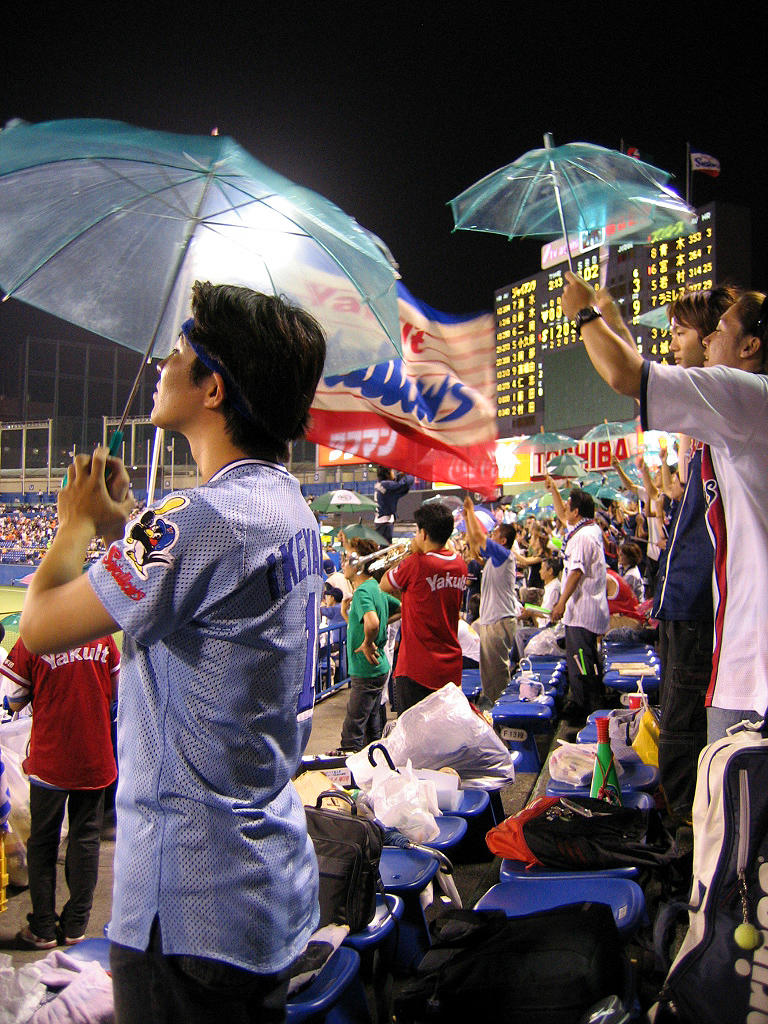 Even though the rain held off, our umbrellas were in constant motion, starting with the first pitch of the game that Norichika Aoki sent into the Giants’ bleachers. Team cheers, and those personalized for each player, build community for a common cause. Unity, loyalty, and sacrifice are the Japanese way. Male cheerleaders stand on plastic crates armed with whistles and flags. Some grow hoarse before the balloon release during the 7th inning stretch.
When American Adam Riggs (“Rig-a-sue”) is announced, Old Glory appears. A Venezuelan bandera is similarly flown for Alex Ramirez (“Rami-chan”), formerly a Cleveland Indian and Pittsburgh Pirate.
Riggs homered in the second, and the Swallows scored in all but one inning to topple the mighty Giants. The game became such a farce that benches emptied. Swallows fans fell silent when one seldom-used player stepped to the plate. Everyone looked at the cheerleaders for direction. Did a chant exist for this guy? It hardly mattered. Final score [with pictures]: Swallows 14, Giants 3.
Tuesday, September 13, 2005
On The Radio
 What began as an off-hand joke became reality Saturday, September 3. A month prior I suggested to Hicca, of Daruma fame, that I be a guest on Rainbowtown 79.2 FM where she produces.
The first weekend of every month a token foreigner is invited into the studio to share viewpoints on Japan. From 10 to 11 a.m., a voice from America hit the local airwaves. Hicca, who translated and produced, planned to question me about teaching. Given the immediacy of an increasingly man-made catastrophe, I wished instead to give voice to Katrina.
The Japanese press hadn’t been covering enough about the flood with upcoming national elections, reminders of which I struggled to block out. Vans outfitted with bullhorns cruised streets broadcasting party platforms. Candidates and staff waved with white gloves from inside, or from atop the van’s roof deck if parked near a train station or supermarket.
Otosan, Daruma’s genial father, dropped by to deliver a needed energy boost: an ice-cream sandwich breakfast. Rainbowtown’s stationmaster (and Daruma regular) was happier to see me than I was him on four hours rest. He asked if I was American. “Sort of” was my first response, unsure of what being American meant anymore except shame and embarrassment over foreign and now domestic affairs.
He pointed to a picture in the paper of black people waiting for food. In Japanese he recounted driving a relief truck to Niigata after a 6.8 quake killed 40 people in 2004. Some survivors abandoned the refined civility for which the Japanese are famous, and grabbed his collar to demand supplies. Storm orphans in New Orleans were grabbing more than just collars.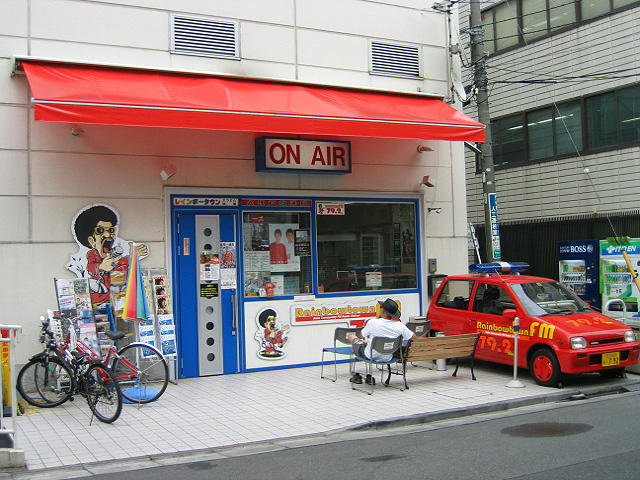 9:57 a.m., show time. I was nervous. Jishin omote gambarimasu, I told him. I’m going to do my best with confidence. Hicca ran through procedures, although neglected to instruct how to switch on my mic, leading to on-air confusion.
In between The Beatles and Aretha Franklin, I delivered a Reader’s Digest summary of Katrina. After all, Hicca had to translate, and many out there didn’t even know the basics of a hard to grasp reality of an all-American tragedy: a major metropolitan area was flooded, sweeping away thousands of lives. I logged onto CNN.com videos of floods, fires, and looting. Graphic scenes enlivened still words. “Ehhhhh, I had no idea,” Hicca kept repeating, off-air.
Before we transitioned 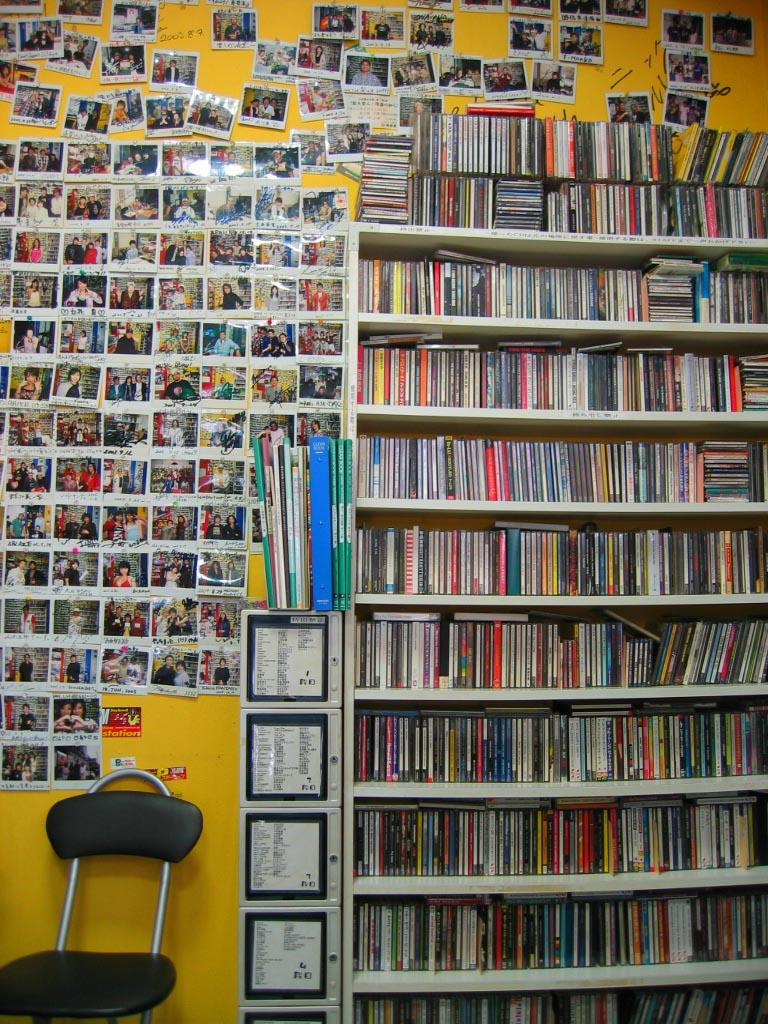 to teacher talk, Hicca played “Stand By Me.” I reflected on the irony of government's failure to do the same for citizens in the most dire of circumstances, with the most basic of needs.
What would happen should a devastating earthquake cripple Tokyo? The bleak reality is that the underclass of foreigners would assume the roll of hapless black Southerners left to fend for themselves amid the rubble.
Thursday, September 08, 2005
Born Again Banking
Only in Japan could opening a bank account qualify as the highlight of my day. As a foreigner, I expect the unexpected, and realize that no task is mundane when literally at a loss for words in an unfamiliar and complex culture.
Japan is a paperwork heavy society, and I dreaded the hassle of filling out endless forms as is customary when opening an account, even in the States. To complicate matters, I did not have a hanko, or personal seal the Japanese use in lieu of their signature that is necessary to execute official documents. While rubber-stamping papers sounded fun, seeking out a hanko merchant to translate my name into Katakana and craft a stamp would be a chore.
So would selecting a Japanese bank. Were any giving away free tote bags? That would make the decision easier. It never hurts to ask; I snagged a reversible one from Vodafone last month. To get paid for my article, I followed the financial advice of a Japanzine editor – use Shinsei Bank, Japan’s answer to Washington Mutual.
Shinsei Bank’s progressive features eliminated  the need to comparative shop: bilingual telephone support 24/7, online banking, free bank transfers, no minimum balance requirement, no hanko, and no ATM withdrawal fees – even when abroad. Japanese for “new birth,” Shinsei reimburses fees incurred when using another ATM. Take that, WaMu.
ATMs in New York are not pleasant places, characterized by harsh lighting, grimy screens, and floors littered with receipts. You look over your shoulder at the homeless guy who held the door open on your way in, and whom if you don’t tip on the way out might hold you up.
Electronic glass doors parted. Shinsei Bank’s ATMs sparkled against the wall. I had the immediate attention of three sharply dressed representatives. The receptionist greeted me and thanked me for coming in. I inquired about a Powerflex account, and was cordially invited to have a seat. I sank into comfy lounge chairs, and watched Bloomberg news images flash silently overhead. I felt like a slob checking into a four-star hotel. Dressed to outsmart the humidity in my reliable ensemble of t-shirt, wind pants, and Tevas, I was at odds with the professional setting. I spent more time pondering what color to select for my cash card than filling out half a page of paperwork. Selection rivaled that of Dutch Boy. Evocative choices included Christmas white, orange juice, chocolate caramel, straw hat, baby face, air mist, fresh leaves, tomato kiss, and red wine cocktail. Some sounded delicious, but I settled for pain old black.
I sat back and leafed through the latest Japanese Esquire. A woman with a brochure approached me. Would I like to take advantage of the American Express promotion? Was there a tote bag involved? No, but how many credit cards did I have, and didn’t I need another? This sounded annoyingly American. I brandished my credit card to appease the saleswoman. She complimented my glitzy wallet, calling it “rich.” I revealed its ¥2000 ($18) contents and corrected her: “No, poor.”
I returned to the special section on New York fashion. Five minutes later she returned with the hard sell. If I signed up, my baggage would be delivered from Narita airport to home for free. Wait, did this include a tote bag? I didn’t have any luggage at Narita, and would be more than capable of transporting it myself, but thanks very much.
Shortly thereafter I was ready to bank, Shinsei style. The associate deposited a packet of information into a sturdy paper shopping bag. I asked for her business card. She demurred. She must have been hired this morning not to have an obligatory meishi.
So impressed with the English-friendly service, I asked to speak to her supervisor, which created the awkward position of her translating my praise for her to her boss. Everyone seemed pleased. I flashed thumbs up, and they bowed until I was out of sight. From start to finish, their treatment of a young and shabbily dressed client with little purchasing power was reverential.
Alack, if only I had money to deposit.
Thursday, August 25, 2005
A Typhoon By Any Other Name
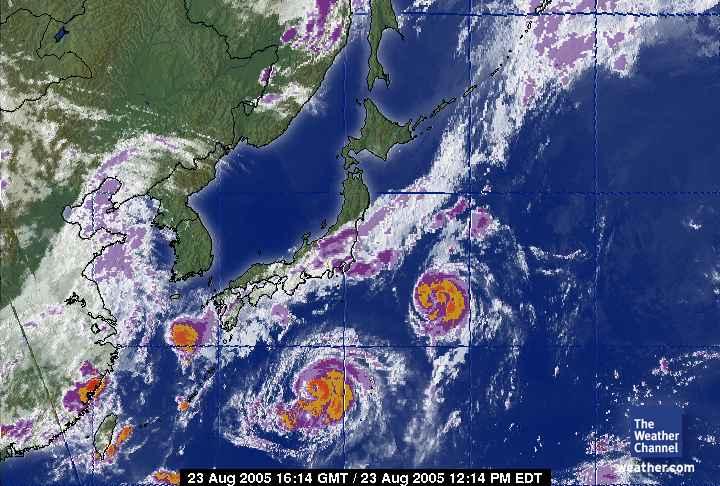 Merely mention the word, and my spine tingles. After surviving the fury of super-typhoon Pongsona in Guam in 2002, I am well aware of the catastrophic potential of such storms. As the news article states, a bumper crop of 10 typhoons slammed Japan last year, which is about seven or eight more than average.
Thus, I heeded warnings about Mawar, which means “rose” in Malaysian. I braved buckets of morning rain to stock up on essentials, namely sushi and Häagen-Dazs. A female voice cried out from the afternoon raindrops; crackling echoed over the emergency PA system. She spoke slowly and calmly, but all I understood was “please,” “this is,” “typhoon,” and “Koto-ku” – the ward I call home. More informative was her stern undertone of caution. Now, did she mention anything about filling up the bathtub in case of a power outage?
Instead of remaining housebound, I strapped on Tevas and rolled up my wind pants to attend my first freelance writers’ meeting for Japanzine, which is publishing a variation of my earthquake blog for its September issue. By speaking in nouns to a platform attendant, I confirmed the following: Konban. Taifu. Chikatetsu. Mondai nai? Nan-ji ni shimari masu ka? (Tonight. Typhoon. Subway. No problem? What time do you close?)
In Tokyo, typhoon Mawar proved to be just a two-day rainstorm. Japan’s elegant umbrella etiquette enables me to enjoy such rainy days. Drizzle or downpour, kasa smoothly pop open to ward off wetness. Plastic sheaths greet customers at shop entrances. Umbrella culture also condones swapping, which initially I mistook for stealing. Tonight someone at our Canadian pub meeting place swiped my umbrella. Of all nights, just my luck, I moaned while peering through streaked glass. Worry not, a fellow writer advised, as I reluctantly helped myself to a replacement from those remaining.
On the way home, I splashed through the empty streets with my newfound guardian, which like its predecessor is clear plastic with a white J-shaped handle. They don’t come any cheaper. Streetlights illuminated driving sheets of rain. The wind was picking up. I danced across a bridge over a swollen canal, reminiscent of a Hiroshige print, Shower at Ohashi Bridge. Tokyo in the typhoon was mine for the taking.
Monday, August 22, 2005
Next Stop…Kachidoki
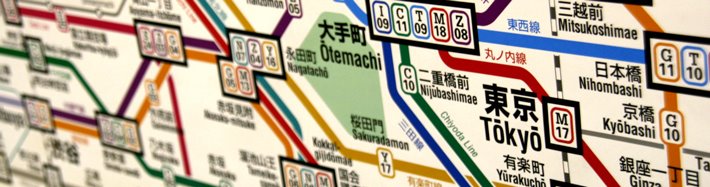
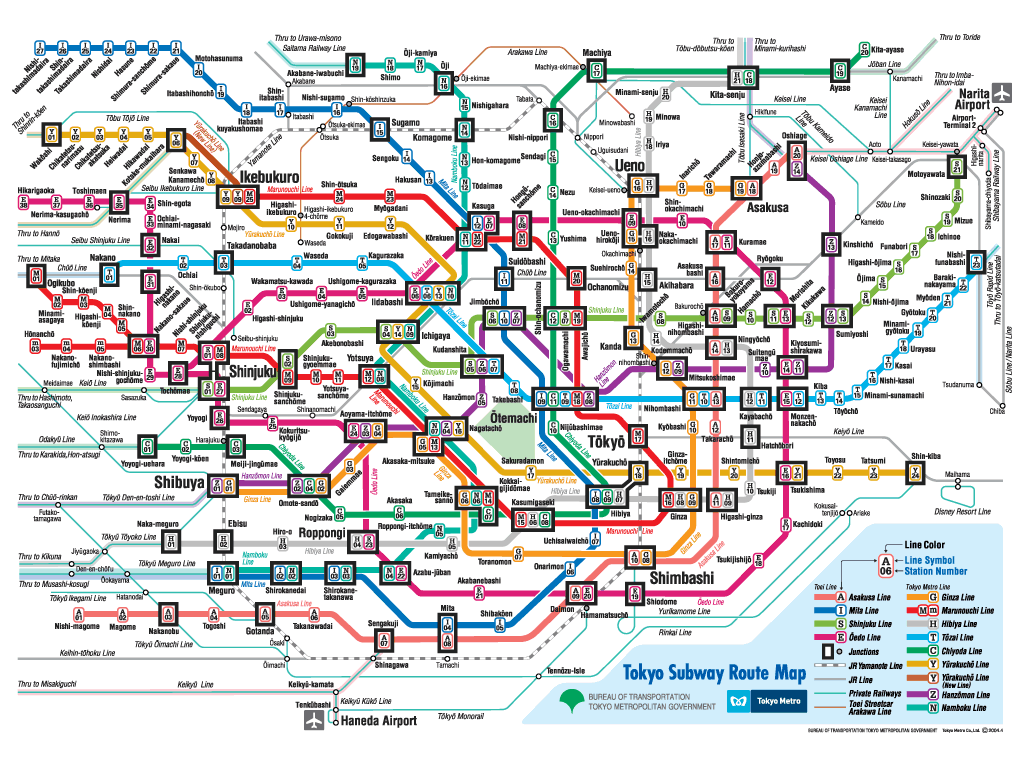 5.69 million passengers on an average day. 168 stations. 114 miles of tracks. 9 lines. And that’s just the Tokyo Metro system. Four private Toei subway lines and about 30 above ground Japan Rail (JR) East lines also crisscross greater Tokyo. There isn’t enough room on one map to depict them all.
When I’m asked about my favorite Japanese words, I rattle off subway stops to surprised reactions. “I never thought about the names before. They are just station names,” one local girl told me. Well, so is 51st Street, or Brooklyn's Avenue X. Unlike their New York City counterparts, however, Japanese names naturally roll off the tongue, begging to be repeated for sheer linguistic enjoyment, which I do to puzzled looks from fellow commuters.
I’m partial to stations starting with “K,” “O,” or on the Chiyoda Line. Here are my Top 10. Can you find and pronounce them all on the map above? Click on it to enlarge. 10.Kayabacho 9.Sumiyoshi 8. Ochanomizu 7.Kasumigaseki 6. Higashi-nihombashi 5.Okachimachi 4.Kita-senju 3.Nogizaka 2.Kiyosumi-shirakawa 1.Kachidoki
Thursday, July 28, 2005
Keitai Dreams
The sun was shining. The humidity was low. It was a lovely day to pursue my keitai dreams.
Lacking a proper visa, my skies were filled with gray. Cell phone contracts are not approved for those holding temporary visitor status. Gray skies had lasted three months. Being without a keitai in Tokyo is like being without a car in Los Angeles. You feel helplessly cut off from the city passing you by. Pay phones and buses are for the birds.
Sleek Japanese keitai are years ahead of their  American counterparts. The latest buzz is touch screens. Features like 2-megapixel video cameras with zoom, 180˚ rotating LCD screens, infrared data transmission, video call, action games, and mp3 compatibility don’t raise eyebrows. But mine did as co-workers showed off their ¥1 phones for last year’s models with technology still unavailable in the States. Phones here do everything, including the dishes…that is, if your washer is Bluetooth enabled.
During my visaless existence, a friend of a friend had lent me his old prepaid keitai. With incoming calls free, I simply bought talk time to initiate dialing – at 57 cents/minute. Calling NY was cheaper than ringing next door. The kicker was that this model was so outdated and cheap that – forget lack of camera – the operating system was only in Japanese. Beyond dialing and picking up, the functions were Greek to me.
I affixed an instructional Post-it note to the  back in the event of an emergency text message. Press the paper airplane-looking key. Select option #3. In the flashing red box, hit enter. Select #2. Scroll down to the fifth field…. It became easier not to keep in touch with anyone.
However, a visa would be a passport to freely communicate using the coolest keitai, the keitai of my dreams. With the visa glue still drying, I popped into a store. I quickly realized that, despite my intention to comparative shop, I had no skills to bargain hunt.
I approached the sidewalk salesman announcing summer deals. ”Sumimasen, eigo ga hanase masu ka?” He put down his mic in mid-sentence, and handed me a bilingual phone. “No, no, no…does anyone here speak English?” Sweat dripped down his furrowed brow. The sales ladies inside were poking by the window like visitors catching a glimpse of a rare zoo animal. “Oh, no! He’s coming inside – run for your lives!” was the next thing that crossed their minds, as they went to pull straws in the back.
After failed attempts in Japanese to inquire about contracts, I found out the only English speaking au brand vendor was on the U.S. military base near Yokohama – talk about roaming. Just one operator in Tokyo was equipped to assist English speakers – a Vodafone branch in Tokyo Rail Station. There my keitai dreams were shattered.
¥1 phones only came with two-year contracts. Cancellation penalties applied. Monthly plans for one-year contracts were too expensive for my infrequent calling habits. Euphoric keitai anticipation collapsed into sad reality. To the sales clerk I uttered, “prepaid phone.”
According to Vodafone’s website, prepaid phones are ideal for people who receive more calls than they make (read: who don’t have a life – like the picture of grandpa using such a model). Since I have no friends to dial in Japan, incoming wrong number calls are free. But after three months of inconveniencing myself with an unworkable phone, I was merely swapping models. While relieved at the ability to finally set up a phone book (okay, I know three people), I kicked myself for ignorance. Since prepaid phones are not contractual, I could have purchased a bilingual model months ago without a visa.
Of Vodafone’s four prepaid models,  I, of course, eyed the cheapest. It was the same non-flip phone style as what I had. No bells or whistles. It was like asking for a IIc at the Apple store in Ginza. I refused to pocket a relic in the most technologically advanced nation. I splurged $65 for a model with a .3-megapixel zoom camera, which actually was a step up from my phone in the States. V301D only came in spark orange. So be it, at least I’ll proudly answer calls on Halloween. I couldn’t help but feel what my apartment neighbor blurted out: “You got ripped off!”
V301D does have a few redeemable features. Strobe light for incoming calls, sub display, and animecha. Animecha feature selectable animations that become the personality of your phone upon opening it or configuring settings. Puta the golden bear is a “cry-baby.” Hanako the bunny totes a snail on a leash. Mr. Zhen the panda “enjoys shaking his groove thing on the dance floor.” Mr. Tanimura the salaryman “faithfully does his bit at the office day-in and day-out.” Judy the white student is “as tough as one of the boys,” but “still enjoys being a girly girl.” And don’t wake Tanu-tan creature from naps, or he lashes out with bulging muscles.
All creative, but I selected Bi-nasu, 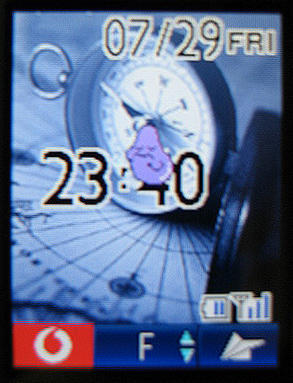 the bowing eggplant. Although nasu is one of the few foods I happen not to enjoy, Bi-nasu won me over with his lovable animations – blowing kisses, sunbathing, guzzling beer, belching, and eating his hair (the green calyx cap) [see photo, right], which also blows off in high winds.
His bio scrolls as follows: “Generally speaking I’m impatient, but I do slow down from time to time to enjoy life in the slow lane. Whenever I have some extra change in my pocket, I like to throw back a few beers with my pals.”
Now that’s an eggplant I can relate to. Having saved more than a few ¥500 ($4.75) coins on my crappy keitai, Bi-nasu, I’m buying.

