During my first year in Japan, I went to a professional baseball game with two students. A year later, I returned to the bleachers, but this time to watch my students take the field. High school baseball in Japan is like college basketball in America: fiercely local and competitive, and more followed than the professionals. Koshien, a national high school tournament, is like March Madness twice a year.
Shin Gakko has a reputation for sporting excellence. For example, women’s handball is one of the top programs in the nation, and a source of talent for the Japanese national team. The SG baseball machine is also a force on the field. Whereas some Tokyoites I met didn’t recognize the city ward (borough) in which I worked my first year, the name Shin Gakko in the suburbs rang a bell because of their success at Koshien. The potential for my students of today to become the professional stars of tomorrow wasn’t a trite exaggeration. This baseball squad was better trained than some national armies. Year-round practice, sometimes twice daily, cultivated a fighting spirit unleashed on a diamond battlefield.
Loaded bats rested on young shoulders. If the well-stocked trophy cases outside of the principal’s office were anything to go by, sports was the pride of the school, its reputation staked to athletic success. A strong Koshien performance counted for more than the exam scores of the other 2,000 students. Some teachers bowed to these crew-cut stars in spite of less than stellar academics, but I didn’t have to force favorites – their receptive attitude towards English made me an instant fan.
At the beginning of the school year, my enthusiasm still bubbly, I imagined myself being that loyal teacher in the bleachers. Visible and vocal, I’d earn a reputation of supporting students outside of the classroom while gaining respect inside it.
Language and logistical barriers, however, sidelined that lofty ideal. Just pinpointing ever-changing game locations proved a challenge. In space-starved Japan, the school’s only field was a fenced-in dirt patch where handball, soccer, track and tennis teams practiced, often simultaneously. As a result, baseball games were held off-site. Those on the weekend were both hours from home and sometimes beyond the reach of public transportation. And reporting to work every other Saturday only increased my desire for distance from school-related activities. Instead of becoming the regular I aspired, I barely made a cameo.
I wouldn’t have even managed one game without active recruitment from Kijo. The second baseman and I had been talking about the upcoming game against Bunryo H.S. for weeks, at a clip of one sentence per day. A morning update from Kijo was part of my routine. I’d punch in at 8:11 a.m. and change into “indoor” shoes that carried me across the concrete courtyard to an 8:15 meeting. Two stories above the courtyard, the 12th grader leaned out of a window to inspect the flood of uniformed foot traffic clomping towards classrooms. I stood out for my size.
“Gooood morning!” Kijo saluted from above. I signaled a silent response. He then cupped his outstretched hand skyward to detect any drops.
“The weather is fine today,” he concluded with a smile worthy of a toothpaste commercial.  Actually, the sky was a miserable grey, but in Kijo’s world the sun was always shining. He had a class president’s persona – affable and outgoing among friends while respectful and studious for teachers. During a year when I struggled to cultivate classroom interest in English, Kijo was a refreshing exception. He initiated conversation in English, and used proper grammar without perversions. From this window we forged a friendship.
If only he had been my student. Those of my own had no appetite for English. Only running the mile seemed to draw longer faces. Yet among the bright spots of talent, lights few and far between, were those with mitts packed among their textbooks.
“Baseball game against Bunryo is in two weeks,” Kijo reminded with a wave before shifting his attention to a teammate below.
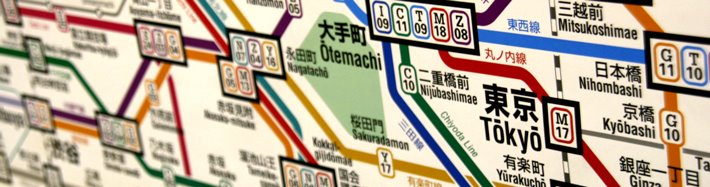
He did more than just remind me. He created a color-coded map labeled in English. It highlighted the way from school to the game with times and transfers for a series of trains unfamiliar to me. Yet my confidence in the cartographer faltered at rural Asaka station, the last stop on my map. A distinction between east and west exits was not labeled among the landmarks. Before I bet on one direction, I saw something familiar, but not from the map.
It was a short navy skirt with gray socks pulled up to the knees. Uniforms were required when attending school-related events, even on weekends, a protocol I suddenly praised. I was relieved to run into Manami at the station. Actually, it was more like I ran after her. I followed her familiar uniform from a distance, hoping she would show me the way.
At first I thought she sensed the stalker in me, leading me in circles through the station. It turned out she was just as lost, so I blew my cover to combine our resources – my illustrated map with her native tongue. Although in Kijo’s grade, she didn’t share his fluency. After six years of study she couldn’t string together two words in English.
After walking for 15-minutes in silence, a stadium came into sight. Manami and I entered side-by-side, dropping the jaws of the student ticket takers and drawing stares from parents handing out programs. I smirked off the attention as Manami led the way to our seats. Inside, school supports took sides. Each section fired up its team with a repertoire of chants, honking trombones and pails of water sloshed on supporters after a run scored. I recognized Shin Gakko students and their band along the third base line. Not sure if off-duty teachers were welcome in the cheering corral, I tagged along behind Manami to the general seating and parent area behind home plate where two of her friends were waiting. The bands blared fight songs to introduce what would be a battle of a game.
Emerging from the dugout in uniforms crisp and white, these teenagers looked like minor leaguers taking the field. A scoreboard flickered to life, and a female announcer introduced the first batter to one-sided applause. Speedy centerfielder Shintaro Nishida stepped to the plate. The hardened looks on players’ faces spread to the spectators. Lines were drawn; everyone dug in.
Shin Gakko knocked in four runs that first inning, but I didn’t recognize any of the batters. Although I taught a number of students on the team, most were sophomores who went through the same punishing drills during daily practice, but watched their elders compete until age privileged them to perform. Kijo, although a senior, seemed not to be in the lineup, but I spotted his white smile around the dugout high-fiving teammates who had scored.
During the 7th inning stretch, players raked the dirt infield. In the stands, mothers busied themselves dispensing paper cups of tea to thirsty supports resting their voices that had quieted since the first inning outburst; we were now down by a run. An offensive reawakening in the 8th inning, however, prompted me to write this column for a newspaper designed for non-native English speakers.
After the game I sought out Kijo to congratulate him on the victory. Before I could get to the throng of players, I bumped into
Principal Ouchy who, in his standard suit and tie, at first didn’t recognize me in a backwards baseball hat and jeans. Elation from the late-inning heroics masked any grumble of disapproval. After all, his school’s reputation was safe for another week.
After recording the final out, Shin Gakko's team (in white, left) rushes to the batter's box where both teams will bow to each other.
Sunday, February 10, 2008
The Away Game

Thursday, September 20, 2007
My Summer Vacation
September spells the end of freedom for students, and the beginning of grading My Summer Vacation journals if you’re an English teacher at Shin Gakko. Back in June I asked Egg Man, the department chair, what assignment we should give our ESL charges over their six week break.
“You mean like some kind of homework?” he asked like I had suggested going against the laws of physics. Apparently such a concept was unthinkable, or at best, discouraged. Above Egg Man’s doubts, I recommended a journal project as an easy, open-ended assignment for students to document their summer vacations. Educational merit aside, I was deeply curious about what the little buggers were doing with their newfound free time.
I designed a booklet with six pages, each split in half. Knowing that there were more cartoonists than wordsmiths among the rows of silent mouths drooling on desks, the top half of each sheet was left blank for optional drawings, photos or newspaper clippings. Double wide lines ruled the bottom half; five short sentences could easily fill the space.
Although originally intended for only my three classes, the assignment quickly won converts across the department. Egg Man ordered hundreds of additional copies; now all 14 high school English sections would be journaling this summer. Such a progressive assignment seemed like a good idea at the time, even at the risk of losing popularity among the moaning students. When school resumed in late August, however, a challenging stack of journals awaited my red pen and its refill of ink.
Scribbles of English were so incomprehensible that I had to limit myself to a dozen journals a day or risk fluid swelling in my brain. Out of more than 500 pages reviewed, my hand-picked favorites are reproduced below. These essays stand out for the lyrical simplicity of their prose that makes for a rhythmic and poetic read even if results run well wide of the grammatical mark. Without any further ado, I present to you:
MY SUMMER VACATION 2006
The summer of Japan must fan. It is very convenient though it is not a wind of nature. Mosquito incense coil. Peculiar shape. Smell. There is an electric type today, too. I thought that the culture of Japan was very wonderful.
It is July 24 today.
Visiting a library on the way.
Children who had been doing the insect removing in the park were seen.
I thought to play in such a wind recently.
Such hot everyday.
It is likely to have to play outside only on such a day.
It was hot today.
First day, we are swimming in the pool and sea on the hotel all day. At night, we have a dinner at the hotel as smorgasbord, which there are Japanese, Chinese, Western food, fruit dessert and various drink and so on.
I went to sea with my littler brother and cousin and uncle and ant. Today is hot. I can few swim. So, I used float ring. I swimming in the sea. Then, I was nearly drowned! the wave was floated my float ring to the shore. I thought die.
August 15 sunny + cloudy
I couldn’t do homework. Because it is very hot today. My room was very hot when I comed from school. I will do homework. But, it is hot today. So I feel a lack of motivation. I think that I want to do cold tomorrow.
August 16 Wednesday
I met an old friend again. He is mother’s boy. I gathered in a house of a friend. I ate curry to lunch. Nose hair stick out. I was very happy on that day.
Today is August twenty three.
I went to school because today was toukoubi. This means go to school day. Teacher talked about new term. I thought that I haven’t finished homework yet. I thought that Vacation has already ended for two weeks. I thought that how early it is!
I thought I sad.
8/31 – It is a day the last in summer vacation today. Homework has not ended yet. I think it is staying up all night today. Please help someone.
For other Engrish entries, have a look back on past compositions at other schools.
Wednesday, June 20, 2007
Introducing...The Staff

Generally speaking, the staff here at Shin Gakko is excellent – friendly, tolerant and dedicated to a fault. They treat us foreign teachers as quasi equals even though we are, well, barbarians who break house rules with only casual teaching credentials to our name (i.e. being native English speakers). Below are staff vignettes with Anglicized nicknames to protect the innocent and mock the guilty.
Arlene
Personal secretary to Mr. Ouchy. Never fails to "herro good morning!" me with her only three words of English while we’re riding the elevator to the 8:15 a.m. staff meeting.
Bambi
A dear of a home economics teacher. Young, sweet and single.
Biology Bob
Quirky science teacher I sit next to in the teachers' room. Never seen him eat lunch all year.
The Bento Babes
Three mothers who staff the school canteen (“The Bento Shack”) where bento box lunches and vacuum-sealed breads are the source of lunchtime sustenance when I don’t have time to chow down on Bertha’s cafeteria cooking.
Bertha & the Kitchenettes
Bertha leads this endearing cafeteria cooking crew. Her bright smile, short graying hair, strong forearms and stronger work ethic merit a comparison to a Japanese Rosie the Riveter. The best part of working at Shin Gakko is their bathtub-size curry rice or fatty sauteed beef bowl.
Charles
British co-worker who amuses me with his daily antics in an otherwise by-the-book atmosphere. Once accidentally exposed himself to Gloria.
Commander Kickshit
Overzealous, gruff boy’s P.E. teacher with an impressive wardrobe of matching Adidas tracksuits. Hates kids and English even more. Dishes out an excessive number of pushups to his lanky charges. Could benefit from a rainbow Care Bear or a bear hug.
Egg Man
A pun on his real Japanese name, Egg Man and I teach English to my insolent homeroom class of 7th graders. “So what we gonna do?” is his patented phrase before we enter the room. With the little monsters waiting inside, I’m tempted to call the Ghostbusters.
English Inc.
Faulty placement agency that duped me into this job. While its employees are nice as individuals, I’ve butted heads with the company over working conditions, salary, health insurance, time off and everything else in my flawed contract.
Esther
Perhaps the longest tenured teacher at Shin Gakko, Esther reminds of my eponymous late grandmother with her passively barbed comments. Despite my limited role as a human tape recorder in her two sections of 11th graders, I look forward to class as a way to spiritually reconnect with Grandma.
Gloria
Terse custodian who sweeps the halls with a grimace. Has no qualms about mopping the men’s room while I’m doing time on the can. Normally a shadowy background figure, Gloria once took center stage when she tumbled down a flight of stairs outside of my English class.
Head of English
But ironically one of the worst at it, Head is an example of textbook learning gone horribly wrong. I bite my tongue whenever he begins sentences with fundamentally, as you know and namely. Case in point: “As you know, in five minutes, namely 8:25, there is a homeroom class of fundamental English.”
Irma
Gloria’s gloved subordinate.
Mr. Microphone
Balding audio-visual guy who wears dark sunglasses even inside his studio cave outfitted with floor-to-ceiling sound equipment circa 1986 and flickering monitors with murky images.
Ms. Mitohara
The most helpful and competent English teacher I’ve ever worked with. She has been my lifeline to any and every question concerning a frustratingly disorganized school management. Yet as a junior teacher and a woman, responsibilities bypass her in favor of more senior and English incompetent male colleagues.
Ms. Murasaki
Prim and proper, this Japanese language teacher is unfailingly polite. Behind that perfect façade, however, I just know that she yearns to abolish English language instruction and banish the barbaric foreigners defiling her country in the name of teaching it.
Mr. Oki
This young and dumpling-shaped English teacher and I teach two sections of 10th graders. Future dream: escape Japan and move to Melbourne.
Mr. Ouchy
A pun on the principal’s Japanese name. His chauffeured black “President” model sedan idles out front sparing him the 15-minute walk to the train station.
Soccer Dan
Finally, a hip math teacher! Tall and 24, Dan draws a line of girls at his desk seeking extra attention after class. Once a soccer player in college, the sportsman keeps in the game as a coach for the boys’ team who rank just behind baseballers as the big men on campus.
Sunshine Suzuki
Ebullient and enthusiastic, this female gym teacher coaches the 7th and 8th grade girls. For my assistant gym teacher duties, I am fortunate to be paired with her rather than Commander.
Suzuki & Suzuki
Two sister spinsters staffing the school store stocked with overpriced mechanical pencils and notebooks. Hairnets, buns and white-powered faces are a throwback to pre-war Japan.
Trudy
Reminds me of my grandmother after she began forgetting my name or that, yes, we have class today and, yes, it started five minutes ago. Her English pronunciation is so mangled that even I have trouble catching the non-sequitors spitting from her mouth. We team-teach one vacuous class of 10th graders who silently count down the minutes until the bell ends foreign language hell.
Unfriendly Wendy
Crotchety head receptionist holding court in the main office where Arlene sits. Faxes my monthly timesheet to English Inc., begrudgingly.
Velma
Dwarfy librarian never without her maroon apron and thick glasses. Possibly having an affair with Mr. Microphone.
Monday, March 19, 2007
Teacher, Can You Spare A Coin?
Spit hit the curb with a smack outside of 7-11. It was 8:06. My eyes moved up from the ground to the source of the guttural noise. I knew that kid. A 16-year-old with a freshly shaved head, his white shirttail peeked out the back of his black uniform jacket. Matching trousers hung low on his slim thighs. He wasn’t my student, but I’m sure we had talked on occasion, probably about coarse rather than course subjects.
His arm amorously wrapped a classmate as he initiated a private moment in a public place during morning rush. One of the great things about Japan is the taboo on P.D.A., which he was flouting while spitting on the road (much more acceptable).
We both reached the door at the same time.
“Oh, sensei [teacher], ohayo!” he greeted with a devilish grin.
“Hey, how are you?” I asked what’s-his-face.
“Oh, sensei,” he cocked his head and repeated, unable to muster the simplest answer in English.
We headed for the same aisle, he for breakfast bread and I for fruit juice. Selection was good. Bread shelves were stocked with all of your favorites like chocobread and peanut butter cream Danish.
“Whaddaget?” I asked.
Corn bread. And by corn bread I mean yellow kernels embedded in white stuff on a Danish.
“That’s disgusting,” I said in Japanese.
“Nah, it’s delicious,” he countered.
I turned back to scan the juices and make a final selection.
“Sensei” he called. “I forgot my lunch.”
“OK, well, here you are,” I said, waving to microwavable pasta with hot dog slices and egg salad sandwiches stuffed with the yolks of those hard boiled.
This morning I felt like apple juice.
“Sensei” he called again. “I forgot my money.”
It was the quiver in his voice that turned me around. I stared into his drooping eyes for clues on how to react. His girlfriend stood in his shadow. Wasn’t she less forgetful? Whether the kids like it or not (and most do not), I get paid to be their teacher. Yet here was a chance to do something more than that. Here was a chance to play dad. I moved closer. I didn’t have to think for long.  My hand intuitively dipped into the outer pocket of my bag. I felt the raised edges of a ¥500 ($4.25) coin and fished it out. His eyes were trained on my bag, waiting to see how much I’d pull out. I felt like everyone in 7-11 had also paused to witness charity in slow motion.
Compared to the rest of Asia, there aren’t a lot of needy kids in the world’s second largest economy. Yet here I was giving the gift of lunch money – enough to make Sally Struthers proud.
“Sensei, arrigato. Arrigato, sensei!” he thanked while cupping his hands to receive the oversized golden gift.
He said it would cover him for both today and tomorrow. Then he grew silent. It was my turn. To foster some sense of responsibility, I told him in which teachers’ room I sat.
“Tomorrow,” he cried in Japanese.
“OK,” I smiled.
“Or the next day!” he added, heading to the register.
N.B. Hey kid, “tomorrow’s” been three months and counting. Sensei wants his gold coin back.
Wednesday, March 14, 2007
Interview with the Foreigner
 I’m more used to writing about others than being written about, but Shin Gakko’s in-school magazine included me in their quarterly issue (click picture to enlarge). Don’t mind my photo, although at least my tie matches my flag. In case you are like me and those pesky kanji are like Greek to you, here’s what I had to say in plain English. Questions are listed exactly as I received them. Answers, however, may deviate slightly from the Japanese printed.
1. Where are you from?
Brooklyn, biotch. You steppin’?
2. What good things about your country?
A lot of space for living and the freedom to live the life you want comfortably.
3. What makes you come to Japan?
Fresh sushi, jinsei-keiken(life experience), schoolgirls in short short skirts.
4. How long have you been in Japan?
20 months. Time fliesね!
5. What makes you attract about Japan?
Good food, healthy portion sizes, reliable trains, and interesting culture.
6. What’s your favorite Japanese food?
Sushi (salmon, salmon roe, eel, tuna).
7. What’s your least favorite Japanese food?
Oba.
(N.B. green perilla leaf also known as shiso used as a garnish in sushi and other dishes.)
8. What’s your favorite place you have visited in Japan?
Daytime, Kanazawa. After dark, the neon (red) lights of 歌舞伎町.
9. What’s your hobby?
Traveling, photography, writing.
10. Have you ever experienced any jobs (excluding teaching job)?
Sports instructor in Guam. Paralegal in New York. The usual.
11. What’s your motto?
If at first you don’t succeed, try again. Harder.
12. Do you speak any other languages?
Español, which despite not using for almost a decade is still light years ahead of my Japanese. (Sigh).
13. Please give our students to your message.
The world is big. Go discover some of it. Learning English can be your passport to new places.
Saturday, March 03, 2007
Tohoku, We Have A Problem
Within the first two weeks of my new commute to Shin Gakko, I was delayed more times than in the previous year combined. I can thank the Keihin-Tohoku line for that. It’s one of Tokyo’s busiest, and as I’m learning, most breakable.
One morning the train stalled in the station for 10 minutes, rattling my confidence in Japan’s to-the-minute timetables. However, as this line also serves the 2,000 students at Shin Gakko, I felt safety in numbers showing up late.
Two weeks later it got worse. Much worse. Ascending the platform at fun-sounding Okachimachi station, I saw a blue train stuck halfway in the station. The doors were closed, but some passengers were inside. Concern crossed the face of the young conductor poking his head out of the window. After an unusually loud horn, the train lurched forward 15 feet and halted. On the opposite side, a green Yamanote line train glided into the station. I smirked to the suckers stuck inside the blue train, and hopped aboard. Blue and green lines run parallel before green splits off to loop around central Tokyo. I thought I’d be clever to bypass the disabled blue train by riding the green one to the last of their shared stations, and catch a blue train further down the line.
Four stations later, I joined the throngs at Tabata station. I had outsmarted myself. There were no blue trains here. Everyone was waiting for the one stuck at Okachimachi. And when it did get moving, that train would be packed with four stations of stranded commuters.
Long overdue, the blue train arrived to an agitated swarm of commuters jockeying for inside position. I laughed to myself. They would never all fit. I didn’t join the fray because I had chosen a poor day to shed my laptop’s bulky carrying case in favor of an unpadded messenger bag.
As only the Japanese can do, everyone squeezed aboard. Except for me. Alone on the platform, I felt their stares drawing me inside. I scanned their pained expressions and noticed a woman smiling at me. I returned her smile with a shake of my head. I was waiting for the next one, which would be almost empty. Had I outsmarted myself again?
The doors never closed, and passengers were gasping. Embarrassment turned to satisfaction as riders rethought their decision, and began lining up behind me. An incomprehensible announcement (at least to my ears) led more to switch sides until the train was less full than when it arrived. That’s when I went in. I spotted two of my students standing inside. Now with enough space to safeguard my laptop, I joined them. They became my lifeline for what qualified as a serious delay, but one that was seriously refreshing.
Some locals gathered along the fence watching the empty tracks. The silence was deafening. Today, the rails shined brighter. Concrete buildings looked a little more charming. The unpredictable had tossed routine on its head. Fretting commuters checked their wrists while I rocked back on my heels.
I spotted the same youthful conductor, and took an interest in his increasing exasperation. No one confronted him, but he could feel the scorn of hundreds of grumbling commuters. I wanted to buy him a beer after this run. It was Friday for me, but his weekend (career?) was ruined. He announced alternative routes to reach destinations, including mine. It involved transferring three times when all I wanted to do was take this train directly there.
If you’re late, you might as well be really late. I wasn’t in the mood to move, and of course the lazy junior high kids weren’t either. Service resumed after 20 minutes, and despite a reverse commute, plenty of people were now waiting to go to the suburbs. I staked out a corner and stood facing the wall to shelter my bag in front of me.
The conductor announced stops with his eyes closed. He looked 22, and was breaking out around his temples. The microphone trembled in his white-gloved hands. His voice remained composed over the P.A. system, but speaking from the back of his mouth and not his diaphragm, it sounded like each word would be his last. The burden of everyone’s lateness was suffocating him.
And then it suffocated me. Passengers flooded in at the next station. I saw one of my students get carried away in the human tide. Uniforms, briefcases, and backpacks crunched together. I got thrown face-first into the wall, and the safe zone for my laptop vanished. I elbowed the bag above the masses, and cradled it on my shoulder like a baby in rising floodwaters. Toes tingled and my arm tired; I rested the bag on a schoolboy’s back, his cheek smeared against the glass. When the doors opened at my station, it was like pulling the stopper out of a bathtub drain. Train etiquette in polite Tokyo doesn’t include waiting for passengers to exit before boarding. I waited until the flow had reduced to a trickle to make my move, but once again misjudged. The tide reversed itself before everyone had cleared out, and commuters – backed up into the stairwells – rushed in.
I punched into work 30 minutes late, but was hardly the last to arrive. Quadruple suicide? I asked the other teachers the cause of the delay.
“Nah, they can hose that down in five minutes,” another foreign teacher said. “It must have been a signal problem.”
On the way to first period, I mechanically asked a high school girl, “Hi, how are you today?”
“I’m surviving,” she said with a smile. Surprised at her skillful English expression, I couldn’t have agreed more.
Monday, February 19, 2007
Where’s the Love?
Not that I needed any hard evidence, but Valentine’s Day at Shin Gakko confirmed what I already suspected: I’m less popular with junior high school girls than Bush is with Europeans…Americans…or anyone for that matter. Speculation into my plummeting popularity will be revealed in blogs to come. Meanwhile, Valentine’s Day was a reversal of fortunes from last year when I was showered with cookies and chocolates. This year I was nearly shut out.  Only at the eleventh hour (3:55 p.m.) did adorable Ayana with her jack-o-lantern grin (seen on the right in her school uniform) offer me sweets, and even this transaction had to be done on the down low and after school. Gifts of affection to the opposite sex are an embarrassment for 13-year-olds, and with me as the recipient, Ayana risked her own popularity for this overture.
Expectations weren’t high that morning after checking my class schedule. Afternoon lessons were cancelled, and one of my three morning classes was with all boys, busy collecting chocolates of their own. I immediately ruled out munificence from the sour seventh graders (Ayana is in the other section). That left first period with more mature eleventh graders as my best chance, but only two girls delivered, and they were from the afternoon section that got cancelled.
Were it not for the generosity of a gym teacher, I would have left school with an empty heart while some colleagues needed shopping bags to haul home their loot. Truth be told, I don’t care about chocolate – it makes my skin break out. Most of the sweets I received were redistributed to other classes as prizes to reward student effort on the cheap.
Despite the disappointment, not all was lost that day, as I carried out a special lesson plan hatched purely for my own amusement. In addition to the vocabulary-building word puzzles, for Valentine’s Day I was going to make them sing. Or at least follow along. I printed out the lyrics to the most embarrassingly romantic song I could play for a class of 39 high school boys, many of whom were jocks.
Ballplayers with crew cuts dutifully recited “I Will Always Love You” at my command. After each stanza the Japanese English teacher translated. Once they were well versed, I hit play on the CD player and grinned. Words are one thing, but sound is another.
A few eyebrows arched in muted disbelief as Whitney Houston filled the room with high notes and heaving sighs. English grammar may be a hard slog for these guys, but eternal affection is an international emotion, right?
While a classroom of American boys would have revolted at music from “The Bodyguard,” their Japanese counterparts were totally mellowed out. That is, until my impassioned lip-syncing and heart pounding coincided with Whitney’s hitting those impossibly high notes at the end, which got them in an understandable uproar. Without any girls to wink at, I tilted my head and outstretched arms at the ceiling while I mouthed the song’s title for the fifth iteration.
“Sensei, sensei,” one begged me to stop. But that was part of the fun. In my class, the “E” in English stands for entertainment, otherwise they don’t stay awake.
After no one fessed up to having a valentine, I gave the boys a homework assignment. One good thing about teaching is that it gives me a platform to preach – quite literally, as each classroom has a raised step behind the teacher’s desk designed for my shorter Japanese colleagues.
“OK everyone. Today go home and tell your mom that ‘I will always love you.’ Class dismissed.”
A teacher should practice what he preaches, so Mom, if you’re reading this, Happy Valentine’s Day and I will always love you.
Wednesday, January 31, 2007
What the #@$&?
is my usual reaction as it sputters to a halt, beeping twice and flashing lights red with anger.
So far, the most challenging aspect of this job has not been learning student names, adjusting to team-teaching methods, or working full-time in a Japanese environment. It’s been making photocopies.
For a country that exports cutting-edge Cannon and Konica products, this private school (not short on endowment from 2,300 students) uses off-brand machines without a paper feeder. If you thought finicky office machinery in America was frustrating, try your hand at making copiers cooperate that are fluent only in Japanese.
One of the three machines is often out of order. When errors arise, the pictorial diagrams popping up on the LCD screen are just as incomprehensible as the message…usually something about door A on the front of the copier.
The most dreaded encounter is with the toner, which magically runs dry whenever I step up to the machine. Spent toner rolls must be unraveled like an inky accordion, rubbing off on hands and clothing. It’s a dirty job, so rather than messing with it, I switch to the next machine.
When that, too, fails, my technical know-how springs into action. The best solution to get the gears whirling is also the simplest. In fact, it’s sort of like playing pinball – rock the machine while blindly pushing buttons until you hit the jackpot. Observe:
Step 1: Open door A.
Step 2: Yank random lever.
Step 3: Slam door A.
Step 4: Repeat steps 1-3
Step 5: Kick machine where it hurts. If no response within 15 seconds, kick again harder.
To further get out aggressions, I turn on Mac – my name for the guillotine of a paper cutter that gathers dust by the window. This thing could slice through a Redwood. It, too, is vintage, yet is smartly designed (activating the cutter button requires both hands after turning a key).
If office machines could date, Mac would be the meathead boyfriend of Ms. Shredder. That’s the actual name of a dainty lil’ thing unable to shred more than three sheets at a time. She’s so temperamental that she’s better left unplugged, just like some of the girls in my homeroom you’re about to meet.
Tuesday, January 23, 2007
Supplies & Demand
Face it. The best thing about going back to school was shopping for supplies. Roaming the wide aisles of Office Mart, the whole year seem so fresh, so organized, so possible. Five-subject notebooks and three-ring binders were staples of students. Stocking up on supplies was a motivational exercise despite knowing full well that a month later you’d be searching for incomplete homework in a folder bursting with papers across five subjects.
When you’re a teacher in Japan, however, the supplies come to you. Two days following the footwear misstep on my first day, I was inventorying inherited junk in the desk drawers. I’ll list last year’s leftovers from most useful to most disturbing:
- Scotch tape
- Chopsticks
- Pliers
- Burberry-patterned scarf
- Old batteries
- Frisbee
- Coloring book of the 50 states
- “Fifty-Fifty” English learning cassette
- Biology for Dummies
- Martial arts gloves
- Punctured ping-pong ball
- Soiled socks
- Empty box of Durex
Not confident to speak up in Japanese, I looked around to see if anyone else was witnessing the injustice. Across from me, another new foreign teacher smirked while twirling his unsharpened pencil. Missing out on the correction fluid pen, however, was the last straw. I had to have it.
The metallic clinking of the ball inside was the sound of productivity. Sort of like a mating call in the jungle, shaking the pen announced something authoritative – that you were perfecting the details of an important project.
“Sumimasen,” I said softly to the man as he was in mid-delivery over a neighboring desk. I didn’t know what else to say once I got his attention. I just pointed to my desk and put on a face that pouted, “Yeah, I’m new here too – just like the three other foreigners receiving supplies.”
He apologized (profusely), and caught me up to stock. I waved the white out pen at my co-worker with a celebratory rattle.
Tuesday, January 09, 2007
Opening Ceremonies
To kick things off in the Year of the Boar, I’ll start at the beginning, which happens to be nine months ago when I began a new job. More demanding hours combined with an increase in paid freelance writing have hampered leisure blogging, so I have a lot of catching up to do.
Rotating among four schools last year, I found it hard to develop friendships with students. I was there solely to assist the Japanese English teacher, and felt awkward asking to eat lunch with the kids or being caught clowning around during recess, often as party to the mischief.
Then along came Shin Gakko, a private school that actually encouraged foreign teachers to be active in the lives of its learners, which included junior high and high school. On top of English lesson planning, my other roles were to be an assistant homeroom and gym teacher. Shin Gakko seemed like the perfect match to grow with the same set of students in various settings around school.
Head first I went to day number one with plenty to cover my feet. Changing footwear is an ingrained habit of Japanese life. For example, in my new, shared apartment, I check shoes at the door and change into one of three pairs of slippers depending on if I’m showering, doing laundry on the porch, or walking through the living-dining-room-kitchen.
At school, here’s what you’ll find in my locker and bottom desk drawer:
1. outdoor shoes – what I wear when I come to work
2. indoor shoes – what I change into to wear inside school
3. ground shoes – what I change into if gym class is outside in the dirt lot
4. gym shoes – what I change into if gym class is in the hardwood gym
5. slippers – for carpeted classrooms
Upon arrival, most teachers change out of their dress shoes they wear to work. Apparently dirt from outside of school isn’t to mingle with dirt on campus. The result is comedic. Teachers look business from head to ankle, but covering their toes are mismatching sneakers or el cheapo sandals with off-colored socks. Assimilating to the strict footwear code of conduct, however, doesn’t have to be difficult. Other foreign teachers here have streamlined the system by wearing a universal pair to cover all surfaces.
I wish I had done so on opening day. That morning I traded black dress shoes for “indoor” white Pumas, which – shhh! – on weekends I wear out to bars and clubs. I had no idea what to expect that first day, but it turned out a little like the Olympics’ opening ceremonies, but with only one country competing.  Lined up in their gym clothes for Sports Day practice.
Convocation was held in the dirt schoolyard with a baseball diamond. Students in linear formation endlessly marched in class by class, and used military-like maneuvers to evenly space themselves out – no small feat considering that there were 2,200 of them. With so many pupils, the high school feels more like a factory churning out students packaged with the same school crest lapel pin.
High school boys wore cadet-like black blazers with a dozen gold buttons fastened from waist to collar. Girls paraded in navy sailor tops and pleated dresses. Middle schoolers were outfitted in tiny grey jackets and trousers or dresses. Black shoes clomped all around. They looked like a uniformed fighting force of a small nation. Standing silently at attention, they awaited word from their commander-in-chief.
The principal faced a microphone on a raised podium over first base. Aged and important-looking men (retired generals?) flanked the platform while rank and file teachers fanned out around the perimeter of the yard. Like the rest of the Japanese workforce, teachers wore shades of black. The overcast weather also dressed for the occasion. I had not.
New teachers entered last. We followed the third base line, touched home, and lined up along first base near the principal. The five foreign teachers were the last of the last. Scanning the group of new Japanese teachers in black shoes, panic swept over me. Mine were white, and for indoors.
“Those are nice shoes, but I’m not sure if I’d necessarily be wearing them right now,” the American behind me said. It was too late to change. My stomach knotted as I faced the crowd standing one teacher away from the end (home plate). Maybe if I stood on the white base line nobody would notice. They did. The foreign teachers cracked jokes as we applauded the entrance of the junior high, the final troops to deploy.
Speeches began without my comprehension. Bowing seemed to be the theme because we did it before, many times during, and at the end of each speech, which were mercifully brief. Then it was time for new teacher introductions. Three by three, newbies ascended the platform to have the chief announce their names before bowing down.
I secretly wished for a sudden downpour. Once the main ingredient for my popularity last year, my snow-colored Pumas would now trigger an avalanche of embarrassment. Three of us foreign men were the last to go up. Walking past the other teachers I also noticed that I was the only one not wearing a white dress shirt, but luckily had a black spring jacket to mask the sky blue underneath.
The sea of bored faces suddenly rippled to life. I’ll never forget the sequence of noises as we assumed the stage. Dead silence, followed by murmurs loudening into laughter. Never mind the feet; it was the face. Three tall, pasty white foreigners (one with shoes to match) were just too much of a contrast from everyone who had bowed before.
Retreating to ground level, I reflected on how my first day could have been worse. That morning I almost pulled beige slacks out of the closet.


