...Continued from previous post.
The Shinjuku Ward tax office was a nondescript building in a nondescript section of Shinjuku, just beyond the shadows of the district’s celebrated skyscrapers. At first I walked right by, mistaking the four-story structure set back from the road for a school – a class of building molded from a similar concrete cookie-cutter batch.
Inside, the room of bureaucrats silently shuffled papers at retro metal desks under light fixtures yellowed with age. Lines snaked on the worn salmon carpet as people waited to turn in forms I didn’t have and couldn’t read.
Not sure of where to start, I walked up to an unstaffed counter. My strategy for assistance was one of entrapment. Looking helpless becomes an advantage when playing upon the innate sensibilities of the Japanese to deliver superior customer service no matter who the client.
I set myself as bait, standing tall and vigilant. One glance and Hiroshi was hooked. Our eyes met. I reeled him in with a smile and wave of papers (actually just the map the Oracle had circled).
Short spiky hair and acne-scarred cheeks gave him a fresh out of school look. Hiroshi was easily the most junior on the graying staff, and as a result was probably under 9-to-5 orders to serve whoever the wind blew in, such as clueless gaijin like myself.
Even though we couldn’t communicate, he dutifully ushered me to a long table with a wood pattern laminate peeling from the corners. I had seen this before. I flashed back to elementary school lunch tables on which I unwrapped the tinfoil around a PB&J sandwich my mother packed with two Saran-wrapped Oreos and a napkin inside a brown paper bag.
Instead of taking out my lunch, I handed Hiroshi the earnings slip that prompted the Oracle to steer me here. Turning in the paper was like loading batteries into a robot. Hiroshi sprung into action, picking up a form that looked like an accountant’s crossword puzzle. He plugged numbers into formulas, tapped on a calculator and juggled the results into rows of white boxes.
“Maybe you owe money!” echoed the Oracle’s haunting forecast.
That outcome worried me. Here I was going out of my way to do the right thing, and I prayed to be rewarded with a tax payout, not punished with penalty for a balance due. I watched Hiroshi’s tabulations with the fixation of a tennis line judge. Refund, refund, refund, I chanted to myself, holding my breath for the sum to settle. Totals climbed with additions and tumbled with subtractions. I felt like I was on some kind of personal finances game show hanging on to see which way the balance would tip.
¥26,820. Hiroshi put his pen down. Positive or negative? I sought clarification in his eyes, but he directed them towards his senior who had appeared behind him to supervise the calculations and translate the result into English.
“This number is your refund,” the man said of my approximately $240 windfall.
I exhaled. In my next breath I naively asked for my winnings in cash, drawing laughter from both employees. A casino this was not.
As I scribbled my bank account information on a deposit form, another sheet of paper appeared. It was a letter – in English and addressed to someone else. Apparently I had to do some off-the-books work to secure my money. No matter what a foreigner’s occupation in Japan, no one is immune from at least some degree of teaching English. Spontaneous tutoring arises without warning and in unusual places, like here at the local tax office. I ignored irregular capitalization as I proofread the letter about a foreigner’s double filing mistake. When I, too, rested my pen, we traded bowing thanks over the long table.
Outside the rain had stopped, and the pavement gleamed under thinning clouds. On my way home I decided to stop by the Oracle to share news of my good fortune.
Sunday, September 09, 2007
Tax Office Jitters

Friday, August 31, 2007
The Oracle of Shinjuku
“There are only two things you have to do in life to be a good citizen,” the Honorable Justice Evans pleaded to the half-filled central juror room at County Courthouse. “Pay taxes and do jury duty.”
After two postponements, there I was reporting for duty less than a week after returning from Japan, which doesn’t have such a legal system, but is considering adopting it. In the meantime, were Justice Evans addressing Tokyoites, he might substitute proper disposal of household garbage for jury duty. Paying taxes anywhere is a given, except maybe in Dubai.
As I looked forward to fulfilling civic duty in America, I thought back to qualms I had about shirking it in Japan. I had cleaned up my act on garbage after initial infractions. And I never had to think about taxes since they were automatically deducted from my teacher’s paycheck.
Complacency with being a good foreign resident changed with the arrival of an official envelope from the Shinjuku office of Tokyo’s city government. Not lost among its thick contents covered in small, indecipherable characters was a bolded bottom line: ¥104,200 with four pay stubs for ¥26,050 each. I only had to read numbers to know I had debts equivalent to $900 due two weeks before I departed.
With time of the essence, I sought a one-stop authority. I asked for an audience with the Oracle. Unlike her predecessors from ancient Greece, China and Mesopotamia, this glasses-rimmed granny didn’t look particularly divine behind a bare desk with a nine button telephone. And rather than “ask for an audience,” I simply walked into the Shinjuku ward office. Nonetheless, her advice was not to be taken lightly. She dispensed such wisdom that I consulted this bilingual bureaucrat four times in my final two weeks. To her, it was a day job. To me, a personal concierge ready to tackle the nitty gritty of getting a pension refund or recycling a water-logged laptop. Charged with helping Japanese-challenged foreigners figure out affairs, the Oracle became a lifeline to wrapping things up in Japan before I shipped myself back to New York.
Frustration preceded reverence. With a grasp of two languages and within reach of a telephone, the Oracle delivered a painful reading at my first consultation. She decoded the suspicious envelope, which was an unwelcome parting present for residence tax owed. While coincidence rather than prescience delivered the bill before my checking out, its bottom line could not be ignored before my imminent departure.
The Oracle was not sympathetic. “You must pay now” became her patented response to each sour face I threw up in opposition to parting with such a hard earned sum.
Pouting to the Oracle would get me no where, but another foreigner waiting in the Oracle’s on-deck chair offered advice of his own. A Japan veteran, the Ph.D. student gently interrupted to explain how changes in tax laws had hit everyone hard. Residence tax in particular had skyrocketed. He knew of people who owed double or triple what they had paid last year.
“But I didn’t pay anything last year!” I cried.
“That’s because your first year in Japan is free,” he said. I was getting nailed for my second year just days before I left for good. He understood the temptation. From the corner of his mouth he insinuated for me to drag out the installments for as long as possible, and to leave without saying good-bye, especially not to anyone official. The Oracle observed the exchange while brooding from her seat.
To pay or not to pay wasn’t the question. It was a matter of how much. Posts from online forums steered wannabe evaders to pay just enough to keep names off the top of the delinquent pile on the tax collector’s desk. I wrestled with how much was just enough. One installment? Two? Or get installments further subdivided and pay even less before slipping away.
I couldn’t block out the Oracle’s uncompromising tone ringing in my ears: “You must pay…you must pay NOW!”
A whispering voice on my other shoulder countered, “Drag it out for as looooong as pooossible.”
Battle lines were drawn in a fight for my morality. Rules were rules, but the Oracle’s do-right demands were hollow; if I wasn’t renewing my visa to stay longer, there was no mechanism to force my compliance before jetting off for good. In the unlikely event that immigration asked for proof of payment, I might be detained until I cleared my name. According to the online community, the specter of such a scenario was about as remote as locusts descending upon the concrete of Tokyo.
Here at the end of my Japan adventures, however, I felt a moral imperative to do right. After all, hadn’t I broken enough laws in this honesty first, by-the-book country? The number of smiling lies I fed to immigration about my intentions for visiting. The three months I taught on a tourist visa. The mega amounts of prescription drugs I smuggled in my luggage to avoid headaches from customs and monthly shipping charges from overseas. To make up for the past, my conscious was guilting me into full compliance.
A few days later I decided to pay the Oracle another visit. A smile of recognition gave way to an eye of suspicion.
I confessed immediately. “I already paid one installment!” It was due before I left, so paying that one was never in question.
I already knew the Oracle’s stance on the rest. Yet I was here for a different issue – getting a refund for payments I made into the national pension scheme. I showed her an assortment of confusing paperwork. One small slip of paper caught her attention. It was an earnings and tax statement from the current year. The Oracle revealed that if I was leaving, I might qualify for an income tax refund, but only the national tax office could tell me for sure. This building housed, among other departments, the tax office for Shinjuku ward where my residence tax would be collected.
A pension and income tax refund would help offset losses from the remaining installments of residence tax. I would be doing everything by the book while reducing the blow to the balance in my bank account.
Just then, the Oracle had a second thought. Storm clouds massed outside.
“But maybe you must owe more taxes,” she warned. “I don’t know.”
Thunder crackled. Lighting flashed. It rained locusts. The thought of voluntarily walking into the income tax office and coughing up more money made me choke, but the Oracle had spoken. I would heed.
She pulled out a map made illegible from countless reproductions, and circled my meeting place with Tokyo’s taxation tribunal. Twenty minutes later I reached their office, and it began to pour.
To be continued….
Thursday, September 08, 2005
Born Again Banking
Only in Japan could opening a bank account qualify as the highlight of my day. As a foreigner, I expect the unexpected, and realize that no task is mundane when literally at a loss for words in an unfamiliar and complex culture.
Japan is a paperwork heavy society, and I dreaded the hassle of filling out endless forms as is customary when opening an account, even in the States. To complicate matters, I did not have a hanko, or personal seal the Japanese use in lieu of their signature that is necessary to execute official documents. While rubber-stamping papers sounded fun, seeking out a hanko merchant to translate my name into Katakana and craft a stamp would be a chore.
So would selecting a Japanese bank. Were any giving away free tote bags? That would make the decision easier. It never hurts to ask; I snagged a reversible one from Vodafone last month. To get paid for my article, I followed the financial advice of a Japanzine editor – use Shinsei Bank, Japan’s answer to Washington Mutual.
Shinsei Bank’s progressive features eliminated  the need to comparative shop: bilingual telephone support 24/7, online banking, free bank transfers, no minimum balance requirement, no hanko, and no ATM withdrawal fees – even when abroad. Japanese for “new birth,” Shinsei reimburses fees incurred when using another ATM. Take that, WaMu.
ATMs in New York are not pleasant places, characterized by harsh lighting, grimy screens, and floors littered with receipts. You look over your shoulder at the homeless guy who held the door open on your way in, and whom if you don’t tip on the way out might hold you up.
Electronic glass doors parted. Shinsei Bank’s ATMs sparkled against the wall. I had the immediate attention of three sharply dressed representatives. The receptionist greeted me and thanked me for coming in. I inquired about a Powerflex account, and was cordially invited to have a seat. I sank into comfy lounge chairs, and watched Bloomberg news images flash silently overhead. I felt like a slob checking into a four-star hotel. Dressed to outsmart the humidity in my reliable ensemble of t-shirt, wind pants, and Tevas, I was at odds with the professional setting. I spent more time pondering what color to select for my cash card than filling out half a page of paperwork. Selection rivaled that of Dutch Boy. Evocative choices included Christmas white, orange juice, chocolate caramel, straw hat, baby face, air mist, fresh leaves, tomato kiss, and red wine cocktail. Some sounded delicious, but I settled for pain old black.
I sat back and leafed through the latest Japanese Esquire. A woman with a brochure approached me. Would I like to take advantage of the American Express promotion? Was there a tote bag involved? No, but how many credit cards did I have, and didn’t I need another? This sounded annoyingly American. I brandished my credit card to appease the saleswoman. She complimented my glitzy wallet, calling it “rich.” I revealed its ¥2000 ($18) contents and corrected her: “No, poor.”
I returned to the special section on New York fashion. Five minutes later she returned with the hard sell. If I signed up, my baggage would be delivered from Narita airport to home for free. Wait, did this include a tote bag? I didn’t have any luggage at Narita, and would be more than capable of transporting it myself, but thanks very much.
Shortly thereafter I was ready to bank, Shinsei style. The associate deposited a packet of information into a sturdy paper shopping bag. I asked for her business card. She demurred. She must have been hired this morning not to have an obligatory meishi.
So impressed with the English-friendly service, I asked to speak to her supervisor, which created the awkward position of her translating my praise for her to her boss. Everyone seemed pleased. I flashed thumbs up, and they bowed until I was out of sight. From start to finish, their treatment of a young and shabbily dressed client with little purchasing power was reverential.
Alack, if only I had money to deposit.
Friday, July 22, 2005
Visa, Everywhere I Want to Be
Junk flyers clutter my mailbox. Pictures are the only clue to services advertised in Kanji lettering. This week’s offers included 80% off horses, chinchilla adoption, a dollhouse moving company, and apartments for cartoon characters. Nearly lost in the shuffle was more personal correspondence: a postcard from immigration notifying me that my visa was ready. Hallelujah! 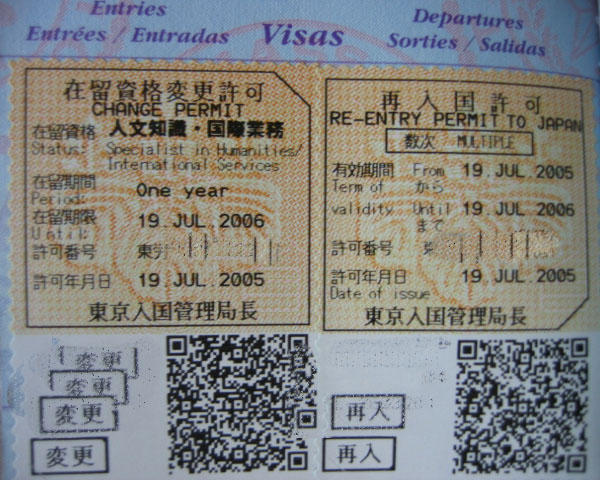 The trip to Shinagawa immigration center in southern Tokyo required a subway to bus transfer. This bus route, however, is not exclusively for foreigners awaiting face time with bureaucrats. Local riders must dread sharing their commute with Filipinos, Australians, Chinese, Americans, and other filthy animals seeking residence permission among this xenophobic society. Curiously, a stop exists in the middle of a bridge, perhaps as a convenience for lonely leapers in a nation ranked among the top in suicide rates per capita.
Even Japanese obsession with order and efficiency could not streamline bureaucratic inertia. I languished in line with people from around the world to trade my postcard for a number, which then would be exchanged for the crowning glory, a work permit stamp in my passport.
I clutched 82; they were now serving 33. I began the countdown to becoming fully legal. No more crossing the street when I spotted police activity. The next number jumped to 43. Then it dropped to 27 before soaring to 75, just 7 away from the magic number. This lottery rollercoaster toyed with my emotions, especially when the blinking counter hit triple digits. Faces familiar from waiting in line had all been served. I groaned when 183 rolled around. Since leaving the country without a separate re-entry stamp invalidates my visa, I also took a number at the nearby re-entry application desk. I might as well wait in two lines at once.
“Hachi-juu ni ban,” said a man behind the counter. I remained mesmerized on the “Now Serving #146” sign. Suddenly it clicked – he was calling 82! I rushed to the counter with my ticket, thankful to at least be conversant in Japanese numbers up to 100. An enormous mole sprouted from the bridge of the man’s nose. He told me to purchase a visa revenue stamp from downstairs and to return to wait for 82 to flash on screen. These fee stamps are sold inside the convenience store on the ground floor. “One package of squid jerky and one ¥4,000 stamp, please.” 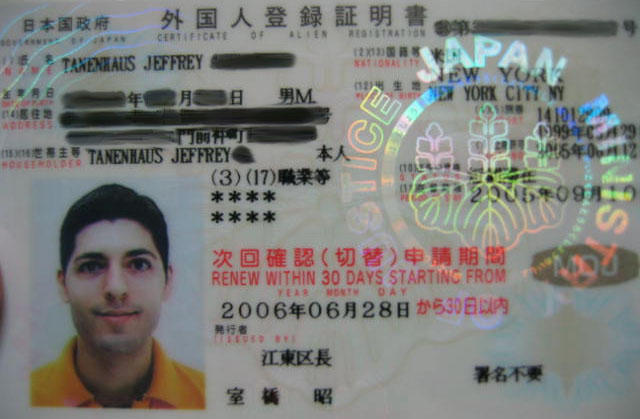
I wasn’t done with Japanese bureaucrats for the day. With work visa and re-entry stamps glued into my passport, I headed across town to my borough government office to pick up my alien identification card, which was ready after three weeks of processing. On the way inside I passed a sign for the welfare office, and considered applying for benefits. Pricey rent, exorbitant health insurance, and below minimum wage salary makes for a losing combination in the world’s most expensive city. But the feeling of having visa in hand after three months: priceless.
Friday, June 17, 2005
Something to Confess

I orchestrated my re-entry into Japan with the precision of an espionage training mission.
Objective: Penetrate Japan’s border as an illegal worker through hoodwinking immigration and customs officials.
Preparation: Obtain two different tickets for the same flight to Narita. Under the guise of a tourist, hide the one with my actual November return to NY, and create a bogus itinerary showing the same inbound flight, but with a July return, a date within the three-month tourist visa window. (I accomplished this with a $3,674.71 full-fare but fully refundable e-ticket, which I refunded just before I left.)
Methodology: Denials, lies, broad smiles, and quick speech to confound officials with a shaky grasp of English.
Handicap: My baggage weighed a ton. 79.5 lbs. to be precise, exceeding Northworst’s 72 lb. limit, and incurring $500 in excess fees. In the concourse of JFK’s Terminal 4, I transferred 1 lb. glass jars of Trader Joe’s peanut butter and 1 lb. bags of dry roasted almonds to my carry-on, and checked in without penalty.
Other contents hinted at my long-term, non-tourist intentions. I rehearsed responses for my ultimate fear: hand search of luggage. Feigning chronic halitosis could excuse my 1 liter tub of Listerine, which cost the same as an 8.5 oz. travel bottle in Japan. Love of carbohydrates surely necessitated importing three boxes of Kelloggs’ Smart Start cereal, two bags of Rold Gold pretzels, and three packages of Swedish fish – a nice change of pace from daily discount sushi dinners. I’d rather get cavities than parasites.
But just how was I going to explain three month’s worth of prescription pills? Or a nose hair clipper the shape and diameter of a vibrator. It’s true function would be lost in translation. I envisioned a demonstration for wide-eyed customs officers.
Having left most clothing in my Tokyo apartment, would anyone notice that I packed the same number of socks as jars of lightly salted crunchy peanut butter? I also would be at a loss to explain the 432 unsharpened pencils and 48 erasers emblazoned with American flags. To be used as student prizes, their boxes read ForTeachersOnly.com. “Of course I’m not a teacher, officer. Flag Day is this Tuesday!”
At Narita, I cringed when immigration stamped my passport on the same page as my initial April entry, which might induce questioning as to multiple trips. Therefore, I approached the weakest looking customs officer, a lady half my size, who true to form lobbed softball questions, including if I had anything to declare. “Of course not,” I lied through my best smile. Patriotic pencils and jars of peanut butter rolled in undetected. Mission accomplished.

