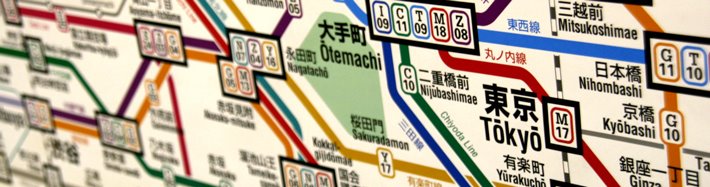
During my first year in Japan, I went to a professional baseball game with two students. A year later, I returned to the bleachers, but this time to watch my students take the field. High school baseball in Japan is like college basketball in America: fiercely local and competitive, and more followed than the professionals. Koshien, a national high school tournament, is like March Madness twice a year.
Shin Gakko has a reputation for sporting excellence. For example, women’s handball is one of the top programs in the nation, and a source of talent for the Japanese national team. The SG baseball machine is also a force on the field. Whereas some Tokyoites I met didn’t recognize the city ward (borough) in which I worked my first year, the name Shin Gakko in the suburbs rang a bell because of their success at Koshien. The potential for my students of today to become the professional stars of tomorrow wasn’t a trite exaggeration. This baseball squad was better trained than some national armies. Year-round practice, sometimes twice daily, cultivated a fighting spirit unleashed on a diamond battlefield.
Loaded bats rested on young shoulders. If the well-stocked trophy cases outside of the principal’s office were anything to go by, sports was the pride of the school, its reputation staked to athletic success. A strong Koshien performance counted for more than the exam scores of the other 2,000 students. Some teachers bowed to these crew-cut stars in spite of less than stellar academics, but I didn’t have to force favorites – their receptive attitude towards English made me an instant fan.
At the beginning of the school year, my enthusiasm still bubbly, I imagined myself being that loyal teacher in the bleachers. Visible and vocal, I’d earn a reputation of supporting students outside of the classroom while gaining respect inside it.
Language and logistical barriers, however, sidelined that lofty ideal. Just pinpointing ever-changing game locations proved a challenge. In space-starved Japan, the school’s only field was a fenced-in dirt patch where handball, soccer, track and tennis teams practiced, often simultaneously. As a result, baseball games were held off-site. Those on the weekend were both hours from home and sometimes beyond the reach of public transportation. And reporting to work every other Saturday only increased my desire for distance from school-related activities. Instead of becoming the regular I aspired, I barely made a cameo.
I wouldn’t have even managed one game without active recruitment from Kijo. The second baseman and I had been talking about the upcoming game against Bunryo H.S. for weeks, at a clip of one sentence per day. A morning update from Kijo was part of my routine. I’d punch in at 8:11 a.m. and change into “indoor” shoes that carried me across the concrete courtyard to an 8:15 meeting. Two stories above the courtyard, the 12th grader leaned out of a window to inspect the flood of uniformed foot traffic clomping towards classrooms. I stood out for my size.
“Gooood morning!” Kijo saluted from above. I signaled a silent response. He then cupped his outstretched hand skyward to detect any drops.
“The weather is fine today,” he concluded with a smile worthy of a toothpaste commercial.  Actually, the sky was a miserable grey, but in Kijo’s world the sun was always shining. He had a class president’s persona – affable and outgoing among friends while respectful and studious for teachers. During a year when I struggled to cultivate classroom interest in English, Kijo was a refreshing exception. He initiated conversation in English, and used proper grammar without perversions. From this window we forged a friendship.
If only he had been my student. Those of my own had no appetite for English. Only running the mile seemed to draw longer faces. Yet among the bright spots of talent, lights few and far between, were those with mitts packed among their textbooks.
“Baseball game against Bunryo is in two weeks,” Kijo reminded with a wave before shifting his attention to a teammate below.
He did more than just remind me. He created a color-coded map labeled in English. It highlighted the way from school to the game with times and transfers for a series of trains unfamiliar to me. Yet my confidence in the cartographer faltered at rural Asaka station, the last stop on my map. A distinction between east and west exits was not labeled among the landmarks. Before I bet on one direction, I saw something familiar, but not from the map.
It was a short navy skirt with gray socks pulled up to the knees. Uniforms were required when attending school-related events, even on weekends, a protocol I suddenly praised. I was relieved to run into Manami at the station. Actually, it was more like I ran after her. I followed her familiar uniform from a distance, hoping she would show me the way.
At first I thought she sensed the stalker in me, leading me in circles through the station. It turned out she was just as lost, so I blew my cover to combine our resources – my illustrated map with her native tongue. Although in Kijo’s grade, she didn’t share his fluency. After six years of study she couldn’t string together two words in English.
After walking for 15-minutes in silence, a stadium came into sight. Manami and I entered side-by-side, dropping the jaws of the student ticket takers and drawing stares from parents handing out programs. I smirked off the attention as Manami led the way to our seats. Inside, school supports took sides. Each section fired up its team with a repertoire of chants, honking trombones and pails of water sloshed on supporters after a run scored. I recognized Shin Gakko students and their band along the third base line. Not sure if off-duty teachers were welcome in the cheering corral, I tagged along behind Manami to the general seating and parent area behind home plate where two of her friends were waiting. The bands blared fight songs to introduce what would be a battle of a game.
Emerging from the dugout in uniforms crisp and white, these teenagers looked like minor leaguers taking the field. A scoreboard flickered to life, and a female announcer introduced the first batter to one-sided applause. Speedy centerfielder Shintaro Nishida stepped to the plate. The hardened looks on players’ faces spread to the spectators. Lines were drawn; everyone dug in.
Shin Gakko knocked in four runs that first inning, but I didn’t recognize any of the batters. Although I taught a number of students on the team, most were sophomores who went through the same punishing drills during daily practice, but watched their elders compete until age privileged them to perform. Kijo, although a senior, seemed not to be in the lineup, but I spotted his white smile around the dugout high-fiving teammates who had scored.
During the 7th inning stretch, players raked the dirt infield. In the stands, mothers busied themselves dispensing paper cups of tea to thirsty supports resting their voices that had quieted since the first inning outburst; we were now down by a run. An offensive reawakening in the 8th inning, however, prompted me to write this column for a newspaper designed for non-native English speakers.
After the game I sought out Kijo to congratulate him on the victory. Before I could get to the throng of players, I bumped into
Principal Ouchy who, in his standard suit and tie, at first didn’t recognize me in a backwards baseball hat and jeans. Elation from the late-inning heroics masked any grumble of disapproval. After all, his school’s reputation was safe for another week.
After recording the final out, Shin Gakko's team (in white, left) rushes to the batter's box where both teams will bow to each other.
Sunday, February 10, 2008
The Away Game

Saturday, July 14, 2007
Afternoon at the Arcade
I'm no fan of boxing or the bland Ikebukuro district of Tokyo, but the other day I had a little fun with both. Thanks to Michelle for finding this gem, to Jen the videographer, and to my video-skilled sister for pasting it together.
Ka-POW!
On a sad side note, this will be my last post from within Japan proper. Although after two years I have decided to move on, the backlog will ensure the blog's continuation for the foreseeable future.
Monday, March 12, 2007
B.J. Play
Being a foreigner in Japan has its ups and downs. So although I wouldn’t normally pay $35 to see “professional” basketball in Japan, I made the most of free tickets for foreigners to attend international day at the arena. I upgraded to better free seats walking to the will call window – only in Japan do fans give away premium tickets. After tipoff, I wondered if anyone in Ariake Arena had actually paid to watch the last place Tokyo Apache battle suburbia’s Saitama Broncos in a match up of B.J. League rivals (the unfortunate acronym stands for Basketball Japan).
Banners in Engrish were scattered throughout the arena: “BS Freaks,” “Try Our Best,” “Our Way. Our Will. Our Win.” and – my favorite – “No basket. No life.” Indeed, the scoreless Apache looked dead as the Broncos stomped all over them in the early going and never looked back. Although the Apache logo is a bird, some boosters wore headdresses that would have made the University of Illinois’ recently retired Chief Illiniwek blush.
C-list celebrities on the court included Apache coach Joe Bryant, Kobe’s dad; Broncos forward David Benoit, one of my favorite former reserves on the Utah Jazz; and a Michael Jackson. A mix of races and sizes squared off as small Japanese guards swished threes from the perimeter while African-Americans like Benoit muscled inside for driving layups.
Not having an affinity for the home team’s garish purple uniforms or a suburban team in kelly green, I rooted for Benoit, who played well despite limited minutes. The contrast, however, saddened me. Once a substitute for Karl Malone, the NBA’s greatest power forward ever, Benoit now came off the bench in a country that has sent just one player to the NBA, which was a short-lived experience for Mr. Tabuse.
As for the game itself, I bet Kobe’s dad wished he had his son on the court, or any other Laker past or present for that matter. Even though the game was out of reach, I felt self-conscious about being the only one to pack up early. With less than a minute to play fans from both sides were still glued to their seats.
Score one for the suburbs, Their way. Their will. Their Win.
Final: Saitama 91, Tokyo 75.
Wednesday, February 22, 2006
Humbled and Hobbled
…continued from last post.
“Daijoubu desuka?” an opponent asked from above.
No, I wasn’t. I was on the floor, where – adding insult to injury – I had watched the ball roll off the rim. I don’t remember if someone tipped it in. The game was over, and I was finished – for a few weeks. Not wanting to draw attention, I quickly dragged myself to the sidelines to change clothes.  The pain was so fresh that I could walk through it before the nerves came to their senses. I unlaced my And1 basketball high tops, and peeled off sweaty socks. A fleshy bulb had replaced my left ankle. It looked like elephantiasis. A recent visit to the world’s only parasite museum (left) was still on my mind.
“See you next week!” Takahiro, 23, called on his way out. Yeah, right.
Everyone was heading home. I panicked. What about me? Cabs aren’t an option if unable to articulate a route (addresses alone are useless in Japan). How to obtain food if unable to walk? I can’t point at a Domino’s picture menu from over the phone. Who could help? Certainly not a doctor. I don’t have insurance here.
Biting my scarf, I faked a thumbs up to the junior high crowd murmuring in the corner about the walking wounded. Downstairs (god bless elevators), the sports center receptionist rose halfway out of her chair.
She knows it’s Friday night whenever I walk in to buy a ticket. We always exchange evening pleasantries. Her mouth parted for the usual thank you-good night, but then her eyes bulged. Lips painted red searched for words. She inhaled through her teeth. I lied again with my hands. Such a pretty face. I’ll miss seeing it for a while.
I scratched together an idea for a home remedy: tape two Coolish ice cream bags around my ankle and pray. I mean, just where was I going to get ice? Sapporo? (Look at who came in fifth!). 

 Forget Sapporo, even the supermarket was too far away. Instead, I shuffled into 7-11, and hobbled over to the cooler. No Coolish, but there on the bottom shelf were bags of “rock-ice for people who know the difference.” I knew. The difference was having an ice pack instead of ice cream bags to reduce swelling. Oh, thank heaven.
With morning came judgment day. The bulb had shrunk. No sign of bruising either (that wasn’t till the third day). Yet, on my way to tutor elementary school girls, a 15-minute stroll to the station became a 30-minute physical challenge.
In a perverse way, I enjoyed the humbling sensation of not taking walking for granted. Overnight I had aged 50 years. I had the gait of the local hunchbacks pushing carts of groceries whom I ordinarily zoom by when dashing to the station. Not being able to walk puts the rest of your problems in perspective.
However, I also felt like even more of an outcast. I get enough unwanted looks on the street on normal days. Now I kept a lowered head to avoid eye contact altogether. A mix of pity, curiosity and fear stared back when I looked up at intersections.
I’m not used to slowing down for the flashing green man when about to cross. I navigated the elevated walkway over the highway with right hand on the railing and left foot in the air, hopping stairs with my right foot like a Double Dare physical challenge (minus the super sloppy slime).
So young, but so crippled must have been running through the minds of passersby. Mothers steered children away from my path as I teetered along the edge of the sidewalk like a wounded animal on its last legs, clutching walls, poles and railings for support.
As usual, weekend plans included only a date with the washing machine. The ice pack accompanied me throughout the evening. I tucked myself into bed, and it into the freezer. Thank you, rock-ice. You’ll always be on hand when my foot needs you, which hopefully is never again.
Tuesday, February 21, 2006
The Hoop and the Harm
From playing basketball with handicapped kids to becoming one myself, my ankle took an unfortunate twist last Friday. All week I look forward to shooting hoops with locals ages 13 and up.
The Japanese are sharp shooters, but lousy defenders. When scrimmaging they seek to shoot as much as possible from as far away as possible. Yamazaki, 21, has a 3-point shot matched in meanness only by his skin disease. His preferred firing range is from between the 3-point line and half court. Swish.
The only times I touch the ball on offense are by accident or offensive rebound. I quickly pass for fear of blowing another lay up. Like the rest of Japan, rims at the ward sports center take exception to foreigners. As the lone alien on the court, I’m easy to spot.
I contribute solely on the defensive end. I patrol the oversized international key while four teammates wait to fast break back down court. There’s no set offense – just fast breaking and 3-pointer launching. Sometimes they just stay on offense. Taking cigarette breaks in between games hasn’t increased their stamina to hustle back on defense.
By 8:30 p.m. I’m ready for a break, too. I sub out 15 minutes early to take advantage of nebiki, discount food shopping, at Chiyoda Sushi. Prices are slashed up to 50% to clear the day’s inventory.
Besides, you know what they say about taking that one last run on the ski slopes. I don’t want to tempt fate in that final game for fear of injuring, well, someone else. I’m known to foul hard, going for ball or head – whichever is closer – in hopes of recording a thunderous block. Swatting the ball out of bounds with authority has caused badminton players on the opposite side of the gym to take notice.
Last Friday, however, I skipped nebiki. Goseki, 21, and always sporting New Jersey Nets gear, was telling me about his upcoming trip to NY with Yamazaki to see the Nets face the Knicks at Madison Square Garden. I frowned. He smiled and said, “Do you feel homesick?”
With about one minute left, somehow I got the ball on the perimeter. Feeling frisky, I surprised everyone by hoisting a shot. My outside touch has improved, but this attempt smacked the side of the rim with a thud. Frustration mounted at not adding to 4 points the whole night (on six shots).
Similar to Japanese shops, “closing time” music filled the gym. Fourteen all. Last play. Offense. Goseki missed a 3. I rebounded. I was too far under the basket to put it back up. I didn’t pass. Not this time. I dribbled outside, then back into the key. Three defenders converged. Pivot, fake, spin. I saw an opening, and sliced between two defenders. Jump! Airborne, I flicked the ball. Light touch. Looks good! Bouncing around on the rim. Front. Back. Bouncing…oooww –
Pain shot through my leg. I’m down. And couldn’t get up.
Did the shot fall like the shooter? Find out tomorrow.
Thursday, January 12, 2006
Taking Swings in Kiba Park
 There aren’t too many places at 35°41' North latitude where you can play outdoor tennis in January. Tokyo is one of them. Ironically, in order to avoid the sun’s tanning rays, Japanese women wear more clothing to play tennis in July than in January. In summer’s 137% humidity, I perspire walking to the subway in a t-shirt, but that doesn’t stop women from wearing full sweat suits with long sleeves, mittens and visors inspired by Darth Vader.
In cooler conditions and under cloudy skies, I joined the Yamakuma family at well-maintained grass courts in Kiba Park, a half hour walk from my apartment. Kiba means “tree place,” and alludes to the lumber stockyards of the Edo period. 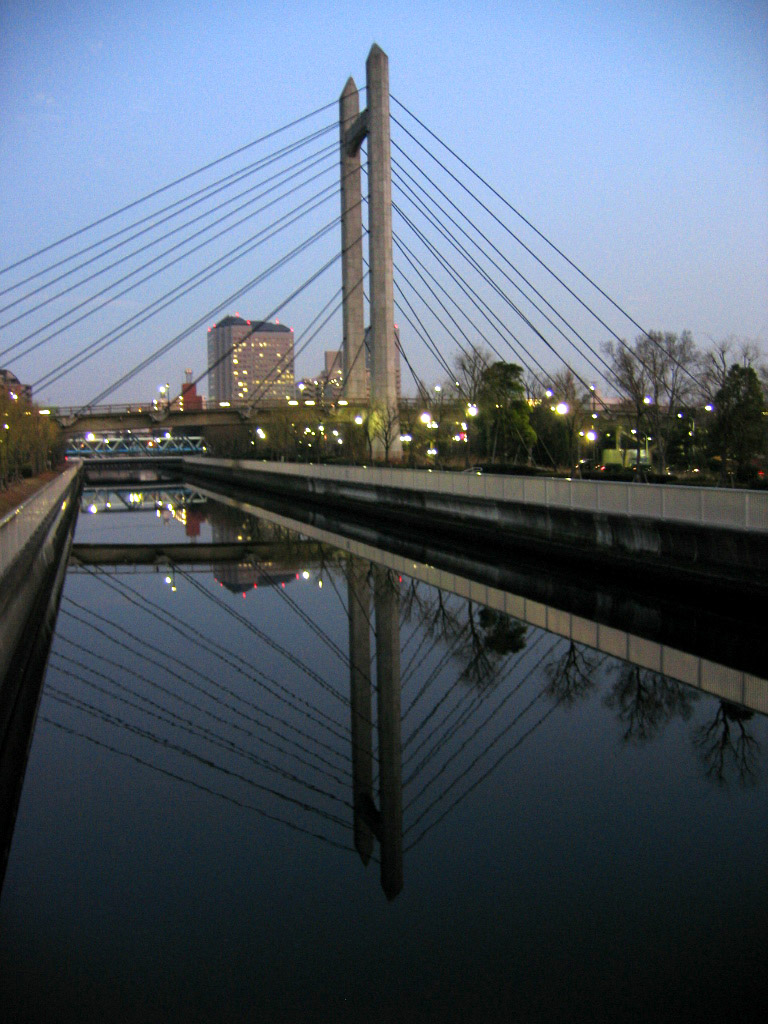 Nowadays, an unsightly concrete bridge accents the park, which attracts a crowd of retired shutterbugs who assemble tripods to document the local wildlife – pampered pooches and plump pigeons. Winter doesn’t enhance this drab park’s appeal, but when in Tokyo one learns to relish open spaces of any kind, even “parks” nestled under overpasses.
I tutor Jiro, the Yamakuma’s 7th grade daughter, for an hour on Saturday mornings. She showed up with a racquet, as did adult 6 family friends. We rented two courts, one for the husbands and the other for the wives. I was assigned to the wives’ court.
For two hours we played matches of four games each, rotating partners. While I hadn’t held a racket since an embarrassing defeat at the hands of an American 7th grader while vacationing in Oman a year ago, at least I was able to follow Japanese tennis jargon as we volleyed balls and apologies for hitting them. A typical point consisted of the following dialogue, gasped in staccato female whimpers:  Oh, I’m sorry! Are you ready?
Ahh, excuse me. I’m sorry.
It’s short, excuse me.
It’s okay. Sorry.
Oh, nice serve!
It’s short, so short. I’m sorry.
Almost!
Okay, next. Your turn, please.
Excuse me, please have a ball. Thank you.
Oh, thank you so much. I’m sorry.
Okay, it’s no trouble. Thank you.
My underhand serve needs work before next week’s qualifying match for Tokyo’s Toray Pan Pacific Open, but I’m set to practice with Nubata’s tennis club after school (also outdoors).
Walking through Kiba Park triggered memories of an earlier visit. I’ve had many bizarre encounters in Tokyo, but this perhaps outranks them all. Back in July, a salaryman at Daruma restaurant took me drinking around the neighborhood. Our last stop was a street cart named yatai. These are portable food vendors, but with fixed sidewalk locations.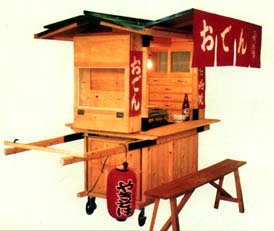 I pulled up a stool, and the salaryman ordered me a can of Asahi and a bowl of oden, a hodepodge stew of strange root vegetables. Four other locals yammering in Japanese ringed the wooden cart, but became intrigued with the foreign diner.
A woman had a son my age, but after 45 minutes the salaryman left me on my own for translations. A man of about 50 with a shaved head and athletic build bought me another can and then a round of sake, which unfortunately were not elixirs to clarify his speech. Even the salaryman had trouble comprehending his thick Japanese with a heavy accent of intoxication.
The yatai chef was calling it a night, and my new friend – missing a bottom front tooth – smiled at me to follow him to the corner. Before the light changed to cross, he hailed us a cab. Climbing in sent shockwaves of uncertainty in this order: (1) cabs are an unaffordable luxury, (2) how was I going to get home from where we were going, (3) where were we going and (4) who the hell was this guy? I began noting landmarks to help me retrace the route for the long walk home. Two right turns and a trapezoidal bridge later, the cab stopped. There was a convenience store and park. We went into the conbini first.
“Hanabi!” I pointed at the fireworks hanging from a rack by the door. I thought I had seen it all, the young clerk was thinking to himself as he eyed the drunken odd couple buying fireworks at half past midnight on a weekday.
The man, who paid for the cab and fireworks, hadn’t stopped talking through either. I was absolutely clueless as to what he was saying as we walked to a grassy field illuminated by street lamps.
I gazed up at the night sky. The next thing I knew, I was seeing stars. I had been knocked off my feet with some martial arts maneuver. And now I was angry. I charged back to return the favor, but bounced off; he was built like an ox.
I can’t remember how long this midnight melee lasted, but it ended as abruptly as it began. He started walking home. I ran after him to hand him the fireworks we’d abandoned. A banzai scream broke the silence as he punted the package into a stand of trees.
I woke up at noon wondering if it was all but a dream. Grass stains on my track pants told otherwise.
Tuesday, September 27, 2005
Take Me Out to the Yakyu Game
 Scratching out a combination of remedial Japanese and English, Omiyada students arranged to meet me at 17:30 at Shinanomachi station’s turnstiles. In a rush and taking an unfamiliar route, by the time I realized that Suidobashi was not the same as Shinanomachi, I was stuck on a Sobu line train in the wrong direction.
It wasn’t my first Japanese baseball game, or even first at Jingu Stadium. In early July I visited the Tokyo Dome, home to the famous Yomiuri Giants, to see the Chiba Lotte Marines take on Hokkaido’s Nippon Ham Fighters. Which was the home team? Last year the Ham Fighters (sponsored by a meat packing company) moved to Japan’s northern island, but still play token home games in Tokyo to please fans that didn’t migrate.
Loyalty divides the two $14 bleacher seat sections. Having no attachment to either team, but finding myself in a sea of Marines’ supporters, I cheered for Chiba. I didn’t want to stand out like a big white thumb more than I already did.
The Dome’s drab interior is peppered with ads for all of your favorite Japanese companies: Casio, Canon, Nissan, Kirin, Fuji Film, and Showa Gas. The Ham Fighters struck for three runs while I was in the subway en route. The crowd’s flag waving and tomahawk chops initially proved more interesting than the game itself, which featured what had to be a record for double plays and only one extra base hit until the 9th inning.
Down 3-1 with two outs in the top of the 9th, Chiba’s tying run stepped to the plate. The crowd chanted “home run” in English. Down to his last strike, Lee Seung Yeop harnessed the cheers and smacked the ball into the bleachers filled with stunned Fighters fans. Trumpets blared. (Yes, fans bring musical instruments to games). Chiba completed the dramatic comeback with three runs in the 10th. Final score: Marines 6, Fighters 3.
A month later I watched the Hiroshima Carp battle my now favorite Yakult (“Yak-a-loot-o”) Swallows at Jingu Stadium. The Carp seem to have stolen a page out of the Cincinnati Reds fashion playbook. These imposters struck for four runs while I was still in the subway. Minutes after I settled into my front row bleacher seat, the Carp doubled their 4-0 advantage with a single swing. Greg Larocca’s (not a Japanese) grand slam was Hiroshima’s second in as many innings. This one was over before it started. Final score: Carp 10, Swallows 0.
Despite the Swallows’ anemic performance, I enjoyed Japan’s most historic ballpark, its brick walls dating from 1926. On a pre-WWII exhibition tour, Lou Gehrig and Babe Ruth played here. Although room for 48,000, Jingu’s humble confines felt more minor league.  Absent were luxury boxes, extravagant concession stands, and corporate promotions that are staples of Major League parks.
To be sure, Yakult Honsha Co., manufacturer of a fermented milk drink, owns the team. Uniformed “Yakult Ladies” peddle these probiotics on bicycles throughout Japan. So, why Yakult? Well, as someone who swallows such a supplement daily, my affinity truly comes from the gut. Furthermore, the Swallows are avian kin to my favorite MLB team, the Blue Jays. They’re also Tokyo’s underdogs, overshadowed by the Yankee-like Giants with their bloated payroll, aging players, high expectations, and huge fan base. Case in point: Swallows games are only televised when playing the Giants.
This brings me to my most recent game, in the shared company of two Omiyada baseball pals as our team hosted cross-town rivals the Kyojin (Giants). We spoke a little Japanese, filling the silences with mouthfuls of squid jerky. No Cracker Jack or peanut vendors in these here parts. Their jaws dropped when I jokingly tried to order three drafts beers from the Asahi lady with a keg strapped to her back.
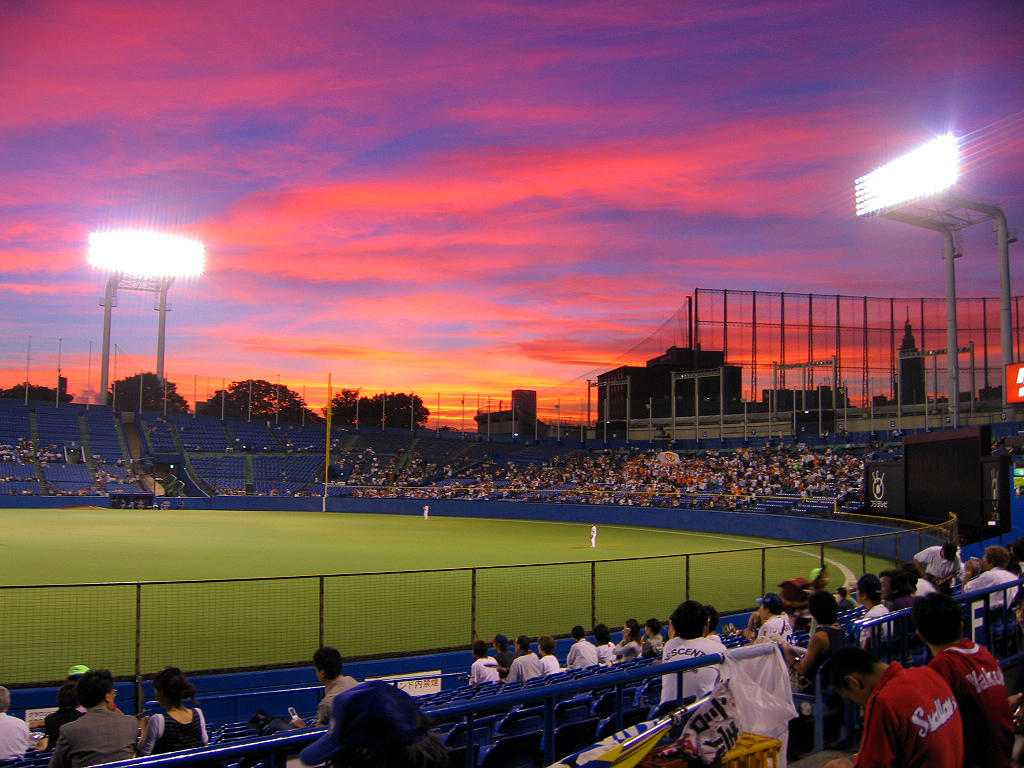
Although forecasted typhoon remnants threatened to disrupt play, the clouds parted for a brilliant sunset. But Swallows fans tote kasa to the ballpark even on sunny days. For every Swallow who crosses home plate, fans recite a team cheer and pop open their umbrellas as a not so subtle gesture to the opposing pitcher that he should hit the showers. 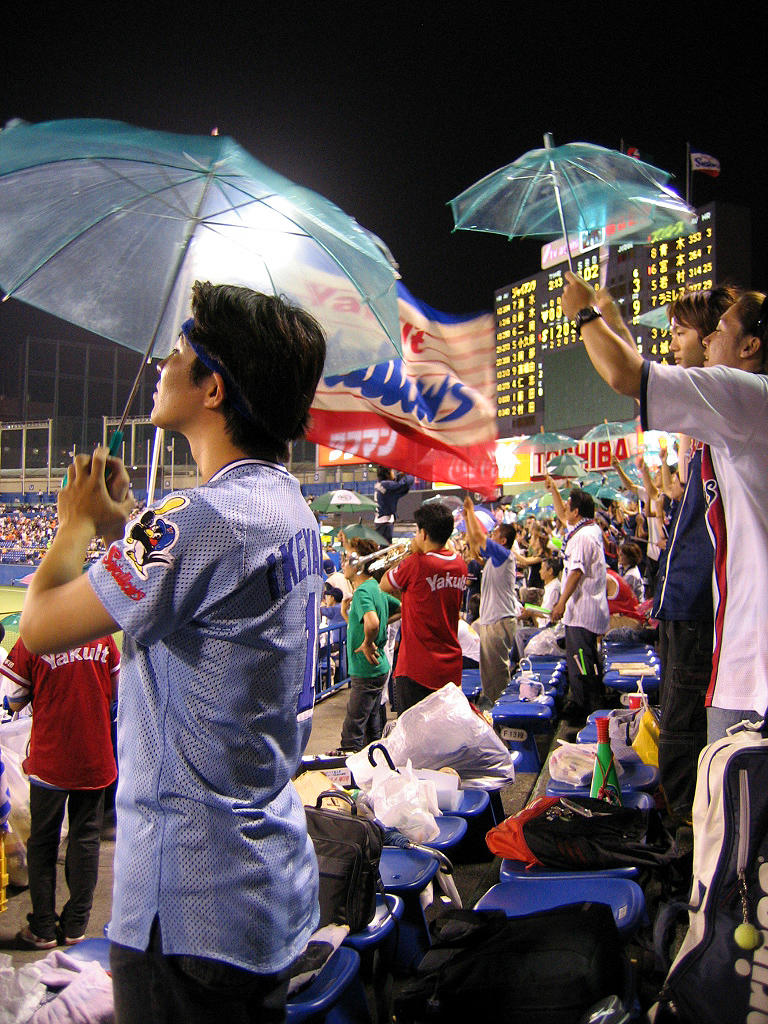 Even though the rain held off, our umbrellas were in constant motion, starting with the first pitch of the game that Norichika Aoki sent into the Giants’ bleachers. Team cheers, and those personalized for each player, build community for a common cause. Unity, loyalty, and sacrifice are the Japanese way. Male cheerleaders stand on plastic crates armed with whistles and flags. Some grow hoarse before the balloon release during the 7th inning stretch.
When American Adam Riggs (“Rig-a-sue”) is announced, Old Glory appears. A Venezuelan bandera is similarly flown for Alex Ramirez (“Rami-chan”), formerly a Cleveland Indian and Pittsburgh Pirate.
Riggs homered in the second, and the Swallows scored in all but one inning to topple the mighty Giants. The game became such a farce that benches emptied. Swallows fans fell silent when one seldom-used player stepped to the plate. Everyone looked at the cheerleaders for direction. Did a chant exist for this guy? It hardly mattered. Final score [with pictures]: Swallows 14, Giants 3.

