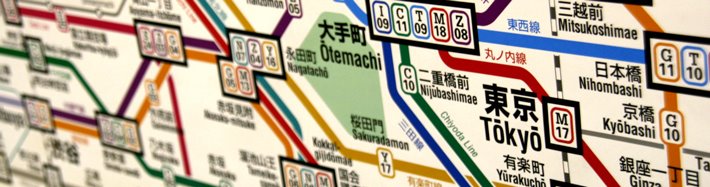
Last June I traveled to Israel on a Birthright Israel program that sends first-timers for free. Here are two articles I wrote that were recently published in Japan about Israel.
Monday, March 26, 2007
Israel

Monday, March 19, 2007
Teacher, Can You Spare A Coin?
Spit hit the curb with a smack outside of 7-11. It was 8:06. My eyes moved up from the ground to the source of the guttural noise. I knew that kid. A 16-year-old with a freshly shaved head, his white shirttail peeked out the back of his black uniform jacket. Matching trousers hung low on his slim thighs. He wasn’t my student, but I’m sure we had talked on occasion, probably about coarse rather than course subjects.
His arm amorously wrapped a classmate as he initiated a private moment in a public place during morning rush. One of the great things about Japan is the taboo on P.D.A., which he was flouting while spitting on the road (much more acceptable).
We both reached the door at the same time.
“Oh, sensei [teacher], ohayo!” he greeted with a devilish grin.
“Hey, how are you?” I asked what’s-his-face.
“Oh, sensei,” he cocked his head and repeated, unable to muster the simplest answer in English.
We headed for the same aisle, he for breakfast bread and I for fruit juice. Selection was good. Bread shelves were stocked with all of your favorites like chocobread and peanut butter cream Danish.
“Whaddaget?” I asked.
Corn bread. And by corn bread I mean yellow kernels embedded in white stuff on a Danish.
“That’s disgusting,” I said in Japanese.
“Nah, it’s delicious,” he countered.
I turned back to scan the juices and make a final selection.
“Sensei” he called. “I forgot my lunch.”
“OK, well, here you are,” I said, waving to microwavable pasta with hot dog slices and egg salad sandwiches stuffed with the yolks of those hard boiled.
This morning I felt like apple juice.
“Sensei” he called again. “I forgot my money.”
It was the quiver in his voice that turned me around. I stared into his drooping eyes for clues on how to react. His girlfriend stood in his shadow. Wasn’t she less forgetful? Whether the kids like it or not (and most do not), I get paid to be their teacher. Yet here was a chance to do something more than that. Here was a chance to play dad. I moved closer. I didn’t have to think for long.  My hand intuitively dipped into the outer pocket of my bag. I felt the raised edges of a ¥500 ($4.25) coin and fished it out. His eyes were trained on my bag, waiting to see how much I’d pull out. I felt like everyone in 7-11 had also paused to witness charity in slow motion.
Compared to the rest of Asia, there aren’t a lot of needy kids in the world’s second largest economy. Yet here I was giving the gift of lunch money – enough to make Sally Struthers proud.
“Sensei, arrigato. Arrigato, sensei!” he thanked while cupping his hands to receive the oversized golden gift.
He said it would cover him for both today and tomorrow. Then he grew silent. It was my turn. To foster some sense of responsibility, I told him in which teachers’ room I sat.
“Tomorrow,” he cried in Japanese.
“OK,” I smiled.
“Or the next day!” he added, heading to the register.
N.B. Hey kid, “tomorrow’s” been three months and counting. Sensei wants his gold coin back.
Wednesday, March 14, 2007
Interview with the Foreigner
 I’m more used to writing about others than being written about, but Shin Gakko’s in-school magazine included me in their quarterly issue (click picture to enlarge). Don’t mind my photo, although at least my tie matches my flag. In case you are like me and those pesky kanji are like Greek to you, here’s what I had to say in plain English. Questions are listed exactly as I received them. Answers, however, may deviate slightly from the Japanese printed.
1. Where are you from?
Brooklyn, biotch. You steppin’?
2. What good things about your country?
A lot of space for living and the freedom to live the life you want comfortably.
3. What makes you come to Japan?
Fresh sushi, jinsei-keiken(life experience), schoolgirls in short short skirts.
4. How long have you been in Japan?
20 months. Time fliesね!
5. What makes you attract about Japan?
Good food, healthy portion sizes, reliable trains, and interesting culture.
6. What’s your favorite Japanese food?
Sushi (salmon, salmon roe, eel, tuna).
7. What’s your least favorite Japanese food?
Oba.
(N.B. green perilla leaf also known as shiso used as a garnish in sushi and other dishes.)
8. What’s your favorite place you have visited in Japan?
Daytime, Kanazawa. After dark, the neon (red) lights of 歌舞伎町.
9. What’s your hobby?
Traveling, photography, writing.
10. Have you ever experienced any jobs (excluding teaching job)?
Sports instructor in Guam. Paralegal in New York. The usual.
11. What’s your motto?
If at first you don’t succeed, try again. Harder.
12. Do you speak any other languages?
Español, which despite not using for almost a decade is still light years ahead of my Japanese. (Sigh).
13. Please give our students to your message.
The world is big. Go discover some of it. Learning English can be your passport to new places.
Monday, March 12, 2007
B.J. Play
Being a foreigner in Japan has its ups and downs. So although I wouldn’t normally pay $35 to see “professional” basketball in Japan, I made the most of free tickets for foreigners to attend international day at the arena. I upgraded to better free seats walking to the will call window – only in Japan do fans give away premium tickets. After tipoff, I wondered if anyone in Ariake Arena had actually paid to watch the last place Tokyo Apache battle suburbia’s Saitama Broncos in a match up of B.J. League rivals (the unfortunate acronym stands for Basketball Japan).
Banners in Engrish were scattered throughout the arena: “BS Freaks,” “Try Our Best,” “Our Way. Our Will. Our Win.” and – my favorite – “No basket. No life.” Indeed, the scoreless Apache looked dead as the Broncos stomped all over them in the early going and never looked back. Although the Apache logo is a bird, some boosters wore headdresses that would have made the University of Illinois’ recently retired Chief Illiniwek blush.
C-list celebrities on the court included Apache coach Joe Bryant, Kobe’s dad; Broncos forward David Benoit, one of my favorite former reserves on the Utah Jazz; and a Michael Jackson. A mix of races and sizes squared off as small Japanese guards swished threes from the perimeter while African-Americans like Benoit muscled inside for driving layups.
Not having an affinity for the home team’s garish purple uniforms or a suburban team in kelly green, I rooted for Benoit, who played well despite limited minutes. The contrast, however, saddened me. Once a substitute for Karl Malone, the NBA’s greatest power forward ever, Benoit now came off the bench in a country that has sent just one player to the NBA, which was a short-lived experience for Mr. Tabuse.
As for the game itself, I bet Kobe’s dad wished he had his son on the court, or any other Laker past or present for that matter. Even though the game was out of reach, I felt self-conscious about being the only one to pack up early. With less than a minute to play fans from both sides were still glued to their seats.
Score one for the suburbs, Their way. Their will. Their Win.
Final: Saitama 91, Tokyo 75.
Saturday, March 03, 2007
Tohoku, We Have A Problem
Within the first two weeks of my new commute to Shin Gakko, I was delayed more times than in the previous year combined. I can thank the Keihin-Tohoku line for that. It’s one of Tokyo’s busiest, and as I’m learning, most breakable.
One morning the train stalled in the station for 10 minutes, rattling my confidence in Japan’s to-the-minute timetables. However, as this line also serves the 2,000 students at Shin Gakko, I felt safety in numbers showing up late.
Two weeks later it got worse. Much worse. Ascending the platform at fun-sounding Okachimachi station, I saw a blue train stuck halfway in the station. The doors were closed, but some passengers were inside. Concern crossed the face of the young conductor poking his head out of the window. After an unusually loud horn, the train lurched forward 15 feet and halted. On the opposite side, a green Yamanote line train glided into the station. I smirked to the suckers stuck inside the blue train, and hopped aboard. Blue and green lines run parallel before green splits off to loop around central Tokyo. I thought I’d be clever to bypass the disabled blue train by riding the green one to the last of their shared stations, and catch a blue train further down the line.
Four stations later, I joined the throngs at Tabata station. I had outsmarted myself. There were no blue trains here. Everyone was waiting for the one stuck at Okachimachi. And when it did get moving, that train would be packed with four stations of stranded commuters.
Long overdue, the blue train arrived to an agitated swarm of commuters jockeying for inside position. I laughed to myself. They would never all fit. I didn’t join the fray because I had chosen a poor day to shed my laptop’s bulky carrying case in favor of an unpadded messenger bag.
As only the Japanese can do, everyone squeezed aboard. Except for me. Alone on the platform, I felt their stares drawing me inside. I scanned their pained expressions and noticed a woman smiling at me. I returned her smile with a shake of my head. I was waiting for the next one, which would be almost empty. Had I outsmarted myself again?
The doors never closed, and passengers were gasping. Embarrassment turned to satisfaction as riders rethought their decision, and began lining up behind me. An incomprehensible announcement (at least to my ears) led more to switch sides until the train was less full than when it arrived. That’s when I went in. I spotted two of my students standing inside. Now with enough space to safeguard my laptop, I joined them. They became my lifeline for what qualified as a serious delay, but one that was seriously refreshing.
Some locals gathered along the fence watching the empty tracks. The silence was deafening. Today, the rails shined brighter. Concrete buildings looked a little more charming. The unpredictable had tossed routine on its head. Fretting commuters checked their wrists while I rocked back on my heels.
I spotted the same youthful conductor, and took an interest in his increasing exasperation. No one confronted him, but he could feel the scorn of hundreds of grumbling commuters. I wanted to buy him a beer after this run. It was Friday for me, but his weekend (career?) was ruined. He announced alternative routes to reach destinations, including mine. It involved transferring three times when all I wanted to do was take this train directly there.
If you’re late, you might as well be really late. I wasn’t in the mood to move, and of course the lazy junior high kids weren’t either. Service resumed after 20 minutes, and despite a reverse commute, plenty of people were now waiting to go to the suburbs. I staked out a corner and stood facing the wall to shelter my bag in front of me.
The conductor announced stops with his eyes closed. He looked 22, and was breaking out around his temples. The microphone trembled in his white-gloved hands. His voice remained composed over the P.A. system, but speaking from the back of his mouth and not his diaphragm, it sounded like each word would be his last. The burden of everyone’s lateness was suffocating him.
And then it suffocated me. Passengers flooded in at the next station. I saw one of my students get carried away in the human tide. Uniforms, briefcases, and backpacks crunched together. I got thrown face-first into the wall, and the safe zone for my laptop vanished. I elbowed the bag above the masses, and cradled it on my shoulder like a baby in rising floodwaters. Toes tingled and my arm tired; I rested the bag on a schoolboy’s back, his cheek smeared against the glass. When the doors opened at my station, it was like pulling the stopper out of a bathtub drain. Train etiquette in polite Tokyo doesn’t include waiting for passengers to exit before boarding. I waited until the flow had reduced to a trickle to make my move, but once again misjudged. The tide reversed itself before everyone had cleared out, and commuters – backed up into the stairwells – rushed in.
I punched into work 30 minutes late, but was hardly the last to arrive. Quadruple suicide? I asked the other teachers the cause of the delay.
“Nah, they can hose that down in five minutes,” another foreign teacher said. “It must have been a signal problem.”
On the way to first period, I mechanically asked a high school girl, “Hi, how are you today?”
“I’m surviving,” she said with a smile. Surprised at her skillful English expression, I couldn’t have agreed more.
Sunday, February 25, 2007
Dinner with the Fam (Part III)
It’s been a while since I’ve chronicled life with my Japanese family (Part I here, Part II here). Their drinking house (izakaya) Daruma is the one place in this megalopolis where I truly feel at home.
It’s 9 p.m. Friday night in Monzen-Nakacho. Izakaya are bustling along the narrow streets of this Edo-era neighborhood as salarymen celebrate the end of the work week (well, at least those who get Saturdays off). Chatter and the sound of clinking glasses resonate from small shops with glowing red lanterns. Despite an empty stomach, I see red as a warning, not a welcome. I dare not intrude into unfamiliar territory, and remain on the cold side of wooden doors and frosted glass.
Daruma is different. A large front window makes patrons (and seat availability) easily visible, and friendly owners keep an eye out for regulars passing by. That’s how I met my parents almost two years ago during my second week in Japan.
I slowed as I passed by Daruma, hoping to catch the eye of the older gentlemen who bowed to me the evening before while I was walking the streets on a nightly food-finding mission. From the safety of the sidewalk on the opposite side, my eyes instead connected with a woman shaped like a turtle.
I made a spoon-fed mouth gesture to gauge if I, a foreigner, was welcome to eat there. Poking her head outside and spouting off Japanese, the turtle of a woman waved me in with enough fanfare to attract the attention of her husband and nearby diners. I walked into the wood-paneled room filled with men dressed in dark suits. On my way to the expat nightlife enclave of Roppongi, I radiated color from inside a DKNY shirt.
Tonight I blended better in a black hoodie and sweats, fresh from a Friday evening basketball game that I still attend despite moving across town. Then, like now, I take the stool closest to the door. A committee greets me the same way they do for regulars who have been dining there nightly for decades.  Aya, the married older daughter (above right), hands me a yellow washcloth to wipe my hands. Her mother, turtle-shaped Ma-san, welcomes me in Japanese. Kitchen hand Nao brings over a tab and nods. This is code for my ordering the usual – deep-fried river shrimp and a big bottle of beer. The cook couldn’t hear Nao’s placing my order above the din, so Nao acted out his best river shrimp impersonation that looked like a swimming dog. We both laughed. The scene inside here is how it was, is, and always will be.
The most effusive of greeters is Dad (Otosan), who was noticeably absent. One of the dozen 50-year-old salarymen took it upon him to slip in a Dean Martin CD from the rack of disorganized albums of Jazz greats like John Coltrane and Miles Davis.
Simply saying “hai” (yes) in response to Nao’s nodding was enough to get a rise out of the salaryman next to me. His oversized glasses rested on a forehead wrinkled from crunching 40 years worth of data – probably by hand. Super-sized moles had sprouted in the valleys of his wrinkles. His head bobbed in and out of consciousness. He closed his eyes while swiveling a toothpick around his gums before tossing it in his plate of soy sauce. He then raised his glass halfway before gravity pulled it back to the warped counter.
Nao delivered an omelet filled with natto (stringy, stinky fermented soybeans), and placed it next to the man’s half-eaten plate of whale sashimi.
“I don’t want it,” he said with a wave of the hand.
“Really?” Nao asked.
“I don’t want it!” he repeated with the defiance of a kid being force-fed broccoli.
The exchange brought Ma-san over from the other end of the counter where she was toasting a red-faced patron and nibbling fried chicken off his plate.
“Half, how about half?” she pleaded.
He would have none of it, so the once model-sexy Aya was brought in for feminine coercion. She slid onto the stool next to him and consoled him. After cutting the omelet with a spoon, she fed it to him “here-comes-the-airplane” style. My nose twitched at the fumes. Natto’s pungent odor is one almost all foreigners in Japan detest, and I’m no exception.
He took one spoonful but refused more, and instead swallowed Aya whole with a bear hug. Unfazed, Aya fed herself, and then passed the plate to Nao, who took a bite and let Ma-san finish the dish.
Just then Otosan arrived. He didn’t see me at first, so I patted him on the back as he was hanging up his jacket next to the CD rack, and got the welcome I missed.
“Ah, Jeff-er-e, my son,” he called out in English, and then leaned on my shoulder.
“Yakeddo,” he cried, wincing.
I knew that word! Or I once did. My brain quickly scanned the archive of Japanese words that have gone in one ear and out the other...Archery! No, that couldn’t be right. He rolled up his trousers, and a bandage appeared around his leg.
“Burn. Burn! You burned yourself!” I said.
“With oil,” Aya chimed in Japanese while picking at a block of ice and sending crystals flying like fireworks.
“With water,” Ma-san added with a gesture of pouring a pot onto herself.  The doctor told him not to work, but a leg burn wasn’t gonna sideline this super grandpa battling liver cancer. Ma spooned the last of the omelet into her mouth before rising up to greet new guests with her high-pitched “Irasshaimase!” Miles trumpeted in the background. Otosan rubbed my back. No matter how mediocre of a basketball game (this one ended with my blowing three put-backs – all on one play), Daruma lifts my spirits.
Otosan moved from behind me to introduce my new neighbor, who had replaced the drunken mole man. I was told that he was “a comedian,” which I soon figured out was a joke meaning fool. The computer programmer ordered raw tuna for the two of us.
I asked Nao for atsuage, fried tofu garnished with horseradish and scallions. Nao tried pushing natto, but like the mole man before me, I’d have none of it. “It smells like my shoes,” I cried, taking one off to demonstrate.
The fool and I talked in a mix of languages, mostly about names and traditions of Japanese food. I was able to understand some of what he was saying, and could even weigh in on Tokyo’s current events, like the stoppage of several north-south train lines during morning rush.
“…Saikyo line…this morning…” I overhead two men discussing.
“Me too, me too,” I butted in Japanese. I had been on that line. “Unbelievable, wasn’t it?” For Japan it was. Operations had halted for almost 10 minutes while I was changing to the Kehin-Tohoku line, reducing a roaring Akabane station to an eerie silence one might find in a cemetery without any birds.
Transit woes are rare here, but when they happen, they are cause for a blog. Stayed tuned for “Tohoku, We Have a Problem.”
Monday, February 19, 2007
Where’s the Love?
Not that I needed any hard evidence, but Valentine’s Day at Shin Gakko confirmed what I already suspected: I’m less popular with junior high school girls than Bush is with Europeans…Americans…or anyone for that matter. Speculation into my plummeting popularity will be revealed in blogs to come. Meanwhile, Valentine’s Day was a reversal of fortunes from last year when I was showered with cookies and chocolates. This year I was nearly shut out.  Only at the eleventh hour (3:55 p.m.) did adorable Ayana with her jack-o-lantern grin (seen on the right in her school uniform) offer me sweets, and even this transaction had to be done on the down low and after school. Gifts of affection to the opposite sex are an embarrassment for 13-year-olds, and with me as the recipient, Ayana risked her own popularity for this overture.
Expectations weren’t high that morning after checking my class schedule. Afternoon lessons were cancelled, and one of my three morning classes was with all boys, busy collecting chocolates of their own. I immediately ruled out munificence from the sour seventh graders (Ayana is in the other section). That left first period with more mature eleventh graders as my best chance, but only two girls delivered, and they were from the afternoon section that got cancelled.
Were it not for the generosity of a gym teacher, I would have left school with an empty heart while some colleagues needed shopping bags to haul home their loot. Truth be told, I don’t care about chocolate – it makes my skin break out. Most of the sweets I received were redistributed to other classes as prizes to reward student effort on the cheap.
Despite the disappointment, not all was lost that day, as I carried out a special lesson plan hatched purely for my own amusement. In addition to the vocabulary-building word puzzles, for Valentine’s Day I was going to make them sing. Or at least follow along. I printed out the lyrics to the most embarrassingly romantic song I could play for a class of 39 high school boys, many of whom were jocks.
Ballplayers with crew cuts dutifully recited “I Will Always Love You” at my command. After each stanza the Japanese English teacher translated. Once they were well versed, I hit play on the CD player and grinned. Words are one thing, but sound is another.
A few eyebrows arched in muted disbelief as Whitney Houston filled the room with high notes and heaving sighs. English grammar may be a hard slog for these guys, but eternal affection is an international emotion, right?
While a classroom of American boys would have revolted at music from “The Bodyguard,” their Japanese counterparts were totally mellowed out. That is, until my impassioned lip-syncing and heart pounding coincided with Whitney’s hitting those impossibly high notes at the end, which got them in an understandable uproar. Without any girls to wink at, I tilted my head and outstretched arms at the ceiling while I mouthed the song’s title for the fifth iteration.
“Sensei, sensei,” one begged me to stop. But that was part of the fun. In my class, the “E” in English stands for entertainment, otherwise they don’t stay awake.
After no one fessed up to having a valentine, I gave the boys a homework assignment. One good thing about teaching is that it gives me a platform to preach – quite literally, as each classroom has a raised step behind the teacher’s desk designed for my shorter Japanese colleagues.
“OK everyone. Today go home and tell your mom that ‘I will always love you.’ Class dismissed.”
A teacher should practice what he preaches, so Mom, if you’re reading this, Happy Valentine’s Day and I will always love you.
Wednesday, January 31, 2007
What the #@$&?
is my usual reaction as it sputters to a halt, beeping twice and flashing lights red with anger.
So far, the most challenging aspect of this job has not been learning student names, adjusting to team-teaching methods, or working full-time in a Japanese environment. It’s been making photocopies.
For a country that exports cutting-edge Cannon and Konica products, this private school (not short on endowment from 2,300 students) uses off-brand machines without a paper feeder. If you thought finicky office machinery in America was frustrating, try your hand at making copiers cooperate that are fluent only in Japanese.
One of the three machines is often out of order. When errors arise, the pictorial diagrams popping up on the LCD screen are just as incomprehensible as the message…usually something about door A on the front of the copier.
The most dreaded encounter is with the toner, which magically runs dry whenever I step up to the machine. Spent toner rolls must be unraveled like an inky accordion, rubbing off on hands and clothing. It’s a dirty job, so rather than messing with it, I switch to the next machine.
When that, too, fails, my technical know-how springs into action. The best solution to get the gears whirling is also the simplest. In fact, it’s sort of like playing pinball – rock the machine while blindly pushing buttons until you hit the jackpot. Observe:
Step 1: Open door A.
Step 2: Yank random lever.
Step 3: Slam door A.
Step 4: Repeat steps 1-3
Step 5: Kick machine where it hurts. If no response within 15 seconds, kick again harder.
To further get out aggressions, I turn on Mac – my name for the guillotine of a paper cutter that gathers dust by the window. This thing could slice through a Redwood. It, too, is vintage, yet is smartly designed (activating the cutter button requires both hands after turning a key).
If office machines could date, Mac would be the meathead boyfriend of Ms. Shredder. That’s the actual name of a dainty lil’ thing unable to shred more than three sheets at a time. She’s so temperamental that she’s better left unplugged, just like some of the girls in my homeroom you’re about to meet.
Monday, January 29, 2007
Traditional Takayama
 I never got around to blogging about my trip to Takayama (高山) last summer, but here's my recently published article about the city.
Additional photos here.
Tuesday, January 23, 2007
Supplies & Demand
Face it. The best thing about going back to school was shopping for supplies. Roaming the wide aisles of Office Mart, the whole year seem so fresh, so organized, so possible. Five-subject notebooks and three-ring binders were staples of students. Stocking up on supplies was a motivational exercise despite knowing full well that a month later you’d be searching for incomplete homework in a folder bursting with papers across five subjects.
When you’re a teacher in Japan, however, the supplies come to you. Two days following the footwear misstep on my first day, I was inventorying inherited junk in the desk drawers. I’ll list last year’s leftovers from most useful to most disturbing:
- Scotch tape
- Chopsticks
- Pliers
- Burberry-patterned scarf
- Old batteries
- Frisbee
- Coloring book of the 50 states
- “Fifty-Fifty” English learning cassette
- Biology for Dummies
- Martial arts gloves
- Punctured ping-pong ball
- Soiled socks
- Empty box of Durex
Not confident to speak up in Japanese, I looked around to see if anyone else was witnessing the injustice. Across from me, another new foreign teacher smirked while twirling his unsharpened pencil. Missing out on the correction fluid pen, however, was the last straw. I had to have it.
The metallic clinking of the ball inside was the sound of productivity. Sort of like a mating call in the jungle, shaking the pen announced something authoritative – that you were perfecting the details of an important project.
“Sumimasen,” I said softly to the man as he was in mid-delivery over a neighboring desk. I didn’t know what else to say once I got his attention. I just pointed to my desk and put on a face that pouted, “Yeah, I’m new here too – just like the three other foreigners receiving supplies.”
He apologized (profusely), and caught me up to stock. I waved the white out pen at my co-worker with a celebratory rattle.
Tuesday, January 16, 2007
Drinking in the New Year
For an all work and no play culture, the Japanese make exceptions to let loose in December and January. That’s when bonenkai (忘年会) and shinnenkai (新年会) parties give co-workers and friends reason to forget the old and celebrate the new.
January 14th’s shinnenkai was with Kensuke (last seen on the blog saving my life) and some of his buddies (last seen barbecuing in the park – click on the “Kensuke” label link at right for a refresher). I anticipated an evening of struggling to speak in Japanese and relying heavily on hand gestures oiled by sake, shouchu, and draft beer.
Kensuke and friends seemed subdued, maybe because everyone was off to a shaky start. Kensuke was set to lose February’s income because Master was closing the izakaya and taking a month’s rest – in Hawaii. Working Mondays at a pachinko parlor wouldn’t make ends meet.
Tak, fighting a cold, looked depressed underneath his wool hat. He didn’t even have part-time prospects after his long hair got him bounced from an interview at another pachinko parlor.
After talking about jobs, or the lack thereof, conversation switched to girlfriends, or the lack thereof. Kensuke and Tomo recounted their foray into Kabukicho, Tokyo’s red light district. After 10 minutes of perusing photos, about $125 got them 15 minutes with the Japanese girl of their choice. Except that when the door opened, in walked a Korean, they said with a trace of buyer’s remorse.
The affable grill master from the summer BBQ was noticeably absent, but checked in a few times via cell phone from home where he was studying for a college exam. Such obligations, however, didn’t stop Tomo from extending Sunday’s shinnenkai until 2:30 a.m. Monday. The slim tae kwon do fighter (below) tied a ponytail on top of his head and cursed off a Chinese test looming later that day.
“Not pass,” he said, gritting his teeth. I didn’t disagree, as his Chinese vocabulary was about the same size as mine – four words.  Around the table, lighters sat perched on cigarette packs like poker chips. Kazu blew rings from his mouth. Ailing Tak dragged on a cigarette and blew mucus into a wet wipe. The table began to clutter with empty glasses, discarded edamame pods, and bare plates as fried chicken, raw octopus, and other shareable snacks were attacked upon arrival. I dipped slender shishamo (ししゃも, smelt fish) into mayo and savored its scaly texture. The Japanese have caught on: mayo makes everything taste better.
Quiet Kazu was wearing a long sleeve shirt imprinted with a map of New York City’s subway. I pointed to the dot on his chest where I was born. A barrage of “New York life” questions followed, which were mostly contorted fantasies picked up from watching too many B-movies.
The guys were most interested in black people and junkies; needle in forearm gestures accompanied their questions about the latter. How many black friends did I have? How did I greet them on the street? Were cops not strict about marijuana? Did I use in high school? Did all junkies use wheelchairs? Did the one junkie per block ratio hold true in the City? So as not to completely disappoint them, I pointed to Kazu’s shoulders and said that in those outlying areas you could find what you were looking for.
I might have misinterpreted, but Kensuke then shared a factoid that for every 100 meters between a NYC police station and his hotel, there was a 150% chance that a Japanese person would get mugged twice.
We later moved into a private booth equipped with a karaoke machine. Earlier, sniffling Tak had been eager to know if I could rap. Something about wanting me to do so at his band’s show. In denial that I couldn’t, he queued “Lose Yourself.” I reluctantly picked up the mic, and by the time I put it back down I had new respect for Eminem’s speed. Hopefully I convinced Tak to keep searching for a performer.
We took turns thumbing through a song book the size of a state telephone directory. I knew just where to flip. With sporadic practice over the months, I’ve assembled a repertoire:
Bon Jovi – Livin’ on a Prayer
Zager and Evans – In the Year 2525
America – Horse With No Name
Javine – Surrender
Linkin Park – Numb
Celine Dion – My Heart Will Go On
It’s a nice mix of oldies, rock, and pop that won’t push my limited vocal range. Celine is a shattering exception, but by that point nobody will remember anything anyway.
Despite my spirited first-time rendition of Mr. Mister’s “Kyrie,” quiet Kazu turned out to be the most talented. While the others stuck with Japanese hits, he handled the Red Hot Chili Peppers on key and in clear English.
Aside from memorized lyrics, however, their collective English ability was quite limited. The five of us nevertheless connected. Cell phone dictionaries bridged gaps, such as for gesture-defying words like entrance examination, conscription, and sperm bank.
Although they kept complimenting my Japanese, it hadn’t improved since the BBQ six months ago. I still only know about 10 verbs, half of which I can use correctly. Instead, I spit out a steady diet of nouns and hope people get the picture. Kensuke made an interesting point. Despite not studying, my living in Japan for less than two years has made me more proficient than their six years of compulsory English education. Kensuke (center) and Tomo
By 10:30 p.m. Kazu and Tak called it a night, but Kensuke, Tomo, and I moved on to a yakitori place that could become my next neighborhood hang out. Staff welcomed me like a regular, and I pulled up a padded beer barrel stool among the lively locals growing louder after every glass. Kensuke kept the sake flowing and ordered skewers of torikawa (とりかわ, grilled chicken skin), tiny bird eggs, liver, and pork slices.
Around 1:30 a.m. a female friend from their junior high days joined us for a final round of sake and skewered entrails. We then parted ways into the chilly January night, 2007 having been initiated Japanese style.
Tuesday, January 09, 2007
Opening Ceremonies
To kick things off in the Year of the Boar, I’ll start at the beginning, which happens to be nine months ago when I began a new job. More demanding hours combined with an increase in paid freelance writing have hampered leisure blogging, so I have a lot of catching up to do.
Rotating among four schools last year, I found it hard to develop friendships with students. I was there solely to assist the Japanese English teacher, and felt awkward asking to eat lunch with the kids or being caught clowning around during recess, often as party to the mischief.
Then along came Shin Gakko, a private school that actually encouraged foreign teachers to be active in the lives of its learners, which included junior high and high school. On top of English lesson planning, my other roles were to be an assistant homeroom and gym teacher. Shin Gakko seemed like the perfect match to grow with the same set of students in various settings around school.
Head first I went to day number one with plenty to cover my feet. Changing footwear is an ingrained habit of Japanese life. For example, in my new, shared apartment, I check shoes at the door and change into one of three pairs of slippers depending on if I’m showering, doing laundry on the porch, or walking through the living-dining-room-kitchen.
At school, here’s what you’ll find in my locker and bottom desk drawer:
1. outdoor shoes – what I wear when I come to work
2. indoor shoes – what I change into to wear inside school
3. ground shoes – what I change into if gym class is outside in the dirt lot
4. gym shoes – what I change into if gym class is in the hardwood gym
5. slippers – for carpeted classrooms
Upon arrival, most teachers change out of their dress shoes they wear to work. Apparently dirt from outside of school isn’t to mingle with dirt on campus. The result is comedic. Teachers look business from head to ankle, but covering their toes are mismatching sneakers or el cheapo sandals with off-colored socks. Assimilating to the strict footwear code of conduct, however, doesn’t have to be difficult. Other foreign teachers here have streamlined the system by wearing a universal pair to cover all surfaces.
I wish I had done so on opening day. That morning I traded black dress shoes for “indoor” white Pumas, which – shhh! – on weekends I wear out to bars and clubs. I had no idea what to expect that first day, but it turned out a little like the Olympics’ opening ceremonies, but with only one country competing.  Lined up in their gym clothes for Sports Day practice.
Convocation was held in the dirt schoolyard with a baseball diamond. Students in linear formation endlessly marched in class by class, and used military-like maneuvers to evenly space themselves out – no small feat considering that there were 2,200 of them. With so many pupils, the high school feels more like a factory churning out students packaged with the same school crest lapel pin.
High school boys wore cadet-like black blazers with a dozen gold buttons fastened from waist to collar. Girls paraded in navy sailor tops and pleated dresses. Middle schoolers were outfitted in tiny grey jackets and trousers or dresses. Black shoes clomped all around. They looked like a uniformed fighting force of a small nation. Standing silently at attention, they awaited word from their commander-in-chief.
The principal faced a microphone on a raised podium over first base. Aged and important-looking men (retired generals?) flanked the platform while rank and file teachers fanned out around the perimeter of the yard. Like the rest of the Japanese workforce, teachers wore shades of black. The overcast weather also dressed for the occasion. I had not.
New teachers entered last. We followed the third base line, touched home, and lined up along first base near the principal. The five foreign teachers were the last of the last. Scanning the group of new Japanese teachers in black shoes, panic swept over me. Mine were white, and for indoors.
“Those are nice shoes, but I’m not sure if I’d necessarily be wearing them right now,” the American behind me said. It was too late to change. My stomach knotted as I faced the crowd standing one teacher away from the end (home plate). Maybe if I stood on the white base line nobody would notice. They did. The foreign teachers cracked jokes as we applauded the entrance of the junior high, the final troops to deploy.
Speeches began without my comprehension. Bowing seemed to be the theme because we did it before, many times during, and at the end of each speech, which were mercifully brief. Then it was time for new teacher introductions. Three by three, newbies ascended the platform to have the chief announce their names before bowing down.
I secretly wished for a sudden downpour. Once the main ingredient for my popularity last year, my snow-colored Pumas would now trigger an avalanche of embarrassment. Three of us foreign men were the last to go up. Walking past the other teachers I also noticed that I was the only one not wearing a white dress shirt, but luckily had a black spring jacket to mask the sky blue underneath.
The sea of bored faces suddenly rippled to life. I’ll never forget the sequence of noises as we assumed the stage. Dead silence, followed by murmurs loudening into laughter. Never mind the feet; it was the face. Three tall, pasty white foreigners (one with shoes to match) were just too much of a contrast from everyone who had bowed before.
Retreating to ground level, I reflected on how my first day could have been worse. That morning I almost pulled beige slacks out of the closet.
Saturday, December 23, 2006
A Fall Pageant
 I’d like to finish the year with some images from Kyoto, Japan’s ancient capital and modern day tourist magnet. This leafy city rivals Tokyo as Japan’s tourist hub, and easily surpasses it in beauty and preserved heritage. Like Kanazawa, Kyoto with its geishas is the Japan that foreigners envision, but in reality it exists only in isolated pockets. Nonetheless, the many UNESCO sites here attest to Kyoto’s being a unique window into this country’s feudal past.
For a brief period at the end of November, nature turns the tables and pushes Kyoto’s architectural gems to background scenery. Like leafpeeping in New England, momijigari is popular in Japan, but New England doesn’t have five-storied pagodas and expansive temple grounds dating back centuries.
Accordingly, the two best spots to view the foliage combine nature with national treasures. Last year I blogged about Nikko. This year I took a bullet train to my date with the belle of the autumnal ball.
There wasn’t a hotel room left in the city. I joined the throngs lining up to enter temples and their outdoor rock gardens (above photo). Mobbed doesn’t even begin to describe the pedestrian traffic, but gazing up at the leaves made the dark coats with clicking Canons fade from consciousness.  You have to be there to appreciate it; my Canon couldn’t capture the delicate intensity of leaves that catch fire when sunlight strikes. The colors, bold and complex, were juxtaposed against a spiritual setting, such as a blue sky, golden pavilion (above), or wooden-framed temple. I was mesmerized. Absorbing the warmth radiating from these colorful trees helped fight the chill in the November air.
Despite being peak season, most of the trees remained green. However, certain species like the Japanese maple and gingko turned the spotlight on themselves and vied for my attention. In Japan’s premier architectural setting, nature, too, was at its finest. Foliage in Kyoto combines the best of nature’s and man’s accomplishments, so sit back and enjoy the pictures.
Kyoto in late September 2006.
Kyoto in late November 2006.
Before heading back to Tokyo, I stopped in nearby Uji for a look at Phoenix Hall (below), which is featured on the back of the 10 yen coin. Uji is also famous for tea. At a teahouse near Phoenix Hall I participated in a private ceremony, which got off to an inauspicious start when I slammed my forehead into the doorframe just after removing my shoes. Participate isn’t really the right word, as the only thing I did was get bowed to. Two kimono-clad ladies prepared a cup of rich green tea before my very eyes, which took a little more precision than adding hot water to a mix. The ceremony was short but highly formal and complex.
Uji in late November 2006.
Tuesday, December 19, 2006
Buddha in Black
 I thought I had seen them all, but alas, another remained. I’ve already described the spiritual satisfaction I get from visiting enormous Buddha statues, which I now realize number four in Japan. Two are famous and two are not. Buddhas at Todai-ji in Nara (60 feet) and Kotoku-in in Kamakura (44 feet) are dwarfed in size but not reputation by Nokogiri-yama’s 102-foot giant carved into the mountainside.
The missing member of Japan’s Buddha family was only one express stop on the Tobu-Tojo line from Ikebukuro. While the closest to the capital, Tokyo Daibutsu (東京大仏, or The Great Buddha of Tokyo) is also the smallest (43 feet).
Sleepy side streets with well-appointed houses near Jouren-ji Temple felt far from the vertical bustle that characterizes the commercial hubs of Tokyo. Behind the temple, a grove of bamboo and a thick carpet of crunchy leaves were two pleasures of nature I’ve never encountered within these city limits.
Except for a leaf blower, the temple precincts were quiet. Yellow ginkgo leaves had finished for the season, but aggressive carp looked as active as ever, opening their gullets wide to fight over air bubbles or fish pellets that my Hawaiian friend Lahela tossed into the pond.
The presence of the main attraction was felt all over the grounds. Tokyo Daibutsu’s silky black bronze body contrasted to the weathered green of Kamakura’s bronze Buddha cast in 1252. Tokyo Daibutsu, however, is about as ancient as I am, and was honored as a New Tokyo Landmark after its completion in 1977.  Yet this is a landmark few know about, and on a Tuesday afternoon in December the seven stone gods of fortune outnumbered human supplicants. I found the smaller Jizo statues in red bibs to be more photogenic. For ¥500 these guardians of deceased and unborn children, pregnant women, and travelers could be purchased and placed on larger Jizo statues to fulfill wishes.
The outing was a chance to test drive my snappy new camera equipped with a powerful zoom lens and advanced auto focus unknown to my old point and shoot. I was able to capture writhing carp, smoking incense, and Jizo statues with as much or as little detail as I pleased. Later on, Lahela caught me performing magic tricks in the leaf pile out back.
Click here to see the results.
Sunday, December 17, 2006
Picnic in the Park
 Just two entries after first blogging about her on Halloween, it was time to say sayonara to Delphine. Japan was losing this Frenchwoman to Australia. Disgruntled with my current teaching job, she offered me hers. Seeing as I do enough baby-sitting of 7th graders, the thought of changing diapers and wiping runny noses of crusty-eyed preschoolers was out of the question.
Thanks to Tokyo’s already mild winters, and with a little help from global warming, November 12 was still seasonal for a farewell picnic in the beautifully landscaped Shinjukugyoen, once the estate of a feudal lord from the Edo period. ¥200 ($1.75) was well worth admission to touch real grass, the most manicured I’ve seen growing in a city otherwise paved over in concrete. Luckily, the Central Park of Tokyo is not far from my new apartment, and was the setting of a few lazy August days when I was on summer vacation.
An international group spread out on the lawn, and dug into perhaps the most international of foodstuffs – Pringles potato chips, seemingly available in every country with UN membership. I, however, packed a supermarket bento lunch box of grilled salmon, and brought tea and cookies for the others to munch on.  Low autumn sunshine cast tall afternoon shadows in the park. Gingko trees with brilliant yellow leaves rustled. Creeping shadows and steady breezes made lounging on the grass feel chilly, so we began tossing around a frisbee with predictably chaotic results. The wind steered the disc according to its whim, on occasion colliding with someone’s back or back of the head.
By 4 o’clock, shadows had overtaken sunlight, and we retreated to a nearby café to warm up over tea and coffee. Thanks to Yukari for being the official picnic photographer, and for inspiring me to upgrade my point and shoot to a digital DSLR retailing for more than a month’s rent.
Christmas came early to Tokyo, but the good-byes continued a month later with Lawrence , my best friend here, and then the freewheeling Jackson who was last seen on the blog atop the Yamanote line’s luggage rack on Halloween. Lawrence is back in Paris while Jackson is off to pursue his career as a talent across four cities worldwide. And I’m still in this conflictingly irritating but fascinating city, but feel like I, too, am on my way out. Top (from left): Tanya (Ukraine), Lawrence (France)
Bottom (from left): Yours Truly (USA), three girls I don’t know (Australia, Taiwan, Japan), Delphine (France)
Not pictured: Michelle (Canada), Yukari (photographer, Japan).
Sunday, December 10, 2006
I Didn’t Do It
Culture shock and the oddities of Japanese life have worn off, but every now and then something takes me by surprise. Such was the case waiting on the outdoor platform of Akabane station, the crossroads of northern Tokyo.  Winds sprayed a December rain onto trains and those waiting for them. I insulated myself with a scarf and gloves while iPod earphones warmed my eardrums. I didn’t look approachable. Firstly, I’m a foreigner. Few Japanese will risk the unknown and initiate interaction with such species. Furthermore, my ears were closed to conversation, and the corners of my mouth sagged in protest at heading to work on yet another Saturday.
But all that didn’t stop a 30-something-year-old man from pushing a book under my nose. The text was in Japanese, but penciled neatly above an image of Bart Simpson was one of his trademark lines: “I didn’t do it.”
The man pointed, and on cue this ever-ready English teacher read the phrase aloud. He pointed again, and so I repeated. His eyes flickered while processing the information.
“I didn’t do it,” he quickly muttered as if Bart had sprung to life.
“Yes,” I said approvingly. He repeated. “Yup, you got it!” I was less enthusiastic by the fourth go-around, and by the seventh time I wanted to unplug him.
I scanned the horizon for my train that would break this awkward encounter. He then flipped to a group picture of men from the cartoon “King of the Hill.” Unfamiliar with the program, I could not comment on the grunts and groans he uttered as he pointed to each character. After seven of them, he stopped making noises, and stared at me with widening eyes.
“I’m gonna kick your ass!” he seethed through his teeth at least three times. I didn’t know who he was imitating, but silently cursed the global influence of American television.
The weirdo wasn’t finished. He turned to a picture of the Simpsons family hanging off the Empire State Building. Homer grabbed the needle in one hand and pumped his fist in the other.
“Doh!” the childlike man cried as if Homer himself were standing next to me. He then imitated something unintelligible for Marge and Lisa before pointing to Bart. I knew what was coming next. “I didn’t do it,” he said once, twice, five times, before belting out a final “Doh!”
Platform bells announced imminent relief snaking towards me. Or maybe not. What if he clambered aboard after me to continue the unsolicited routine?
“I’m gonna kick your ass!” he hissed into his book while walking to the opposite track. The doors closed (another melody – aren’t they fun?), and by the time they opened at my stop, I had completed another blog entry.
Tuesday, November 28, 2006
White Heron
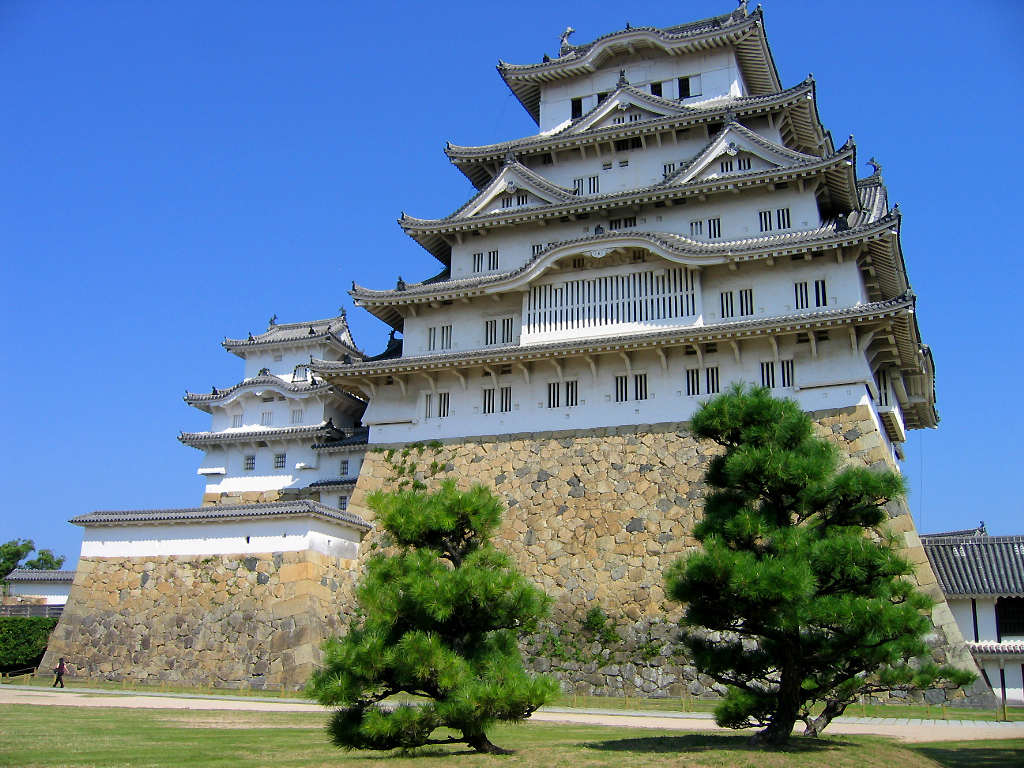 About 400 years old and 400 miles west of Tokyo, Himeji castle stands elegantly, white, and layered like a wedding cake (or a flying heron, take your pick). Being Japan’s best-preserved castle and a UNESCO World Heritage Site make it the belle of fortresses once protecting this feuding island. Unlike the recently reconstructed castle in Kanazawa (or Nagoya, Osaka, etc. take your pick), Himeji owes its longevity to being a virgin to fire and battle. Himeji somehow dodged WWII bombs that rained down on the rest of the town, and today exhibits its original and impressive fortifications surrounding the photogenic five-story donjon.
Himeji, however well preserved, is a one-castle town, so after a self-guided tour and a bento lunchbox on the sidewalk, it was time to fly.
Friday, November 17, 2006
Freaky Foreigners
 Halloween. You get the feeling that the Japanese think they should be celebrating it because it’s Western and in the movies, but aren’t sure how to go about it. Pumpkin-themed things are available, and if you look hard enough you may find a genuine miniature pumpkin, which in central Tokyo looks lonely and lost from the patch.
“Happy Halloween” signs are just window dressing. There’s no substance behind the decorations. And without Thanksgiving as a buffer holiday, some stores launch into Christmas mode in mid-October. That's another Western holiday the Japanese don’t quite grasp, but have added their own twists.
Thank goodness for foreigners to set them straight. In addition to conversational English, we can prove our worth by teaching the joys of dressing up like freaks and gorging on candy until our stomachs explode (nowadays from liquor).
Every four years I’m due to celebrate in full gear:
1998. New Hampshire. Freshman year of college, hallmate Susannah persuaded me to cross-dress so that she could do my makeup. Thankfully those were pre-digital days.
2002. New York. My resort uniform (purple swimming trunks, white tank top, shell necklace) from a former job in Guam was widely mistaken for a marathon runner, an event held later that week.
2006. Tokyo. Having already purchased red wristbands, finger guards, headband, and bandanna to dress up for school sports day (think color war), I realized I could save money and be creative at the same time. 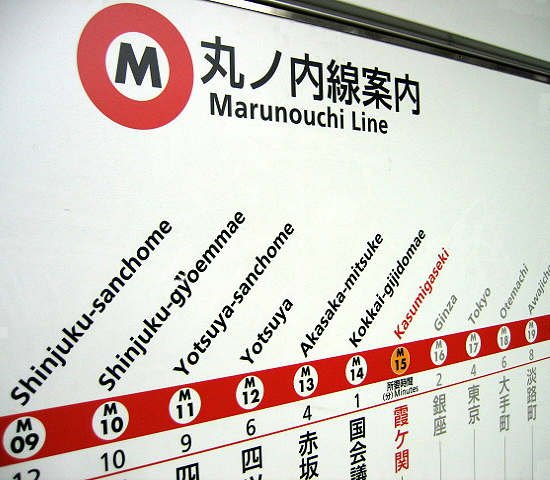 The subway line closest to my apartment is coded red. Inspiration met originality – I would be the Marunouchi Line, Tokyo’s second oldest and my second most disliked after the Ginza Line. Sometimes it’s so crowded that I miss my stop because I can’t fight my way out fast enough. Carriages that smell like the men’s bathroom don’t add appeal.
After working a thankless 13 consecutive days at school, I was ready for a holiday, any holiday. The Halloween dance card was full: four parties in one night. The first required no invitation.
In the same vein as a flash mob, an expat Halloween tradition calls for a costumed convergence on platform 13 at JR Shinjuku station, the busiest in the world. Here we would catch (commandeer) a Yamanote line train. With 3.55 million riders daily, this line is the bread and butter of Tokyo mass transit. Famous for its light green color and cattle cars where the seats fold up during rush hour, Yamanote trains endlessly circle the core of Tokyo connecting the city’s major transit hubs.
Dressing in red wouldn’t be clear enough, so I spent two hours fashioning the Japanese for “Marunouchi Line” onto the back of my red track jacket. It’s the first and last time I’ll ever write kanji, but the result was striking. Two letter “M”s taped on the butt and thigh of matching sweatpants completed the look. 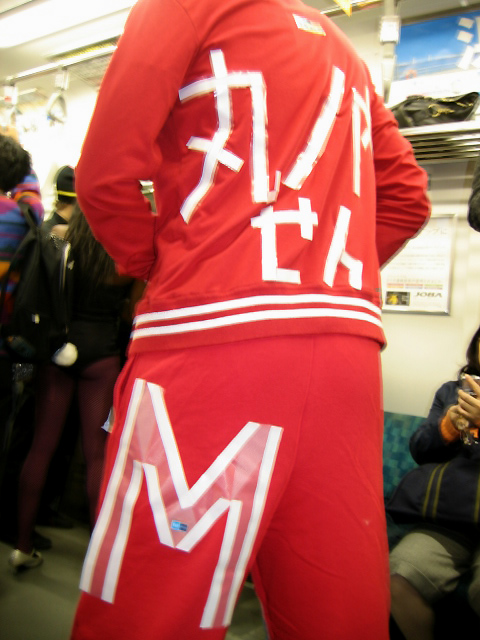 From the front, I looked like a bad 80s rapper. From the back, I was more puzzling. Who would embody a subway line? Again, Halloween is not a well-known concept here, so I simply looked freakish from every angle. Stepping outdoors, I quickly retreated back in – to a convenience store to pick up two canned cocktails (7%) to calm my nerves on the way to platform 13. I got the rare-bird-escaped-from-the-zoo look. Tropical plumage from head-to-toe was a magnet for attention. I became sensitive to sounds. Even busses rumbled by with laughter.
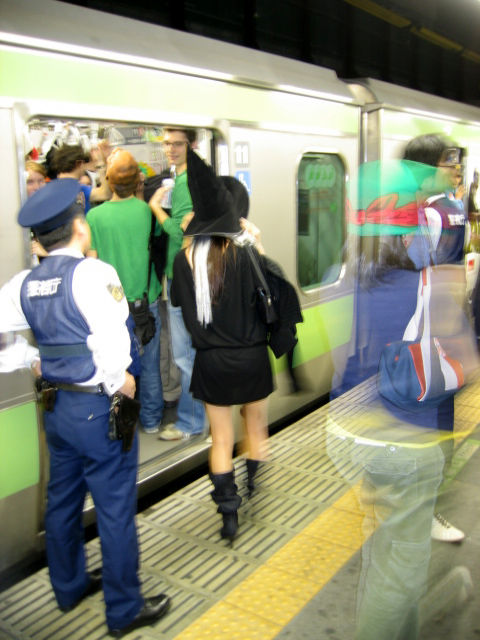 Powerless police officers puttered about platform 13, whispering distress into their radios. Open containers, however, were legal. And so were we, just waiting for the train.
The 21:07 to be exact. That was the pre-decided time to ride. I stepped on the yellow line, and aimed my camera at headlights growing in the dark. The conductor, aware of who awaited, put some serious juice on the horn as the train blew into the station. The crowd cheered. It was party time.
Without enough crazy foreigners to take over ten cars, only the last was targeted. Passengers were given the courtesy of exiting before the spirits of the night stormed the carriage to rile up the unlucky remaining ones. One Japanese woman, coincidentally in an orange sweater, looked like she had seen a ghost, so to speak. The doors closed, the gears wheezed, and we cracked open beverages and yelled “kanpai!” to toast our departure.
Shin-Okubo…Takadanobaba…Mejiro. Locals left and those in costume consolidated control of the car. At each station, boarding passengers received a rowdy welcome, whereupon they scrambled up the platform to find a tamer car. As usual, many commuters waited at Ikebukuro station (change here for the Marunouchi Line). They froze on the platform. The next train was only five minutes behind.
The mood inside was festive, but there’s really only so much fun you can have drinking aboard mass transit. The Yamanote loop takes about an hour, but my next party started in half that time, so I jumped train at Komagome station to retrace my tracks back towards Shinjuku.
According to someone who saw the evening news, foreigners were blamed for causing delays on the line because at each stop revelers would dance on the platform right through the closing door melody and jump back on in the nick of time (see footage below).
For more, check out these Youtube highlights. I guess I exited too early cause it looks like they had a lot more fun than I had.
My friend Delphine, uncostumed but accompanied by a Columbian suitor, also reversed course. Pabo seemed a little spooky himself, a hunch that she confirmed at lunch the next day. Apparently he had a thing for the French damsel, which he subtly conveyed by trying to force her hand down his pants to prove just how small it was. Over instant messenger he once sent her an unsolicited picture of his toothpick.
“He goes on three or four dates a week,” Delphine said. “And he takes girls to love hotels and films it. He’s showed me. ‘It’s small, isn’t it?’ he asks me.” Delphine said that while he’s kooky, he’s no liar.
After Maria’s birthday and Halloween party in Shibuya, I cabbed it to DJ’s place. Rain began to peel away my letters, so I skipped the fourth party to crawl home to bed.
Meeting up with Delphine for lunch the next day, she took one look at my clothing and said with a smirk, “I like you in red better.”
* * * A week later was Jackson’s birthday, which he rolled into a post-Halloween bash on a boat cruising around Tokyo Bay. Ever the crazy Canadian, I like Jackson because he’s that guy. Check him out here lounging on the Yamanote line’s luggage racks.
Once again I dressed up in the color of embarrassment. Halloween was so last week, I thought. No sooner had I locked my door than I heard English voices echoing down the corridor. Crap! It’s my neighbor Mike whose name I’ve seen on the mailbox but hadn’t met in person. He and three friends turned the corner before I could unlock the deadbolt and hide inside.
“Uhh, hi?” I said, clutching my keys.
“Hi, I’m your neighbor” Mike said, doing his best to act casual.
“I don’t usually dress like this, I swear.”
“You’ve got a party to go to, I see,” a friend said.
“Yeah, it’s a post-Halloween thing. I know it’s over, but….”
“Hey, it’s been happening all week,” the friend said, bailing me out.
To get to the pier, I caught a ride on what else but the Marunouchi Line. On the platform, a Japanese man came up to shake my hand and call me a “cool guy.” I felt like a traitor transferring to the Ginza Line, where a drunken salaryman also stopped to shake my hand with a giggle, but fortunately not a grope.
Party pictures can be viewed here.

Sunday, November 12, 2006
Train Bingo
How well do you know your fellow commuters? Play the game and find out. I'm behind the concept and text. My co-worker labored on the illustrations. Disclaimer: some squares may only apply in Japan. Click to enlarge.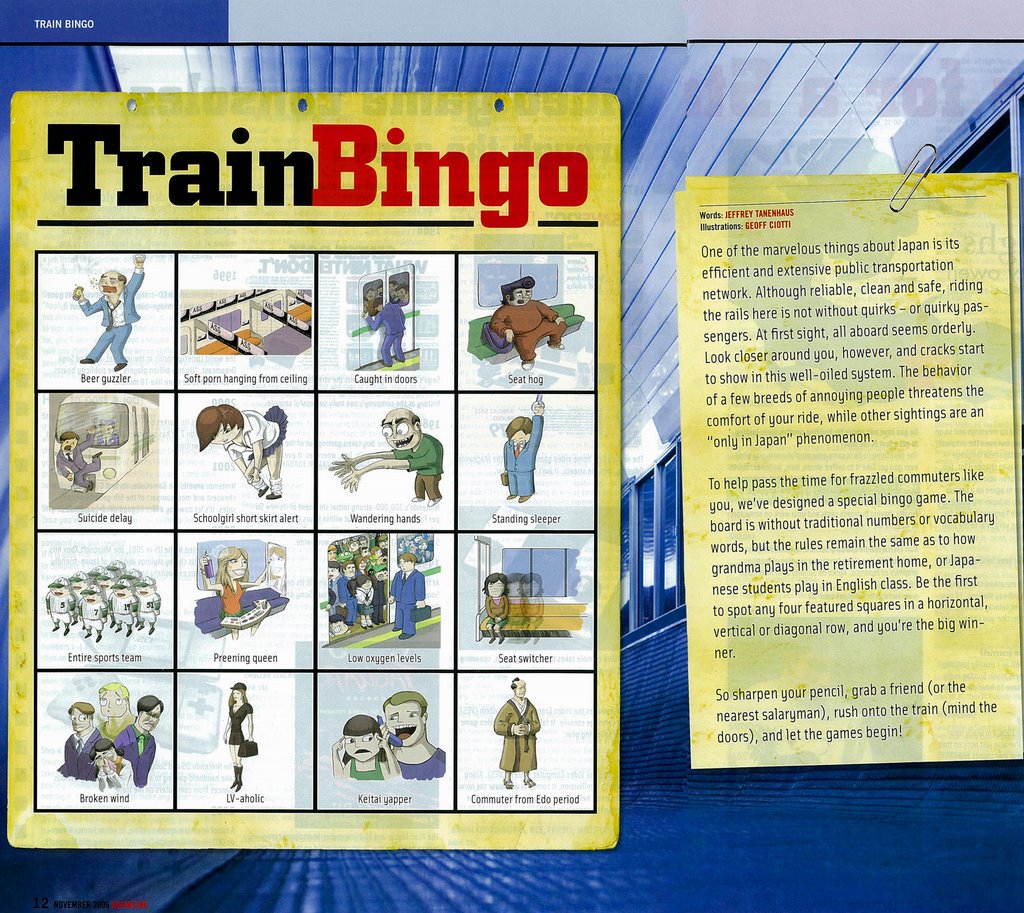
Thursday, November 02, 2006
Pinch Hitting
Teaching intractable junior high kids without basic English skills, I’ve often wondered what it would be like to take on elementary school ones rawer in behavior and ability. In February I found out.
Subbing in the suburb of Funabashi required a 5:40 a.m. wake up call. That was the easy part. To earn some extra income east of Tokyo, I had to transfer from the safety of a train with English signage to the unpredictability of a Japanese-only bus.
Figuring out the right stop was like solving a math problem with only two known variables: travel time from the station depot and the cost of the journey, which every now and then increased with distance. The kanji of stop names flashed up on the screen like scrambled squiggles, and I couldn’t catch the driver’s announcements. A wrong guess would leave me, the functional illiterate, late for school and freezing alongside unknown empty fields.
Students of this elementary school (where I arrived on time) had one 20-minute English lesson per week. That’s in addition to their Spanish class. Two things struck me about the English classroom: no chairs and no board. Before I could reformulate my lesson plan, by twos in marched the first class – seven-year-olds with mucus-streaked cheeks and curious eyes fixed on the giant white alien. I stared at them, and they stared at me.
Nametags dangled from their necks, and one began whimpering about something. Others intently picked their noses or smiled with mouths full of misaligned teeth. I was not accustomed to students out of uniform. Their hodgepodge sweatshirts and overalls included mangled phrases like “Life Is Like A Music” and “Somewhere I Have Never Been. Sometimes I Am.” Yet their clothing was as colorful as their eyes were warm. They were clearly surprised to see a new teacher half the age and weight of their regular Tuesday instructor.
The great thing about elementary school is that it’s game time all the time. Their cooperation and enthusiasm put my junior high misfits to shame. We first reviewed vegetables by splitting into small groups and playing memory with flash cards. No blackboard was necessary because they couldn’t read English let alone much kanji (just like their subbing sensei). So they memorized English words based on picture associations. Spinach, sweet potato, and spring onion, their vocabulary made me hungry for lunch until I thought I heard them recite “toilet paper” when holding up a picture of a bell pepper.
“Stormy Night” played over the PA during lunch. When nobody in the teacher’s room noticed that the song got stuck, I politely pointed to the ceiling speaker and then to my ear while bowing my head with a smile.
With winter approaching again, I think back to that cold day in a new place. Inside, the miso soup for lunch and extra servings of smiles warmed me up. Just a one-day job, by the end it was still hard to say sayonara. The little buggers tagged along in the corridor as I walked to the stairs leading down to the entrance.
Changing into my outdoor shoes, I heard footsteps and looked up. An Adidas tracksuit bounded downstairs to send me off with a hug. I gave the boy a final sayonara, and made my way to the bus stop.
Outside, the sidewalk abutted the playground where recess was in full swing. Two girls kicked up dirt while balancing giant orange cones on their heads. Then I spotted the tracksuit jumping off the jungle gym. The next thing I knew, the boy slid through the gate. He attached himself to my leg and wouldn’t let go. I forget what I said to him in Japanese, but I’ll always remember that firm grip of appreciation.
Subscribe to:
Posts (Atom)


