“Miyukiiii, you’re late!” shouted a teacher from his sidewalk post.
The staff of Douyoto School acts like protective parents stationed on street corners around the school looking out for stragglers. This is a small school – only 280 students, and thus has a family atmosphere. They almost lost one member before my eyes. Had the same teacher not blocked Miyuki’s intended sprint through the crosswalk, he would have had an unfortunate encounter with a minivan.
It was a bittersweet week. I hadn’t taught at my favorite school since Halloween, but January’s reunion would be short-lived. It was my final scheduled appearance. The 7th graders seemed to have forgotten my name because some insisted on calling me Johnny or Bobby. I think they’ve been watching too much TV again. Nevertheless, they welcomed me back with open arms and a few questions, like “how do you say ‘anus’ in English?” and “was that you on TV?” I hope the two weren’t related.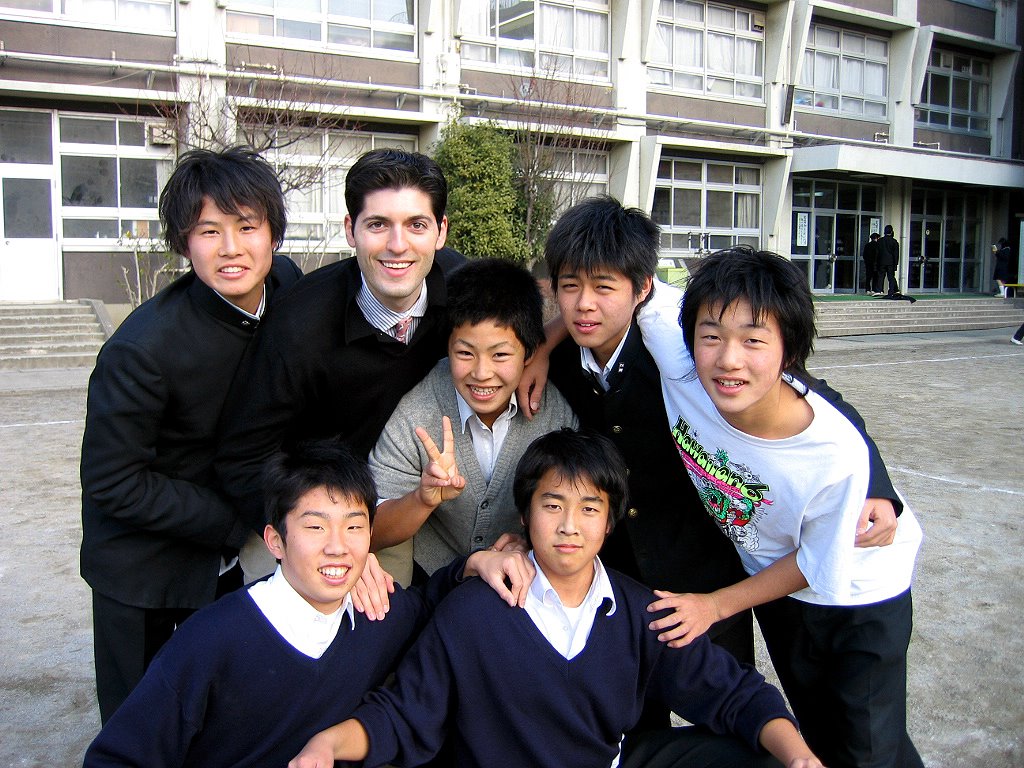 I quizzed them with listening comprehension passages about Thanksgiving and Hanukkkah. Unlike at Kanokita School, where only the walls pay attention, Douyoto students volunteer to recite model textbook readings. English, while not as popular as gym, is at least favored over math and art. In a school survey, 61% rated English as either their favorite subject or one they like.
This, after all, is the school where I coached two students to victory in a sweep of the two first prizes at the ward’s English speech contest. Douyoto divided my loyalty by unseating last year’s champion Nubata School, the second favorite of the four I teach at.
As a parting gift, Douyoto 8th and 9th graders gave me a new batch of compositions to correct. The 9th graders, currently mired in jiken jigoku (high school entrance “examination hell”), wrote about their dreams. It was heartening to read their aspirations pieced together in mangled English. Among the future bakers, barbers, clinical psychologists, weather forecasters and nursery school teachers, some didn’t yet have a “future dream.”
Others expressed exactly what they wanted. One boy confessed an urge to “become a temporarily straight adult.” Talk about lost in translation! Two verbalized definitive goals. One, to follow in dad’s footsteps at Japan Rail. The other, to become a conductor on the Seibu line in a 3800 series train, a mechanical diagram of which accompanied his text.
A humble girl had this to say:
I want to be common housewife in the future. Why? First, it is an ideal every morning that send a husband and child out. I am similar afterwards and do terrible housework in various ways and want to finish first. Now I do not like a help of a house very much. Therefore I want to do my best little by little.
I’m setting her up with this boy:
My dream I would like to be happy old man. What’s happy? Happiness might be different for the person. The dream for me is to do to want do it is necessary to do, and doing. It’s my dream!!
Meanwhile, the 8th graders described “their important one thing.” Family, pet cat, soccer ball, baseball glove and Nintendo were common. One girl wrote about having “a considerate heart.”
This capitalistic boy coveted more tangible values:
My important thing is money. A mony can change everything.
Japanese money is yen that has many kinds. The smallest yen is own yen next five, ten, fifty, hundred, 500….A money made all of us happy, and it is life. Comic books enthrall Japanese young and old, apparently even in the afterlife:
My important thing. It is many comics. It gave me many some thing. For example, knowledge, smiling face, etc…It isn’t miss my life. I like comics. So my coffin in these comics. Because I want to read comics in the other world.
As this blogger well knows, never underestimate the power of the pen:
I have a important thing. It’s a pen. Because it is needed to write. But I often break it. Now I have six pens in my pencase. I often by pen. But it is expensive, isn’t it?
If you say “Yes” you are right.
If you say “No” you are stupit.
Yet even teacher make mistakes. I misspelled cockaroach, cavier and badmitton on the board. I drew an uncomfortable silence after mispronouncing the Japanese word for Thanksgiving (kansha-sai) as kancho-sai. Day of Thanks came out as “enema festival.”
A blooper at recess was just as embarrassing, but more painful. I should have known better than to play a sport I know nothing about while in loafers. I’m not sure how it happened. Maybe I tripped on the soccer ball, or maybe over my own feet, but the next thing I knew I was tumbling. Not just falling down, but a sputtering, flailing dive. Had my palms and right knee not broken the fall, I would have tasted playground dirt.
My stumble drew a chorus of laughs. I casually dusted off my stained trousers, which hid a skinned knee glistening with blood that hadn’t broken the surface. “You’re weak,” one boy shouted in Japanese, adding “and slow, too” while I hobbled after him ready to ring his neck.
I atoned by teaching two 8th grade classes on my own. Technically this is illegal because I am not a certified teacher in Japan. 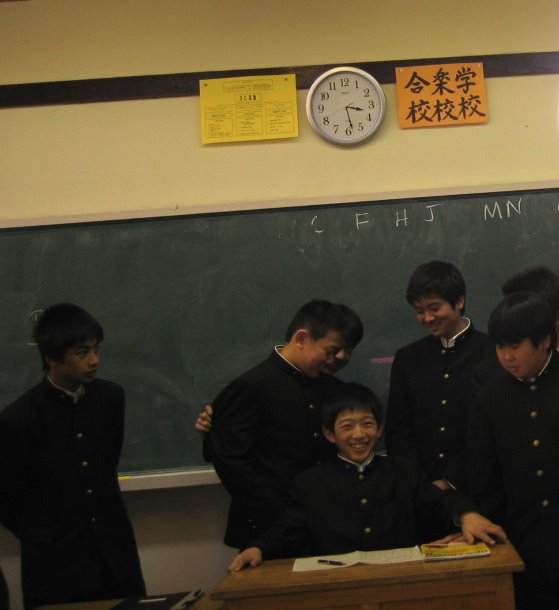 However, Ms. Kimura had to take her feverish son out of elementary school and to the doctor, leaving me in charge of the lesson plan. I drilled cooperative students on reading passages and vocab before running out the clock with hangman. I told them it was our last class together. They stood up, bowed and gave me a mild round of applause. I high-fived my way out the door for the final time.
Monday, January 23, 2006
Long Time, No See

Thursday, January 19, 2006
An Eye for IQ
 Instead of Aiko’s regular Tuesday night private lesson at my apartment, we took a field trip to a neighborhood sushi restaurant. It’s always packed. The salaryman next to me was watching live soccer on his phone.
The place is known for its swimmingly fresh and stunningly cheap seafood. Aiko did all of the ordering, and I did most of the eating – tuna, octopus and squid sashimi and conger eel tempura. The fish was so fresh that for once I didn’t gag at the normally briny stench of sea urchin when it hit my tongue. I nibbled at shredded radish garnishing the sashimi plates.
Just when I didn’t think I had room for any more, soup arrived. Aiko described it as ara shiru, a clear broth with fish bone, head and meat. I cupped my hands around the warm bowl and raised it to my lips. Clean and refreshing.
All that remained was an unidentifiable chunk. Aiko’s bowl was empty. I looked into mine. The meat looked back at me. I couldn’t believe my eyes. I had an epiphany like when your brain unscrambles a Magic Eye optical illusion. From the bottom of my bowl stared a fish eye. Strands of meat clung to the socket, but there was no mistaking the opaque bubble in the middle.
“Are you supposed to eat this?” I cried as quietly as possible.
“Yes, it’s delicious,” Aiko said.
I poked the eye in the eye with a chopstick.
“It’s hard! It’s an eye!”
I can’t remember the last time I got squeamish over food, but the cold look of the eye was jarring. I wanted the waitress to clear my plate, yet out of curiosity I kept poking it as a warm up for the inevitable.
The grey-haired waitress detected my indecision, and told Aiko that boiled sakana no me (fish eye) was good for the skin and intelligence. An eye for IQ.
“Maybe it’s best if you eat it with another food,” Aiko suggested. “Like tofu, if you are scared.” I was scared, but intrigued. Curiosity won, but my taste buds had the final say. My nostrils flared. It was crunchy like plastic. Was it the cornea? Sweet gelatin oozed onto my tongue.
I wanted it out of my mouth and fast, but only had a moist washcloth for a napkin. I pursed my lips, and breathed heavily through my nose. The shredded eyeball sloshed around in my mouth. Teeth cracked on a pachinko ball. Is this what they mean by eyeball? My throat closed. There was nowhere for it to go but back out. I raised the bowl and spat.
Aiko had been watching my contorted facial expressions, which now eased with relief. A swig of beer neutralized the aftertaste. Check, please.
Wednesday, January 18, 2006
Breaching Sashimi Borders
 I took a stool at Daruma restaurant, where the scene has been rather quiet the past several visits. I told Masa I was hungry and wanted something “bigger” than my usual meal of kawaebi, the Japanese equivalent of popcorn shrimp. She knew just the thing, and yelled something at the cook, who greased up an already greasy iron pan.
As I awaited the mystery meal, a salaryman on the adjacent stool startled me by striking up a conversation. It was the standard where was I from and where did I live now. He picked at a plate of sliced fish the color of blood. “Do you like kujira?” he asked. I like all types of raw fish, but this looked a little too raw for my taste.
Kitchen hand Nao came over to translate by pictograph. My eyes lit up. This wasn’t just any fish. It was whale. It’s only on the menu of two countries – Japan and Norway – that haven’t banned the practice despite international pressure.
“Some foreigners think it’s rude for Japanese to eat,” the man said, sliding a piece onto my plate. I was surprised to see it served at a hole-in-the-wall like Daruma. Whale is expensive, and its consumption on the decline. It’s now considered a delicacy instead of an entrée at school lunch, which remains a childhood memory one art teacher would rather forget.
The blood-red chunks didn’t look appetizing. Unlike smooth slices of tuna, whale looked more fleshy than fishy. It didn’t dissolve inside my mouth like tuna either. I couldn’t spit it out in front of everyone, and kept chewing until the lump felt masticated enough to wash down with beer.
Squid eyes. Whale. What’s next to cross my lips? Sakana no me. Stay tuned for Fishy Business Part 3.
Monday, January 16, 2006
Squid Eyes
 How can you tell if you’ve been in Japan for too long? When hankering for a snack, you bypass the Kit-Kats and Doritos and beeline to a supermarket’s raw fish section.
I needed an after school pick-me-up, and picked up a container of baby squid. At first I wasn’t sure if its contents could be eaten on the spot. I had never seen squid eyeballs as white beads. Were they supposed to be cooked? My stomach growled. The enclosed packet of mustard was enough to convince me that raw was the way to go.
I lamented the unofficial no eating while walking rule in Japan, but stuffing slimy squid tentacles into my mouth on the way to the train station did seem a little messy. Yet, I couldn’t resist. I looked both ways, and popped the seal. The unexpected crunch of the eyeball almost chipped a tooth. I spit out the rock on the sidewalk, and carefully continued chewing.
My midday snack wasn’t as tasty as it had looked. Once I in the privacy of my apartment, however, the de-eyeballing process was easier. Adding mustard and soy sauce turned raw taste into a tasty treat. 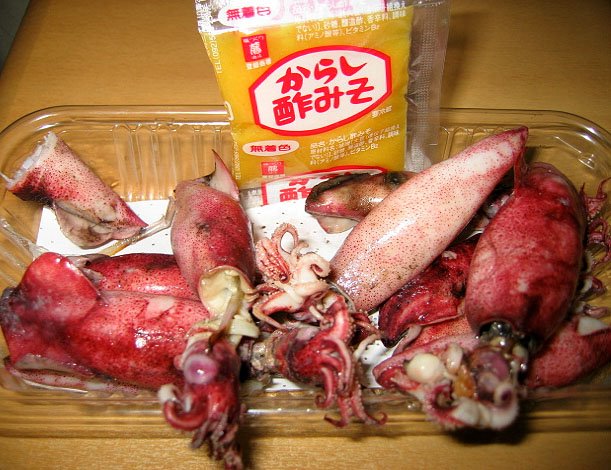 I e-mailed an American friend about crossing new fishy frontiers. She shot back, “That is absolutely DISGUSTING – sounds like you need a care package and quick!!!!!!!”
Now that you mention it, yes. Everything bagels, pizza without corn and mayo toppings, non-Asian ethnic food and anything else that doesn’t contain dried baby sardines, rice or squid eyeballs would be fine, thanks.
Thursday, January 12, 2006
Taking Swings in Kiba Park
 There aren’t too many places at 35°41' North latitude where you can play outdoor tennis in January. Tokyo is one of them. Ironically, in order to avoid the sun’s tanning rays, Japanese women wear more clothing to play tennis in July than in January. In summer’s 137% humidity, I perspire walking to the subway in a t-shirt, but that doesn’t stop women from wearing full sweat suits with long sleeves, mittens and visors inspired by Darth Vader.
In cooler conditions and under cloudy skies, I joined the Yamakuma family at well-maintained grass courts in Kiba Park, a half hour walk from my apartment. Kiba means “tree place,” and alludes to the lumber stockyards of the Edo period. 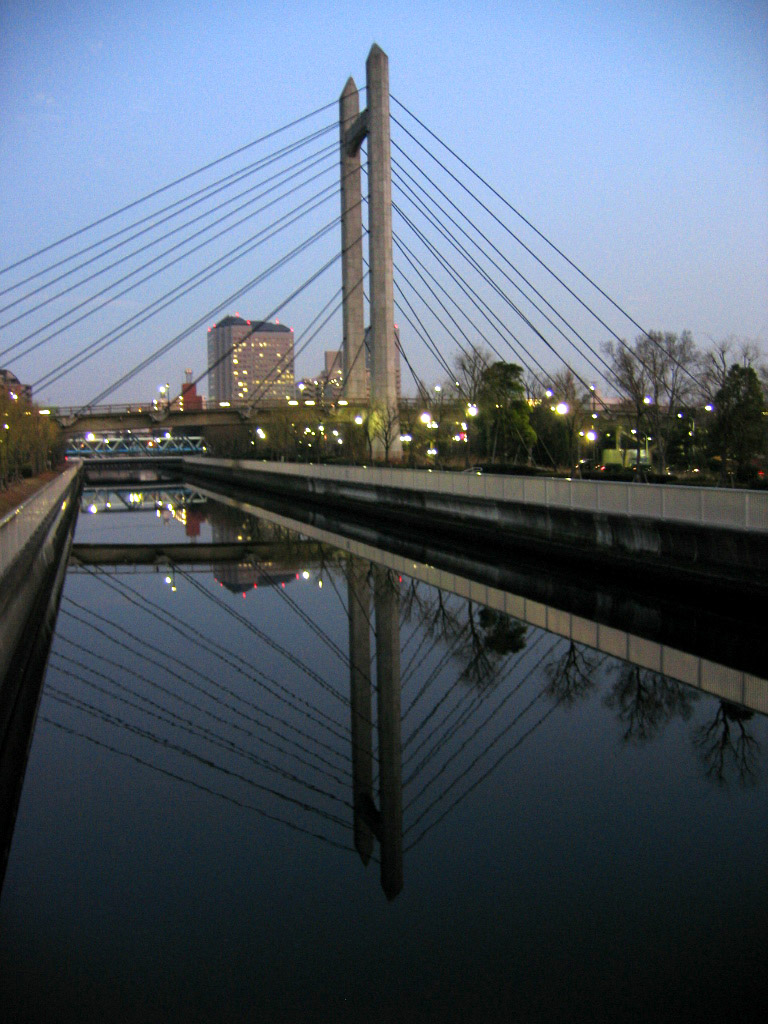 Nowadays, an unsightly concrete bridge accents the park, which attracts a crowd of retired shutterbugs who assemble tripods to document the local wildlife – pampered pooches and plump pigeons. Winter doesn’t enhance this drab park’s appeal, but when in Tokyo one learns to relish open spaces of any kind, even “parks” nestled under overpasses.
I tutor Jiro, the Yamakuma’s 7th grade daughter, for an hour on Saturday mornings. She showed up with a racquet, as did adult 6 family friends. We rented two courts, one for the husbands and the other for the wives. I was assigned to the wives’ court.
For two hours we played matches of four games each, rotating partners. While I hadn’t held a racket since an embarrassing defeat at the hands of an American 7th grader while vacationing in Oman a year ago, at least I was able to follow Japanese tennis jargon as we volleyed balls and apologies for hitting them. A typical point consisted of the following dialogue, gasped in staccato female whimpers:  Oh, I’m sorry! Are you ready?
Ahh, excuse me. I’m sorry.
It’s short, excuse me.
It’s okay. Sorry.
Oh, nice serve!
It’s short, so short. I’m sorry.
Almost!
Okay, next. Your turn, please.
Excuse me, please have a ball. Thank you.
Oh, thank you so much. I’m sorry.
Okay, it’s no trouble. Thank you.
My underhand serve needs work before next week’s qualifying match for Tokyo’s Toray Pan Pacific Open, but I’m set to practice with Nubata’s tennis club after school (also outdoors).
Walking through Kiba Park triggered memories of an earlier visit. I’ve had many bizarre encounters in Tokyo, but this perhaps outranks them all. Back in July, a salaryman at Daruma restaurant took me drinking around the neighborhood. Our last stop was a street cart named yatai. These are portable food vendors, but with fixed sidewalk locations.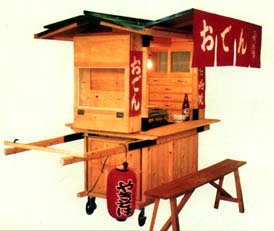 I pulled up a stool, and the salaryman ordered me a can of Asahi and a bowl of oden, a hodepodge stew of strange root vegetables. Four other locals yammering in Japanese ringed the wooden cart, but became intrigued with the foreign diner.
A woman had a son my age, but after 45 minutes the salaryman left me on my own for translations. A man of about 50 with a shaved head and athletic build bought me another can and then a round of sake, which unfortunately were not elixirs to clarify his speech. Even the salaryman had trouble comprehending his thick Japanese with a heavy accent of intoxication.
The yatai chef was calling it a night, and my new friend – missing a bottom front tooth – smiled at me to follow him to the corner. Before the light changed to cross, he hailed us a cab. Climbing in sent shockwaves of uncertainty in this order: (1) cabs are an unaffordable luxury, (2) how was I going to get home from where we were going, (3) where were we going and (4) who the hell was this guy? I began noting landmarks to help me retrace the route for the long walk home. Two right turns and a trapezoidal bridge later, the cab stopped. There was a convenience store and park. We went into the conbini first.
“Hanabi!” I pointed at the fireworks hanging from a rack by the door. I thought I had seen it all, the young clerk was thinking to himself as he eyed the drunken odd couple buying fireworks at half past midnight on a weekday.
The man, who paid for the cab and fireworks, hadn’t stopped talking through either. I was absolutely clueless as to what he was saying as we walked to a grassy field illuminated by street lamps.
I gazed up at the night sky. The next thing I knew, I was seeing stars. I had been knocked off my feet with some martial arts maneuver. And now I was angry. I charged back to return the favor, but bounced off; he was built like an ox.
I can’t remember how long this midnight melee lasted, but it ended as abruptly as it began. He started walking home. I ran after him to hand him the fireworks we’d abandoned. A banzai scream broke the silence as he punted the package into a stand of trees.
I woke up at noon wondering if it was all but a dream. Grass stains on my track pants told otherwise.
Tuesday, January 10, 2006
Shock ‘n’ Defrock
It was judgment day at Nubata School. What do you want to be in the future? That was the lesson planned for 8th graders. I was to ask each student his or her aspirations just as soon as the teacher passed back last semester’s English test. The Japanese school year is divided into three, and each marking period has one or two tests per subject.
The students looked nervous, and given their scores I would have been, too. Mr. Nakamura called out names, and students lined up with tortured looks to receive their academic fate. “Is this test out of 100?” I whispered. Mr. Nakamura chuckled with embarrassment. I was seeing red inked numbers in the teens.
“Ayyy sensei,” one girl cried, quickly folding her paper. Another grabbed her pigtails in frustration. One student aced the exam. It wasn’t the guy shredding the paper under his desk. It seemed that the quietest students either understood class very well (85% and above) or were hopelessly clueless (25% and below). “That’s pathetic,” I said in Japanese, patting the shoulder of a back row boy who fell three points shy of breaking double digits. I hope there’s a curve.
I began the lesson with a row of girls, who professed desires to become rich girl, pretty girl, rock star girl or a great human. I then moved to the boys by the window because they have the shortest attention spans. One wanted to become “a wind,” which seemed to make sense to him in his little world of anime artfully drawn in his notebook’s margins.  The third boy back was a little rascal with a shaved head and mischievous eyes known as Saito. “I want to be a priest,” he said laughing and waiting for me to react. I shrugged off his insincerity, and queried the boy behind him.
Saito apparently was serious because he suddenly grabbed my ass. Not just a friendly pat on the butt, but a full-on, crowded train chikan grope. I wheeled around in disbelief to see Saito grinning with his hand still outstretched. He repeated his desire to join the clergy. “That won’t be a problem,” I assured him. “I’m sure the priesthood will just love you.”
Stern warnings only embolden Saito, who unfortunately continues to fumble around for out-of-bounds places. It could be worse. I’ve yet to be a kancho victim. This word is Japanese for enema, and is a popular ruse with elementary school boys who, hands clasped like a gun, sneak up and jam outstretched index fingers into a buddy’s rectum.
Somehow, I just don’t see this catching on with American kids, but the time-honored tradition is alive and unwell in Japan. T-shirts available. Arcade games (gulp) available. Sick stuff? Hardly the tip (ahem) of the Japanese iceberg.
Saito’s friend Kenichi, who has a sharp wit and perhaps the best English in the class, had a flattering response. “I want to be a Jeff-sensei in America,” he said of his desire to teach Japanese to Americans. I clutched my heart. Had I finally broken through to a student? Of course not. After class, Ken said he was just kidding. He wanted to be a priest. I dodged his hand just in time.
Friday, January 06, 2006
Private Dancers
It was a “one-derful” day. In the teachers’ room, my chin rested on a notepad where I was jotting down thoughts. I was scheduled to teach just one class, and that was three hours ago during first period. I wait until after the subsidized school lunch to ask to be excused for the day.
Two girls entered the room with a soft “shitsuri shimasu,” which is customarily said upon a entering a room to apologize for the disturbance created. Whatever teacher they were looking for wasn’t here – I was alone. When they didn’t leave, I looked back up – they were looking for me!
I asked them where we were going. A lanky girl said “the sports dome.” Intrigued, I followed. We headed to a room above the gymnasium where once I did taiko drumming with the “handicapped students.”
Girls were milling around in their gym clothes awaiting Haruko’s instructions. Male students affectionately call this gym teacher “short, fat woman” in English. She seems to embrace the appropriate description.  Haruko’s class was practicing Japanese folk dances to be exhibited at their upcoming school festival. Each student grasped a yellow and white sensu (Japanese fan) and shakujo (stick rattles with metal bells). The girls, some beaming behind their fan-shielded giggles at performing for a visitor, took their positions.
Haruko popped in a crackling cassette. The girls swayed to the traditional rhythms. The fisherman’s dance looked like a reenactment of an epic tug-o-war. And if you’ve seen the size of the torpedoes auctioned in Tskuji fish market, you’d understand why.
The girls watched my reaction as they twirled. They were no longer dancing for Haruko; they were dancing for me. The choreography, music and intimate setting felt like the real Japan. Sure, Japanese festivals are impressive staged events, but this uncostumed, raw demo in a middle school gymnasium felt more visceral.
Despite a few dropped fans and miscalculated tugs that sent some toppling over, the girls executed well. One dance was a school tradition performed since 1983.
“Shall we dance,” a girl asked me near the end of class, quoting the recent movie based on a Japanese film. Others called for me to join, but I sat contently watching the young experts.
Tuesday, January 03, 2006
Gongs At Midnight
 Fifty minutes to midnight, I was in my apartment with a sixer of Sapporo munching on day-old sushi and gizzard skewers. The television was on. I was exactly where I wanted to be.
The New Year’s Eve tradition of kohaku uta gassen was in full swing. J-pop stars were pitted in a battle of the sexes while kimono-clad enka singers waxed about unlucky love to sway the older demographic. Gorie, the transvestite comedian, sided with the girls’ team. While the parade of talent featured a few too many feathered boas for my taste, not so for the average Japanese household, 50% of whom tune into the program (down from 80% in the 60s-70s).
Unlike in the West, New Year’s in Japan is steeped in tradition more meaningful than champagne, Dick Clark and Times Square. The holiday is similar to Thanksgiving in that it’s the one time families get together. Bamboo and pine ornaments adorn entrances, soba noodles symbolizing longevity are slurped whole and bizarre seasonal foods crowd supermarket aisles.
Also unlike in the West, I was having trouble getting myself invited to a year-end celebration. Time was running out, and so were the contacts in my phone book.
Hidemi was with her family in Mie prefecture. Basketball buddy Takahiro was down the street, but also with his parents. Sweet Kaori was texting me to arrange a follow up to her trial lesson in June. Nao (male) was going to Yokohama for an event staff party. Nao (female) wasn’t returning messages. And I wasn’t returning Fumiko’s.
Yoichi was having a party in his apato, but then suddenly changed plans for Chiba. Michelle and Nobu were in New York. Lawrence was in France. Hicca, of restaurant and radio fame, was in the hospital with a brain tumor. I almost thought about texting Satoshi. Almost.
So, like most other days here, I spent omisoka alone, but not lonely. Another tradition is to visit a shrine at midnight, or sometime during the three-day holiday. About 70% of Japanese make a pilgrimage for ceremonial rather than religious reasons. More than three million descend upon Tokyo’s Meiji Shrine, which is about the number of salarymen swarming into my Otemachi-bound subway car on non-holidays.  Luckily, my neighborhood is home to Tomioka Hachimangu Shrine, perhaps one of the five most important in Tokyo. At 30 minutes to midnight, I set out to rendezvous with the god of war. Just Hachiman and I would ring in the New Year together. Little did I expect such a crowd to vie for his attention.
 The shrine was packed with people waiting to make a wish. Food stalls cooked up tempting treats in a haze of scented smoke. Never mind champagne, it was tako-yaki time (fried octopus-filled golf balls, right).
I exchanged greetings with two basketball acquaintances who spotted me while awaiting their fortune slips. Not wishing to wait in line for a custom I didn’t understand, I played roving photographer. I nudged my way up to the front of the shrine just before midnight, and videotaped the clapping crowd as gongs boomed. Some drunken guys hoisted one of their own, and bounced him as if he had just scored the winning goal.
The best part about the New Year, however, isn’t the anti-climatic countdown. It’s wishing random people well. This was made more satisfying in Japan where I was a foreigner unexpectedly equipped with the right phrase, and – after five Sapporos – emboldened to startle strangers.
Among those I bestowed New Year’s wishes upon were the supermarket checkout clerk (to purchase said Sapporo), the muffin girl in the silly hat working the bakery aisle, grandma Yoko the Chiyoda Sushi lady where I order out three times a week, a gang of high school troublemakers sitting on a park fence and a couple walking a dog down a quiet side street.
I spotted another young couple. “Sumimasen, shin nen no hofu wa nan desuka?” (What’s your New Year’s resolution?). Waiting for the walk signal, they were trapped. In typical Japanese style, the woman repeated my question. She then shot her boyfriend/husband the look. Traffic stopped. He laughed to end the conversation. The response needed no verbalization: more sex in ’06.
I continued to indulge in Japanese tradition on New Year’s Day, as I made a McTeriyaki burger my first meal of 2006, and watched the 85th Emperor’s Cup soccer match in bed (the red team won).
While I received no fortune at the shrine, I got an e-mail from Atami, a Douyoto 9th grader. His message was one we can all embrace: “2006’s ambition is ‘Don't forget progress spirit always.’” Amen, little guy. It’s going to be a good year here in Tokyo. Akemashite omedetou gozimasu to you, too.
Friday, December 30, 2005
Blind Dates
Hair neatly parted? Check. Nostrils and teeth free of debris? Check. Plentiful supply of invigorating Frisk peppermints? Check. It was time for my first goukon.
Satoshi’s friend had arranged everything. I would meet them outside of Shinjuku station, exit A13 (there are, after all, about 50). I had traded mangled text messages with Satoshi for the past two weeks, but forgot what he looked like. We only met once in passing at a party and exchanged numbers. Now we and two other guys were going to meet four girls for drinks, dinner and a possible first step towards lifelong romance.
Goukon is a Japanese-style group date involving equal numbers of guys and girls, often the type that struggle to find their own dates beyond a structured invitation from an equally desperate friend.
Maei, Maki, Mariko and Eriko were waiting in the basement-level restaurant’s private booth. I removed my shoes and climbed in. We began introductions as our drinks arrived. Aside from names, I understood and said very little. One of the guys spoke some English, but other than that I could only express common interests with Eriko by repeating hip-hop stars on her Sony mp3 player.
Maki had the looks and the piercings – 19 of them, in fact. Not all were visible. “I want to see them later,” I blurted out in Japanese. Sometimes I forget my audience is not always adolescent males. She looked older than the other girls, perhaps early 30s, but I wasn’t one to guess. I was surprised to learn that Satoshi, who looked 23, was actually 33.
He was also on his third glass of shochu (whisky and water) before I had broken apart chopsticks to sample the appetizing raw tuna slices drizzled with peanut butter and clover sauce, or that’s what it looked like.
Perhaps impairment caused Satoshi to call Maei “Maria,” who grunted at the affront. She was a piggish girl with an attitude, and scowled at him all night. She also divulged that her mother owned a restaurant in Tochigi prefecture where horsemeat was the specialty. It was apparently very cheap. I double-checked to make sure I interpreted correctly. Yes, the horsemeat came with egg and ginger sauce. I’m not sure if the eggs were on the side or in the sauce, but I was glad we weren’t eating in Tochigi.
While Japanese flew all around me, I dove into buta no kakuni ni boi, or boiled pork squares, which don’t sound much better than horsemeat, but were heavenly. With the girls nothing special, at least I had an endless supply of pre-ordered food arriving at the table.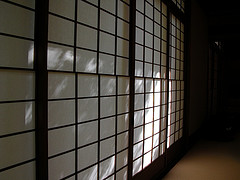 Later in the evening a woman slid open our booth’s shoji, a paper door with wooden frame. She dropped off promotional cigarettes in green and pink packs. A nicotine-like rush came over me as I thought about owning my first pack. While I would never buy one based on principle, I’ll take anything free and targeted at me, even cancer sticks.
Satoshi, who smoked as much as he drank, had other ideas. He gave all of the pink packs to Maria, and kept the green ones for himself. He knew the American didn’t smoke, but where was his Japanese sense of obligatory hospitality?
The best part of the goukon was periodically changing places. This clever twist ensured a mixing of the group in case you initially sat next to Mariko, who had less to say than I did. Changing places also enabled me to devour the untouched plate of pork squares at the other end of the table.
Although all seven of us except Satoshi started off with beer, by the end of the evening I was one of only two such drinkers left. The others had switched to shochu or mixed concoctions. Warned about last call, Satoshi ordered an extra round. This happened twice more, with drinks coming before the previous ones were finished. Maria hoarded three full glasses, and was talking loudly across the table at Satoshi.
I was stuffed, but slid chocolate cake onto my plate. You can’t eat and drink this well for ¥6000 ($51)/person in New York.
When I returned from the restroom, I asked Satoshi where the girls had gone. I struggled to understand that they had left without saying goodbye. Satoshi wasn’t ready to call it a night, and in his thirst hailed us a cab to an Irish pub.
Students were keen to know of my Japanese experience. Perhaps next time I should listen to their suggestions. As one 9th grade girl advised, “Don’t go on a goukon. The girls are pathetic.”
Monday, December 26, 2005
Jam-Packed Road Trip
 Japanese mass transit is predictable to the minute, and its workers don’t have pension issues (right, New York?). However, cattle cars are a predictably boring and hectic means of movement. I was eager to trade darkened tunnels with unpleasant odors for the freedom of an automobile with fresh air on the open road.
Shuichi, the English student of my American friend Michelle, would chauffeur with his own wheels. Would our getaway vehicle be one of the 10 I cited as having head-scratching names? The side door automatically rolled opened on the white 2003 Honda Stepwgn, which might hve mde my tp 20.
Michelle packed typical Japanese road trip fare: squid jerky, octopus bits, and sweet potato soft chew sticks. I had the foresight to bring two “international-style” CD mixes of top 40 hits. Otherwise, Michelle and I were poised to commit double suicide in the back seat as O-zone’s hit single “Ma Ya Hi” was stuck on repeat during the 45 minutes were circled around trying to find the Shuto expressway out of Tokyo.
The confusion was in spite of a GPS system onboard, an indispensable gadget for anyone daring to drive to an address in this city. While such systems in American cars display the nearest Six Flags or Burger King, Japanese GPS pinpoints soba noodle shops and ubiquitous convenience stores.
I quickly grew nostalgic for being pressed up against dark-suited strangers. Monday was a holiday, so you’d think that by Sunday morning people would have already headed for the hills. Not the case in a country where 7pm is early to leave work, even on a Saturday. I learned a new word on this trip: jutai. It means traffic, of which we faced 24 kilometers (15 miles) worth.
Not even purple Etc. toll lanes (think E-ZPass) could speed up the trip. Two mixes proved insufficient, and O-zone came back on with a vengeance. I love Romanian dancepop just as much as the next guy, but it’s best in small doses. Really, really, really small doses.
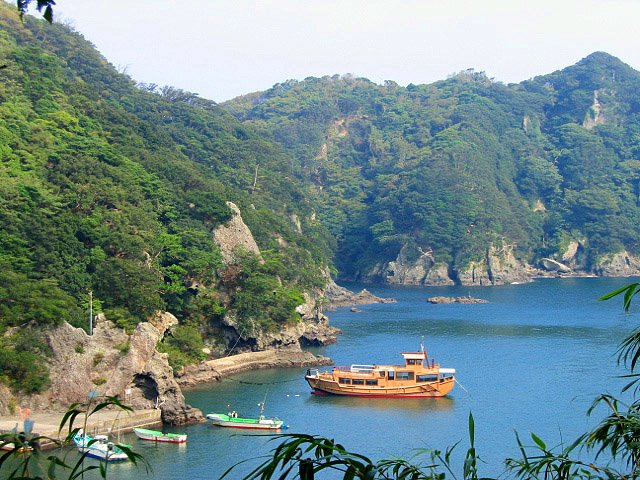
Traffic snarled again at the gateway to the Izu Peninsula, a popular getaway for its onsen, or thermal hot springs. Route 135’s one-lane roads hugging the coast were illuminated with red brake lights.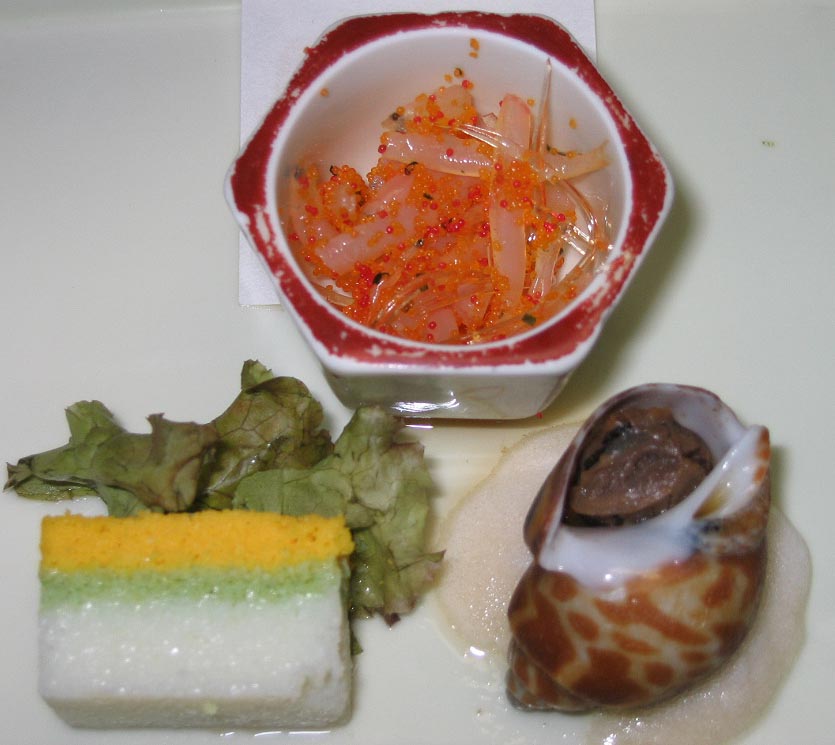 After a sumptuous feast (click right for a yummy close-up) and relaxing night on futons in a traditional ryokan inn and scenic sightseeing the next day, I anticipated a long haul back to Tokyo Monday night.
Night fell on the Shuto expressway, but all was not dark. Brake lights shined 40 kilometers (25 miles) towards Tokyo.
Wednesday, December 21, 2005
A Very Jewish Christmas
At Kanokita, where the kids have no appetite for learning, Mr. Mochizuki passed the buck to me to answer more interviewing-the-foreigner questions to eat up class time. “How to celebrate Christmas in your home country” was first on a handwritten ditto entitled: “Let’s Enjoy!!! Mr. Jef retraces himself.”
Mr. Jef introduced the subject with skilled drawings in colored chalk. Students recognized the ornamented Christmas tree and gift-wrapped presents beneath it. So far, so good. But confusion ensued when they identified sleigh-riding Santa as a snowman. To clarify, I sketched a chimney and fireplace, and added directional arrows showing Santa’s path from the sleigh down the chimney to deliver presents under the tree. But further explanation was needed. The fireplace mantle was not adorned with a plate of rice crackers or pizza. The glass was not filled with coffee, juice, champagne, shochu or sake.
One dark Tuesday, I regurgitated this 50-minute lesson four times in a row. My holiday spirit soured by the fourth class. I lit the fireplace logs and redrew a cross-section of the chimney with a bulge and dangling legs. Poor Santa. While Mr. Mochizuki translated, I fanned the flames, which shot up and singed Saint Nick and ignited the “Christmas socks” hanging from the mantle. Soon, tree tinsel was ablaze. Some boys were giggling. I wasn’t taking any prisoners this holiday season.
I drew a reindeer. The girls whimpered upon learning that I had eaten one (yes, a kebab in Finland). Shock turned to horror as I drove home the point by sketching Rudolph’s forehead with a bite removed. I sliced open the body to add entrails spilling out in hastily rendered chalk. The bell shook me from my trance. The boys were still giggling. The girls hung their heads. I hung mine. What had I turned into?
That the day has religious roots was news to some. A few were surprised to learn that it marks Christ’s birthday, not Santa’s. One asked, "how old?" While Christmas is secularly celebrated in Japan, I sensed an opportunity to convert young minds to the joys of a new holiday. Not just one day of presents – but eight! 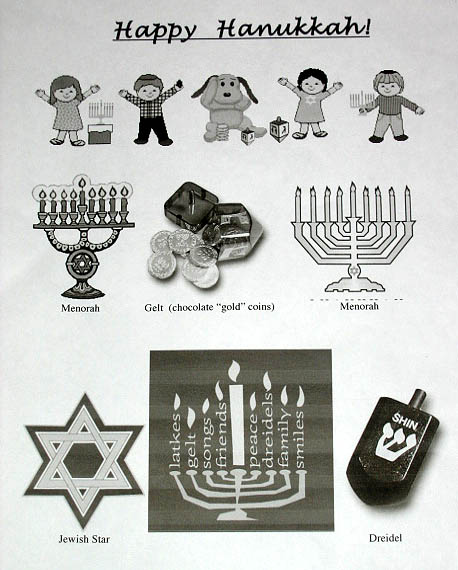 “Happy Chanukah!” I wrote on the board, emphasizing the guttural “ch.” Giggling resumed. “Hadaka?” one snickered. My religion’s holiday unfortunately sounds like the Japanese word for “naked.” I handed out a printout with images of menorahs, gelt and dreidels.
“Chocolate money [gelt] is delicious!” I cried, rubbing my tummy, hoping to jumpstart the class. Okay, Plan B: break out the games. “Do you know dreidel?” Someone echoed “jello,” another “judo.” For the 7th graders, I simplified the lesson into a Christmas dreidel game, dispensing with the whole Jewish thing altogether. The capacity of 13 year-olds to absorb a foreign topic in a foreign language is quite limited.
I divided each class into five groups, and distributed a dreidel to each. Familiar with Japanese koma counterparts, they only needed about 30 seconds of practice. Advanced dreidelers spun them upside down or on their foreheads.
I quickly switched 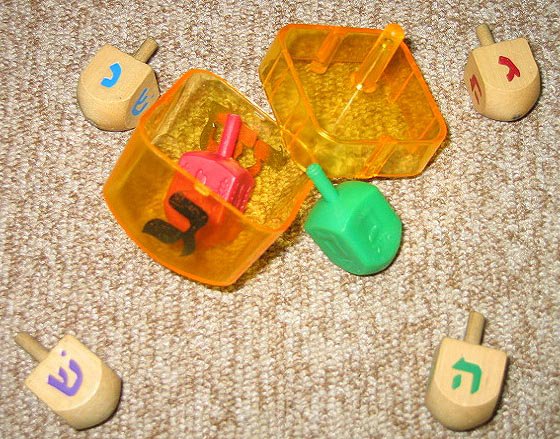 to the competition phase where one member of each group spun his or her dreidel on the floor. The last one standing earned a pencil. Everyone gathered around to watch; students instantly took a liking to the Jewish koma game.
The release from textbooks, excitement of competition and promise of prizes turned class into a festive atmosphere. After the games, we merrily sang the dreidel song until time expired. Hook, line and sinker.
Monday, December 19, 2005
A Complaint
“Hey Jeff, do you have a sec?” It was Todd, the grey-haired jovial Australian head of my teaching placement agency. We were walking from our monthly teachers’ meeting to the company Christmas party at a nearby izakaya.
Meetings are a chance to compare notes, which for me means verifying that my students are indeed the worst in the ward. “Wow, none of my schools are like that,” Jon said upon hearing selected stories. “The craziest questions I get are marriage proposals.”
“Great, let’s walk ahead,” Todd suggested. Singled out, I tensed up. This wasn’t about a Christmas bonus or teacher of the month honors (both nonexistent at the agency). Thoughts raced as to what I had done wrong at school.
Masturbation sprung to mind. As the kids test out their adolescent vocabularies, I’ve worried that Japanese teachers have detected the dirty words and blatant hand gestures students greet me with, much to my embarrassment yet subtle encouragement.
For example, while checking on progress of blackboard copying, I moseyed over to one bad boy in the back of the room. “How big?” he said, pointing to my groin. Two erasers sat on his desk. I pointed to the jumbo one and said “American.” Then I pointed to the mini eraser and said “Japanese” before turning my back on the laughter and pacing down the aisle.
A class at Nubata the week after created more of a stir. It featured school pervert Ryoki, who has previously caught me off guard. Once morning bows were exchanged, the Japanese teacher, only two years my elder, asked me to recap Thanksgiving activities in New York.
I also had taught at this school the week of my departure. Once I passed pervert & co. in the stairwell.
“When are you going to New York?” Ryoki asked.
“Friday.”
“I want a gift.”
“Okay, what?”
Pause. “Strawberry condom.”
His friends then clamored for lemon, grape, orange and Christmas (?) flavors.
Two sentences into my Thanksgiving shpiel, we made eye contact. Ryoki – sitting in the second row – flashed me the hand gesture for you know what. A snot ball flew out of my nose. Basting the turkey is one thing, but masturbation? I wheeled around to hide my laughter and use my sleeve as a tissue.
I regained direction and continued with less than perfect pronunciation while biting my tongue. “What did you eat on Thanksglivling Day?” the teacher asked in his normally mangled English.
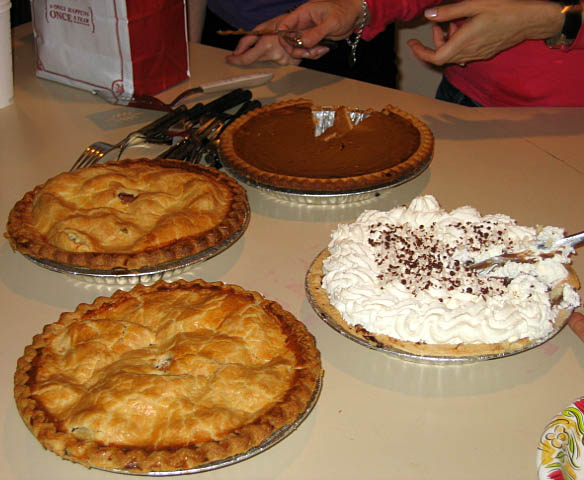 “Pussy, pussy,” Ryoki whispered in Japanese. The teacher must have heard it, but didn’t react. Meanwhile, I was struggling to keep a straight face while listing the four kinds of pies I ate. “Oppai,” Ryoki moaned, deliberately confusing dessert with the Japanese word for breast.
The teacher quizzed comprehension about the pies’ names, and then asked if there were any questions. Ryoki’s hand shot up. He wanted to know what I had done in my house at night. In case I couldn’t take the hint, he made the gesture. I paused, falsely smiled, and said that I watched TV, which played right into his trap. “Oh, what kind of TV do you watch?” he snickered. The news. And no, not the Naked News. After class this brash boy approached me with one last question: where was his souvenir?
I digress.
“Jeff,” Todd began, “We’ve gotten an e-mail from a school saying that you’ve fallen asleep during class. Twice.” I shot him an are-you-kidding-me? look. “I know,” he continued, “I’ve been there in those over-heated rooms standing by waiting to be played as the human tape recorder.” Kenichi, the company co-head, caught up with us and flashed a nervous grin of stained black teeth. “Honestly, Todd, I don’t know what they’re talking about.” Sleeping in class conjured up images of student heads buried face down in their arms on the desk. “I mean, I might have zoned out for 30 seconds, but I never fell asleep in class,” I added, leaving out the part about propping myself up against the back wall while fighting the weight of my eyelids. Damn gravity.
Todd’s tone was friendly; he was just checking up. Not that I’m worried if it happened. I’m confident I’ve been a good sensei and friend to the students in spite of the part-time salary and rent-an-English-teacher treatment I get from my Japanese counterparts.
On the other hand, who bothered reporting such a thing? Students get away with it all the time here. I narrowed suspicion down to two schools, and chose Ms. Shomatsu at Omiyada as the tattletale. Beneath superficial kindness lurks a history of her sweating the small stuff.
At the beginning of one such class, students nervously got her attention. This was unusual because they rarely break the mold and initiate dialogue with the teacher. But today they had something to show her. Something urgent. She walked over to where they were pointing at the floor and scowled in Japanese. My first thought was a mouse.
No, she returned to the front of the room holding a mini straw at the end of which was a hardened piece of chewing gum covered in dust. Back in the teachers’ room, she showed off the catch of the day as if it were a drug syringe. Somewhere, a report was written. Perhaps another e-mail.
I’m not here to make pals with the teachers. So long as the students are on my side, I’m happy. And if I did nod off, it goes to show just how boring teachers’ lessons really are.
Thursday, December 15, 2005
The Joys of Englisex
You know students are getting comfortable with you when they begin asking questions beyond the realm of grammar or “life in America.” Lately, hormones are at high tide in the 8th grade hallway of Nubata Junior High.
A wide-eyed boy ran over to me with two uniformed friends in tow. “Ohh Jefferee! Oh, ahh…do you know a masturbation?” I didn’t raise an eyebrow. I’ve now been asked this question more times than if I like natto.
It all started weeks ago. After lunch with the 9th graders, I followed some boys (see photo) onto the breezeway that connects the school to the gym. This is where the cool kids congregate to avoid post-lunch cleaning chores and kill time before fifth period. They just sit around, occasionally putting a shorter kid in a headlock.
A punky looking boy first popped the $25,000 question among middle schoolers. Immediately, all eyes were on sensei. How exactly was I supposed to respond? The line between mentor, friend and pervert is a slippery slope when you’re teaching minors. My response would set the tone for future interactions, and I didn’t want to open the flood gates of impropriety. So, how to respond without responding? Two years of legal assistant work had prepared me well for such a challenge.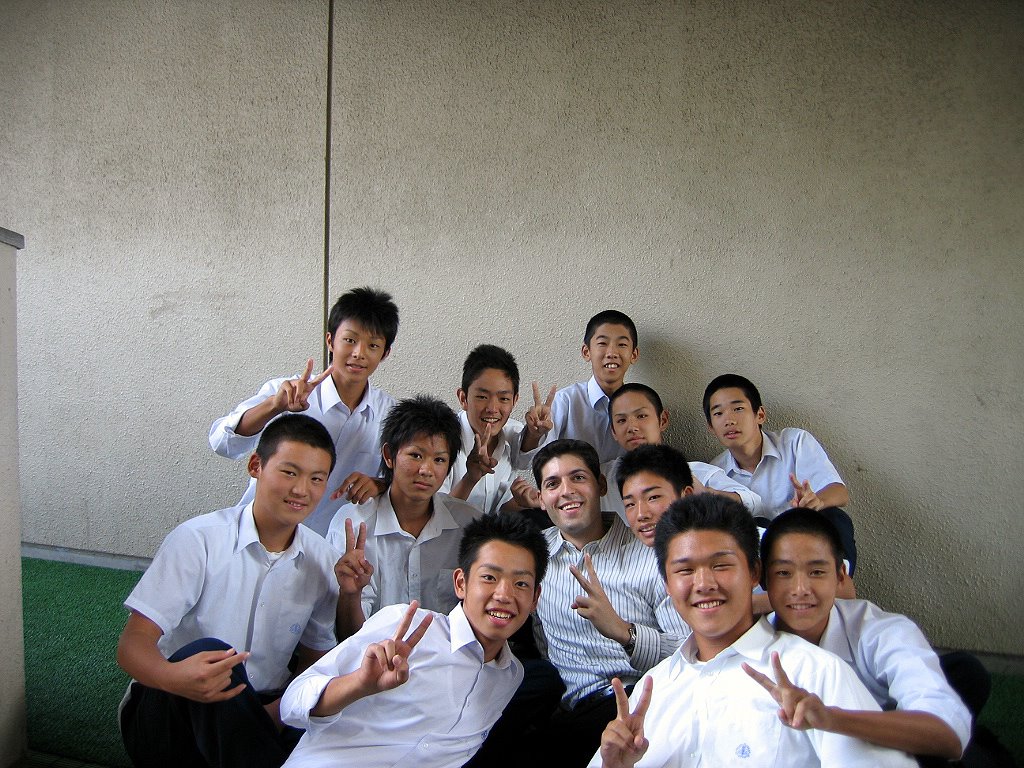 “Shiko-shiko?” I smiled. I simply translated “masturbation” into the vernacular. The boys fell over laughing. They couldn’t believe I had mastered the finer points of their language. “Yes, yes…can you do?” one asked. “Everyday?!” another piped up. “Sen-zuri manichi?” I fired back (literally, 1,000 rubs everyday?). Hysterics ensued. One boy demonstrated the international gesture with a jerk of his fist.
Unfortunately, addressing the subject in any form was grounds for further questioning — “Can you have sex?” “Is American wiener large?” “How big, how big?”
Also unfortunate was that three 9th grade girls had been drawn to the doorway by the noise. One girl wearing an eye patch and a toothy grin innocently imitated the gesture. “Oh, no, no no!” I said rushing over. Enjoying the attention, she pumped more vigorously while my mind raced for Japanese words to string together to convince her to stop.
Her friend – privy to its significance – shook her head, but left me to do damage control. Students were finishing up their cleaning. Another teacher might show up. I grabbed a broom and pumped it while sweeping the floor. “See, it’s a way to clean,” I said blushing with desperation. “Now cleaning time is over, so stop it.”
Although the 9th graders were the first to mention it, the 8th graders are the most inquisitive. A gang cornered me (see photo and hand placement of pervert on the right) in the hallway and tested out the English they didn’t learn in school. Behind their cherubic grins, Nubata School boys have dirty, curious little minds. 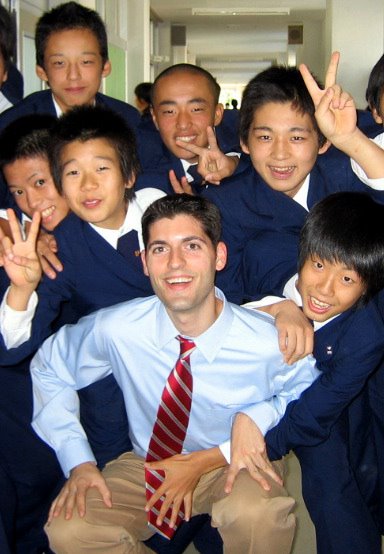 “Do you have any sex friends?…When do you watch adult video?…Sex machine!…Black penis man!…Do you have Christmas sex?…Christmas condom!” I swatted away the questions, but began to crack with laughter. A pimply-faced kid with a chipped tooth said, “My mom has a big penis!” I cracked. “Too young, too young!” I protested.
Another began, “Your mom….” I clenched a fist above his head in anticipation, but didn’t understand a word, and neither did the other boys crowding around me. The questioner scattered to the back of the group in embarrassment.
Another boy stepped up to face me. “Do you girl virgin, girl no virgin?” I lunged for his collar, but he ducked. A different one popped up like in that arcade game where you bop rodents with a padded mallet. He pointed to the one who had just disappeared: “He hair has just now.”
“ENOUGH!” I roared, fighting my way out of the crowd that continued tagging along at my hip.
They’re a tough bunch to shake. One day a group of 8th graders were leaving school just as I was. It didn’t take long for the topic to come up. Their smiling faces were brimming with questions. I let them entertain me while refraining from becoming the uncomfortable educator.
I seek refuge from oversexed middle school minds on the fourth floor. The 7th graders don’t know enough English to verbalize adolescent sentiments. Or so I thought. The normally mild-mannered Subaru (the boy, not the car) approached me with one thing on his mind: “Ehh, do…ehh…you know ahh masturbation?” Send help. Word is spreading.
Monday, December 12, 2005
Mr. Nishono
Familiar shuffling approached my desk in Omiyada School’s teachers' room. I didn’t look up from my book. I knew what I’d see. Mussed salt-and-pepper hair crowning a man with a wrinkled work shirt two sizes too big for his wiry frame. Stringy hair failing to conceal the bald spot creeping forward. Bifocals sliding off the end of a freckled nose. If after lunch, forgotten crumbs clinging to the corners of his mouth. It was time for class with Mr. Nishono.
A fellow English teacher didn’t even know his given name when introducing me on my first day. The students don’t either; they call him hage (bald) behind his back. The hair that remains reminds me of a frayed steel wool pad.
I’m handed a “teaching plan.” It reads, “This class is full of underachievers.” However, Mr. Nishono adds that they are not all “in bad condition” like the class he once abruptly cancelled my services because of their misbehavior the day before. He always does his best to shield me: “First, you wait here while I prepare the lesson.” I read for 10 more minutes while he attempts to subdue the eighth graders.
No such luck. Once permitted to enter the room, I’m instructed to make “daily conversation to each student.” I ask them basic questions like the date, weather or favorite color. These warm-up exercises prove too complex for some.
First up is a boy with a grating voice whom I try to avoid. When we pass in the corridor, he yelps monkey noises loud enough to disturb teachers down the hall. In response to “Hello, how are you?” he recited a list of fruit juices. His writing is no better. I pointed out that his a’s look like u’s. “Yes very much fine thank you!” he boomed.
The rest of Mr. Nishono’s lesson plan leaves less margin for student creativity:
“You Read (P 32) when I ask you to (students listen).
You Read new words when I ask you to (students repeat).
You Read (P. 32) when I ask you to (students listen).
You Read (P32) – students repeat (Phrase by Phrase).
I teach.
(Ending reading)
You read (P 32)”.
I leave class knowing P 32 by heart.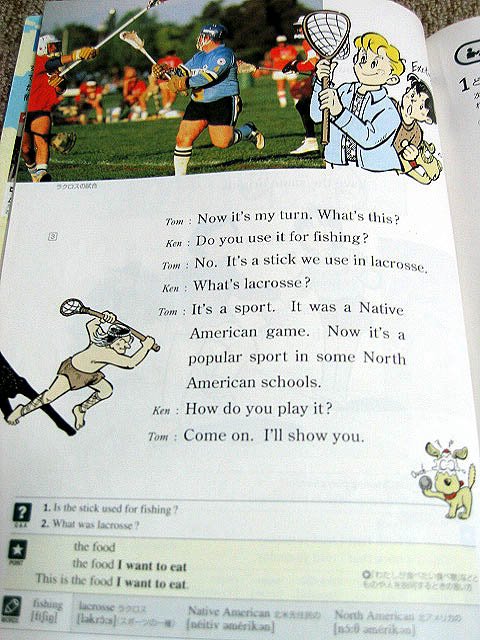 Another week’s teaching plan is also prefaced with a warning: “They are very mischievous class.” I couldn’t wait. The textbook pictured an overweight, unmistakably American lacrosse high school player. Not being a lacrosse sportsman myself, Mr. Nishono decided that I should “please relax” on the sidelines.
I observed the girls paying some attention, but the boys didn’t even have their books open, except for one – a Japanese novel. Behind him a kid fiddled with rounded magnets to form a snake that slithered across his desk with polar attraction.
Others were fashioning fighting sticks out of rolled paper featuring a girl with an anti-drug message. They passed around tape and scissors, with one crafting a ball out of tape. I sat at an empty desk in the back jotting everything down.
Then suddenly sensei stepped out for a few minutes. I assumed control, and plucked a sword off a student’s desk. I turned from the protesting boy to face the student patching together the tape ball. “Batter up!” I cried, managing several swings before Mr. Nishono returned with dittos he had forgotten.
Recently, absent-minded Nishono embraced the holiday cheer with a class sing-a-long to “Wish You A Merry Christmas.” Heavily accented British children caroled on CD. The words completely stumped the Japanese children, whose vocabularies didn’t include “good tidings to you and your kin.” Figgy pudding stumped me. Mr. Nishono blindly hummed along, and pushed repeat to extend everyone’s confusion.
By the fourth go-around, a girl cranked up the volume and positioned her ears next to the stereo. I gasped as one boy jabbed a blunt box cutter blade into another’s uniform. On autopilot, Mr. Nishono just kept humming, his bifocals glued to a page of lyrics he couldn’t articulate. I moved away from the blasting Christmas music to spy on a boy drawing. It was a cartoon caricature of me.
Wednesday, December 07, 2005
I Don’t Know What You Did Last Summer
Last year an unfounded rumor that Douyoto school was going to close spooked off parents who can send their junior high school aged children to any school in the district. As a result, half the usual number of seventh graders matriculated. Although the student body of 280 is the smallest of my four schools, it felt overwhelming when faced with correcting their English compositions about “My Summer Vacation.”
This was the first writing I’ve seen students do beyond copying down the board. The result was amusing on first read, but painful thereafter to correct. Sometimes the Japanese English teacher couldn't figure out what the students were trying to say in the accompanying Japanese. Here’s the best of the worst:
I was Yoyogi Park Festival play the drum.
Many people was Festival come.
I was rest yakisoba eat.
Last all play.
Play the rice eat.
Come back was confectionary.
I can tense a well good fine.
-----------------------------------
I was going to look the Festival
My friend a strike drum a festival
My friend a drum strike figure very fashionable.
After that going a stand food buy a lot of things.
I have very good time.
-----------------------------------
I was went to Hakone in July.
I was arrived at Hakone noon.
I was lurch at the lesterant.
After that going Hakone Sekisho.
After that a music box museum
I was a very have a good time.
-----------------------------------
I went to Aichi Expo on our school trip. The most impressive pavillion was Mitsubishi Future Pavillion.
It was a place, the earth without a moon. The place I can’t imagine, all day long was eight times end even hard wind blow even not forest’s and oxygen almost pass away, even human being wasn’t born. So the moon is very important.
-----------------------------------
I wasn’t able to go to the famous pavilions. Because Aichi Expo was filled with people. There wasn’t more interesting than I imagined. It was very interesting for me to play with my friends whole night. Hiroki, Tatsunari and Sachioweje my room. We knew whole night isn’t allow but we did it. We drank coffee, watched TV, talked about each other’s secret and made a noise. This trip made me happy, and it made my precious memories too.
Friday, December 02, 2005
’Tis the Season
for warm butts. On the way to work, I snagged a seat when the doors opened at Kinshicho station’s outdoor platform. Nothing seemed out of the ordinary. And then one stop later, I noticed a pleasant sensation. My buns were roasting. The carriage’s air wasn’t noticeably heated, but the padded seats sure were.
But they weren’t yesterday, and I sat on the same train, in the same car. Outside highs remained mild – 50s and low 60s F. What had changed? The calendar. Now that it’s December and officially winter, heating is switched on in trains and in classrooms. School hallways and bathrooms, however, remain out of bounds, and freezing. The open windows don’t help either.
Outside temperature is irrelevant. The calendar guides dress code and indoor climate control. According to the government, summer starts on June 1. In order to reduce greenhouse gas emissions, the “Cool Biz” initiative mandated that office air conditioning not be turned below 28 C (82 F), and suggested that suit jackets and ties be left at home. Summer ends September 30, and in October “Warm Biz” kicks in. Heaters are not to be cranked above 20 C (68 F). Once the October page is torn off, Burberry-inspired scarves come out in force, coiled around the necks of schoolgirls despite it not being cold enough for a jacket (or pants – as the girls continue to trot around with exposed shins in their all-season skirts). Although an accessory, scarves have become an all but mandatory part of the fashionable winter work uniform for schoolchildren and many adults.
Inside the train, warmth radiated from my seat. I felt like cuddling with the two OLs (office ladies) flanking me, locking my arm underneath their elbow, nodding off on a shoulder, and riding the rails out to Chiba prefecture.
Wednesday, November 30, 2005
Rumors Were True
 I was wrong. The kids were right (see previous blog). I was on TV Sunday night. My face was plastered on primetime, beamed into millions of tiny Japanese homes, including the bedrooms of middle schoolers mesmerized that their sensei doubled as a TV star.
A strange phone call from Kai at Jupiter modeling agency caused me to reverse my conviction that the kids had mistaken my identity. “Jeff-san, I need to get your bank information so that we can pay you ¥3000 in January.”
Caught so off guard, I almost played along. “Umm…actually, you don’t owe me anything. I never did a job for you.” I think I should know. I mean, how could I possibly have appeared on TV in absentia?
Apparently quite easily. All the network needed was a headshot that the agency snapped when I registered in August. Because there is no actors’ guild or modeling union, my likeness can be exploited like a cheap commodity. You play by industry rules, and this network required confidentiality as to which faces had been selected until after airing.
Kai explained that I appeared on TV Asahi’s popular quiz show “iQ.” Japanese contestants are challenged in a game of memory featuring pictures of foreigners. “For Japanese, cannot recognize foreigners – they look the same. Your face came after a German.”  I won’t have to imagine the pained expressions and wild gesticulations of Japanese contestants stumped when faced to recall foreigners. I hope to obtain a complimentary DVD copy of the program. However, part of me feels like a pawn used – without my knowledge or consent – as a means to an end: to boost ratings through humiliation of outsiders. On the other hand, that’s the most effortless $25 I’ll ever pocket.
Monday, November 28, 2005
Evolution
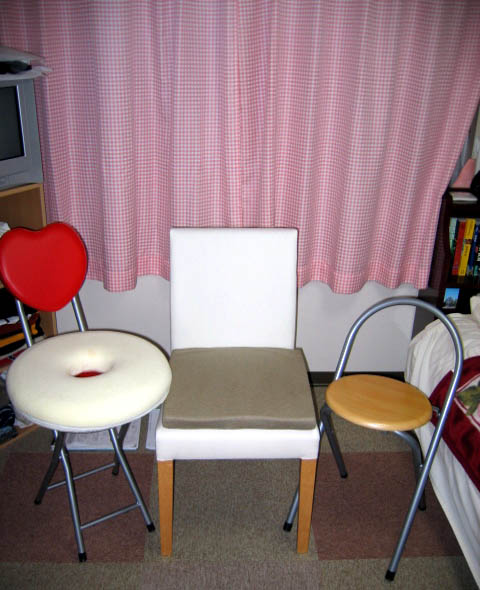 Progress has been slow and all too painful. But seven months into my Japan adventures, I’ve finally found adequate back support for the hours I spend sitting on the computer. From a backbreaking wooden stool to its thinly padded Valentine’s Day kitschy cousin, meet the end-all, be-all: a plush yet robust wooden chair purchased from Muji.
Seat cushions have evolved, too. The latest and comfiest also hails from Muji, and fits squarely on the newest furnishing gracing my 140 square foot palace. This form-fitting foam padding and sturdy lumber chair hopefully spell an end to lumbar agony during lengthy blogging and e-mailing sessions. Now, if I could only do something about those curtains….
In unrelated news, my return to Tokyo after an enjoyable respite in New York was marred by an unusual bomb scare not far from where I work. I first found out about it from Yahoo! news headlines. Don’t miss the other latest national “news” links following the article.
And finally, I need to put an end to some speculation. No, I was not on TV Asahi’s quiz show Sunday night. I let down about a dozen excited Omiyada students today, including one who was “100% sure” that it was I. Perhaps the imposter is the one siphoning my lucrative modeling audition calls. I am placing a ¥1000 ($8.50) bounty for any information leading to his whereabouts.
Thursday, November 17, 2005
Nikko IS Nippon
 Like Kamakura and Kyoto, Nikko is a foreigner’s idealized conception of Japan. Ornate temples, traditional shrines, sculptural trees, and moss-covered statues make it a storybook setting of a bygone era – the early 17th century to be exact. The Nikko-San’nai area is one of Japan’s 12 UNESCO World Heritage Sites, and in autumn Nikko’s structural beauty is matched only by the vivid landscape.
A scheduling error allowed me to ditch a day of policing Kanokita’s underachievers and instead tour Nikko’s tranquil temples in peak kouyo (literally, “leaves turning red”) season. Nikko was in full bloom in November, a month after the Lake Chuzenji trip.
An older Japanese man asked to sit beside me on the early morning Nikko-bound train that first stopped in Tochigi, his home. Eager to speak English, he shared a throat lozenge and stories from visiting New York five years ago. I asked what he was doing in Tokyo overnight. Apparently, his pension didn’t give him enough money to “play.” I raised my eyebrows when he told me that he drove a taxi in Tokyo “twice a day in one week.”
To come across a driver who speaks English is like finding a seat on the Yamanote Line. Not that I’ve ever tried asking around, as the meter starts at more than my bento box dinner costs – ¥660 ($5.60). The size and jumbled layout of metropolitan Tokyo has got to make it the world’s most challenging taxi driver job.
Yet, I broke free of this congested city for another refreshing outing in the countryside. The air was crisp, but the sun warmed my hands. The sky was blue. The leaves were red, yellow, orange, and green. Sunshine illuminated fall in its most colorful moment while I wandered around some of Japan’s most acclaimed attractions.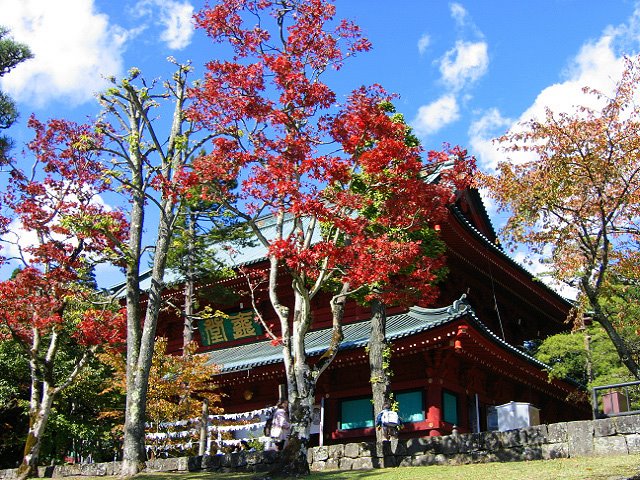 Rinno-ji. My first stop included Eastern Japan’s largest wooden structure, Three Buddha Hall, which houses – you got it – three large golden statues inside.
 Five-Storied Pagoda. This is another postcard image of Nikko. I also saw a great marketing opportunity for Vodafone to increase its spotty coverage by converting the spire into a cell tower.
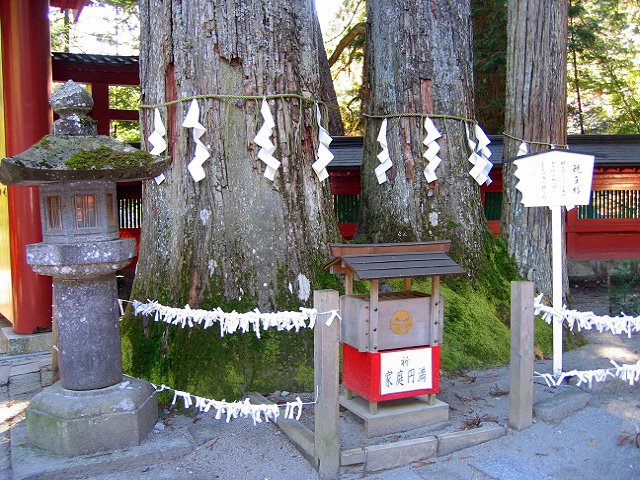 Futarasan Shrine. Nikko’s oldest structure (rebuilt in 1619) is dedicated to the area’s three holy mountains, including Nantai-san. The forest backdrop was especially peaceful.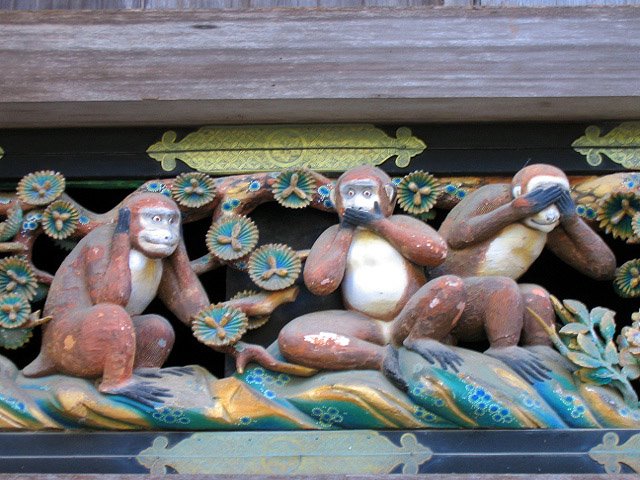
Tosho-Gu. With 55 buildings, this complex is the largest and home to perhaps Nikko’s most famous feature – woodcarvings of monkeys above the Sacred Stables. The three monkeys that depict the “hear no evil, see no evil, speak no evil” principle of Tendai Buddhism are better known than the prime minister. Let’s just say that the hype is just that; I prefer their San Francisco counterparts.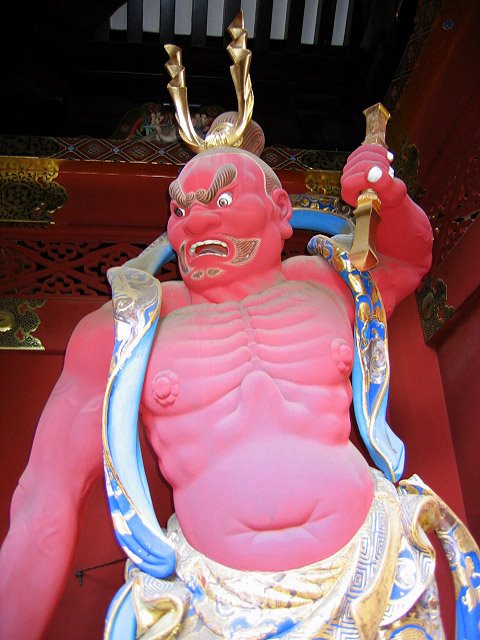 Taiyuin-Byo. Tomb of the third Tokugawa Shogun, Tokugawa Iemitsu, is a damn good place to rest in peace. The mausoleum is a grandiose yet impeccably designed complex on the forested edge of Nikko. The afternoon sunlight percolated through towering cedars hiding this jewel. When my number is up, someone please dig a hole for me here.
 Shin-Kyo. This vermillion icon, the Sacred Bridge of Nikko, is in reality a puny disappointment. Rather than pay to cross its 100-meter expanse, I opted to photograph it from the shoulder of the four-lane highway running beside it.
I quickly moved on to Kanman Ga Fuchi. This is an easy hiking trail through a Stone Park lined with weathered statues of Jizo, the guardian of deceased and unborn children, pregnant women, and travelers. The adjacent river completed the timeless setting.
Tourism posters proclaim “Nikko IS Nippon [Japan].” Nikko wo minakereba “kekkoh” to iu na is a famous expression that translates to “Don’t say ‘magnificent’ until you’ve seen Nikko.” Another dimension to this Japanese pun is “See Nikko and say ‘enough.’” I say, Juu-ichi gatsu no Nikko wa gen so tekki desu. Nikko in November is magical.
Blogger’s Note: I’m leaving all things Japan behind for one week to celebrate Thanksgiving in New York. Sayonara bento box, it’s turkey time! Expect the next entry to appear after 11/28.
Tuesday, November 15, 2005
Lake in the Mountains: Chuzenjiko
 Nostalgic of New Hampshire autumns, I ventured two hours north of Tokyo to the temple-studded town of Nikko. Bestowed with UNESCO World Heritage status in 1999, Nikko is also a gateway to a large National Park.
Nikko’s leaves were still green in mid-October, so my Japanese friend Makiko and I pushed another hour west into the mountainous Lake Chuzenji region, about 1270 meters (4167 ft.) above sea level. The coach bus navigated Irohazaka winding road and its 30 hairpin curves. Trees ringing the lake, however, were only just beginning to bare their fall coats.
Nearby roared Kegon no taki, considered one of the three most beautiful waterfalls in Japan. Water cascaded 97 meters (318 ft.) into the mist below. Instead of taking the traditional leap like lovers with no prospect of marriage, we hopped aboard another bus to transport us 15 miles deeper and higher up into the woods.
Our pursuit of peak foliage ended at Kotoku Onsen. We followed a trail lined with birch trees. The air was redolent of wet bark. I inhaled the scents of fall. Finally, I had found nature in Japan, and escaped the endless urban landscape of concrete apartment buildings that matches October’s overcast skies. The dirt path led to an elevated track through the woods. The trees thinned to reveal a field walled in by mountains ablaze in seasonal color. A cloud belt encircled the midsection of Nantai-san (2484 m., 8150 ft.). This sacred mountain is the topographical godfather of the region. Now an extinct volcano, its lava flows created Lake Chuzenji by damming up a river.
Sunshine pierced fast-moving storm clouds to ignite the dried pampass grass field of Senjogahara. The wheat-like stalks contrasted with the dramatic patchwork of color in the mountains. Birch trees rose from these alpine marshlands in the watchful shadow of Nantain-san. These shirakamba are known as “noble women” of Senjogahara plateau. Their slender, white figures make shirakamba a fitting description. I could have spent the whole afternoon soaking up a setting reminiscent of New England.
A school trip of spirited 11-year-olds was taking the same hike. For once, the kids were clad in their choice of mismatched sportswear, and not school uniforms that make them look like naval cadets. My passive serenity as a day hiker disappeared. The shift to energetic schoolteacher was automatic. We traded greetings in both languages, and I handed out a few high-fives. A boy wearing a Yakult Swallows hat grinned when I began rattling off their roster. “Now I know what you are like in school,” Makiko smiled.
Ryuzu Falls marked the end of our forest wandering, and the beginning of a late afternoon downpour. Ryuzu’s water flows 210 meters (689 ft.) and feeds Lake Chuzenji. The deck from a nearby teahouse provided views of the foot of the falls, where rocks split the stream of water. The formation is said to resemble the head of a dragon, from which the falls take their name.
The hike worked up an appetite. The local specialty of yuba, thin layers of coiled bean curd, was a meaty supplement to ramen. Makiko said the succulent skewers of yakitori were among the best she’s had. For dessert, it was blueberry soft serve and a bag of addictive potato chips for the train ride home. Flavored with rich Hokkaido butter, they are only available during fall, so I’ve begun stocking up for the long winter ahead.
Foliage is the best thing about fall. To seek nature is the best reason to leave Tokyo. It wouldn’t be long before I returned to visit Nikko itself.
Take a hike! Well, a virtual one.
Thursday, November 10, 2005
Kids Say the Darn’dest Things
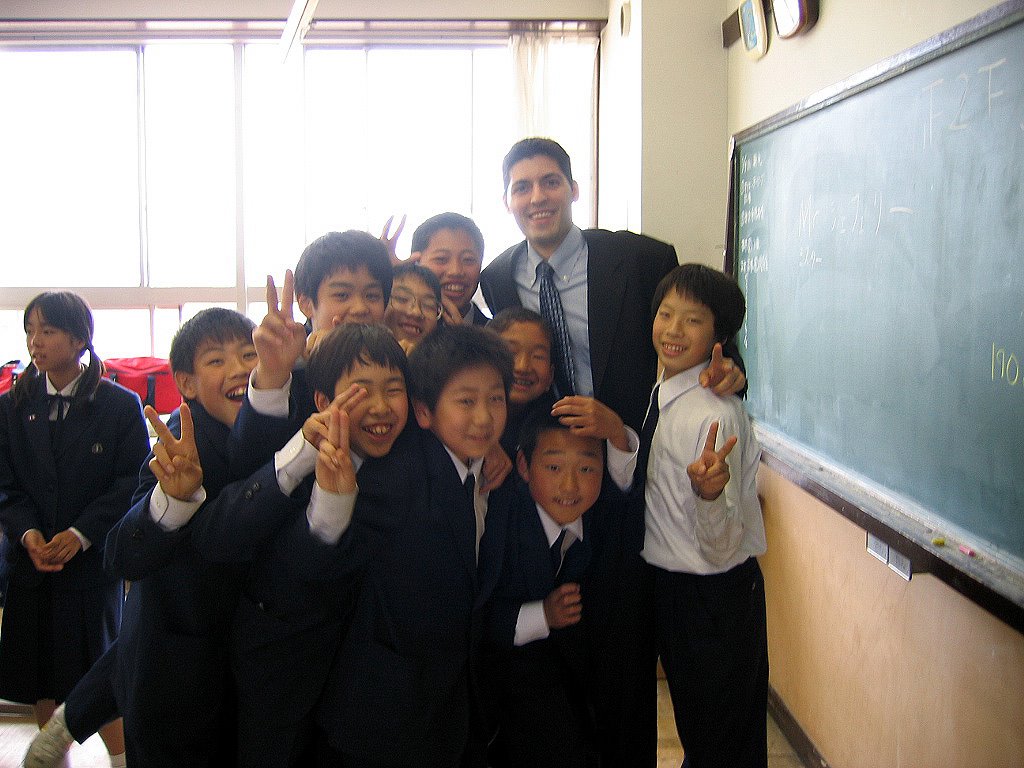 After about 50 self-introductions, I’ve finally finished introducing myself to all classes at the four junior high schools. It only took six months. I’ve compiled the top 20 questions they asked following my self-introduction. Their provocative queries and my honest responses are below:
20. What is your best time in the 100-meter dash?
Slow.
19. What’s your salary?
Peanuts.
18. Who is the prettiest teacher at this school?
Next question, please. [What I wanted to say: They’re all over the hill, so the prize goes to the principal’s 25-year-old acne-cheeked secretary who dresses in skimpy bedclothes.]
17. Do you own a gun?
No, but in Thailand I shot a crossbow at a jackfruit.
16. Is it true that it is prohibited to wear a hood in front of black people?
Unless it’s a white hood, you’ve been watching too much terebi.
15. Is English of black people different?
Hip-hop music video lyrics may not match vocabulary contained within your Let’s Talk textbook.
14. Have you met Arnold Schwarzenegger?
No, but does Bill Clinton count?
13. How did you get so tall?
By studying so hard, my brain grew and so did the rest of my body.
12. What are the positives and negatives of having a high nose?
Probably the same as having slanty eyes.
11. Have you ever seen a UFO?
No UFOs, but betcha didn’t know your teacher was an illegal alien.
10. Do you like our class more than your mother?
No, my mom makes me delicious smoothies.
9. Where was your first kiss?
[Ruled taboo by Japanese teacher.]
8. What kind of woman do you like?
[Scanning brain for PG-13 adjectives]…I like a smart woman.
7. At what temperature do you have your bath?
I take showers, but thanks.
6. Do you like whisky?
No.
5. Chicken, beef, or pork?
Pork, but I try to keep kosher.
4. Can you eat five cakes in one day?
You know, not all Americans are pigs.
3. What is your blood type?
Unsure. [Blood type here indicates compatibility or personality, like a zodiac sign].
2. I want to go to New York. What is your telephone number?
In New York or Tokyo? 080-30**-**** [cut off by Japanese teacher].
1. Will you marry me if I become the Prime Minister of Japan?
Mochiron! Of course!
Saturday, November 05, 2005
Halloween: Octopus, Medusa and Manslaughter
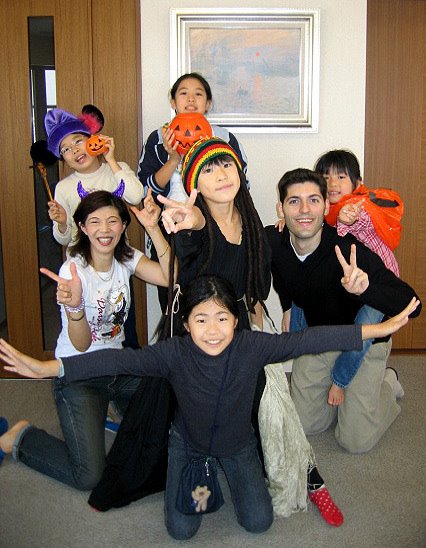 Holidays offer the chance to substitute the usual textbook drivel with creative lessons. In Japan, Halloween passes with little fanfare, except for at establishments catering to boozing foreigners. With some students only vaguely aware of the traditions, I kicked off classes by bringing the ghoulish cast of characters to life through colored chalk.
This created immediate cross-cultural confusion. After I sketched a ghost, a boy shouted out “octopus,”  so I added feet, only to draw more laughs – ghosts in Japan don't have them. I guess that’s also true of their American counterparts. Students guessed “bones” for my rendition of a skeleton. I then explained the superstition of black cats, which happens to be the name and logo of a parcel delivery service here.
A witch flying on a broomstick by moonlight was easily identified, so I went a step further to rile up the crowd. Straddling a broom borrowed from the class cleaning closet, I hopped across the room letting lose a high-pitched cackle. Even the sleeping kids (there’s always one or two) awoke to see the commotion. One boy in the front row started crying because he couldn’t stop laughing.
Trick-or-treating posed a challenge to explain. I acted it out by weaving a garbage pail through the aisles of desks, knocking on a few to ask for chocolate and candy. I got only blank stares in return, so the Japanese English teacher stepped in to translate.
At Kanokita School, Mr. Mochizuki shared a grisly Halloween story from 1992 when a 16-year-old Japanese exchange student in a white disco costume rang the wrong doorbell in search of a Halloween party in Baton Rouge. The startled proprietor yelled, “freeze,” but the boy mistook the command for “please,” and approached the man wielding a .44 Magnum, which he unloaded into the trespasser’s chest.
This tragedy reinforces the Japanese stereotype of trigger-happy Americans. Mr. Mochizuki was always dredging up the issue of guns in America, and capitalized on an incident that hit close to home to prove American barbarism. Arms folded, I held back disgruntlement and leaned against the door, watching young grins turn upside-down. We all gasped at the story’s exclamation point: 31-year-old Rodney Peairs was acquitted of manslaughter. I regained the floor and quickly shifted gears to build up anticipation for the unveiling of my Halloween costume, a Rastafarian wig friends purchased while vacationing in Jamaica. Scattered cheers answered my call for, “Do you want to see my costume?” so I excused myself and ducked into the hallway to throw on dreadlocks. I looked both ways to avoid embarrassment in front of Halloween-unaware teachers, or worse, district education officials on the lookout for signs of progress in the chaos at Kanokita.

 What the heck was sensei wearing on his head? The puzzling costume produced amusing guesses, most commonly that I was a girl. Other mistaken identities included, Mexico, Medusa, and tree roots. One girl was in favor of the new look: “it suits you,” she said. The girls wanted to touch my locks while the boys wanted to try on the wig, which played perfectly into my plan of getting photo-ops.
The dreads shed and scratched, but I kept the wig on for the duration of the class for amusement’s sake. I tied the hair into a bun to get it off my shoulders. Sometimes I pretended to eat it. Sticking a dreadlock inside each nostril was a crowd pleaser.
In religious holiday news, on October 13 I informed Mr. Mochizuki that I would not be eating lunch with the children that day. I would not be eating lunch at all because of Yom Kippur, the Jewish Day of Atonement.
No, I was not on a diet, did not have a stomachache, and was not about to undergo a medical procedure. Explanation of why I was fasting was more difficult to translate than what the students surmised.
Although not religious, I make an effort on the holiest day of the Jewish calendar. But neither Jews nor Judaism rang a bell with Mr. Mochizuki. Not even after looking up the translation in the dictionary. After I convinced him that Judaism was not a sect of Christianity, he asked, “Are you Islam?”
I groaned silently, and tried a different tactic. “Do you know the country of Israel?” No. “How about the Holocaust?” Curious stare. “You know, how Hitler killed 6 million people in Europe, and well, most of them were Jews?” “Ahh, okay,” the teacher said, as if recalling some trivial factoid from the recesses of his brain. “Please tell the children some information.” “About the Holocaust!?” Thankfully, classes last only 50 minutes.
Around the corner is Thanksgiving, which while my favorite holiday on the calendar of either country, is rather boring to explain to Japanese students. We consume truckloads of turkey and harvest vegetables in the company of our dysfunctional extended families. Scrawling a turkey on the blackboard invited creative interpretations of Thanksgiving’s iconic bird, but fortunately peacock, ostrich, and pigeon do not make the menu at my family’s dinner. Pigeon pie, anyone?

